
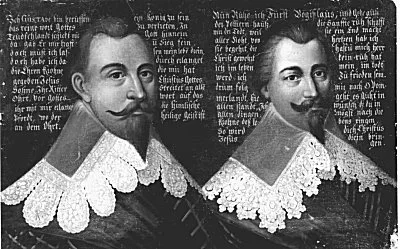
The last Griffin at the Szczecin castle
Bogusław XIV was born on 31 March 1580 in Barth and died on 10 March 1637 in Szczecin. According to Wikipedia, he was the last ruler of West Pomerania from the House of Griffin. He became duke of Szczecin on 28 November 1620, after the childless death of his brother Franciszek, and from 1625 he also ruled in Wołogoszcz and had the whole of West Pomerania under him. He died at the Ducal Castle (the Castle of the Pomeranian Dukes), which had been the seat of his house for centuries.
His rule coincided with the Thirty Years' War. Wikipedia writes that he did not manage to preserve the duchy's neutrality: in 1627 he had to agree to the quartering of imperial troops under Albrecht von Wallenstein. Three years later, according to German Wikipedia, Gustavus Adolphus, who had landed in Pomerania, forced him into an alliance at the Szczecin castle. The treaty of 25 August 1630 was, for political reasons, recorded as signed on 10 July. The duke kept civil administration, but the country was occupied by Swedish troops.
In April 1633 Bogusław suffered a stroke and, according to Wikipedia, partly paralysed, never returned to full health. In the summer of the same year he designated his nephew, Ernest Bogislaw von Croÿ, as his successor in the office of Bishop of Kamień. Wikipedia also states that in the 1630s the influence of the noble estates greatly limited the duke's power, and at the time of his death he no longer had real power in his state.
Who was to inherit Pomerania
The basis of Brandenburg's claims was the agreement of Grimnitz of 26 August 1529. According to German Wikipedia, in it the Hohenzollerns recognised the direct dependence of the Duchy of Pomerania on the emperor, and in return the margraves of Brandenburg received the right of inheritance in the event that the Griffins died out in the male line. The agreement was confirmed in 1530 at the Diet of Augsburg by Emperor Charles V.
When this case occurred in 1637, the situation turned out to be different from what was on paper. According to Polish Wikipedia, Bogusław's will excluded the Brandenburgers from the succession and handed Pomerania to the Swedes. German Wikipedia adds that in 1638 Emperor Ferdinand III granted the duchy as a fief to Elector George William, in accordance with the Grimnitz agreement. The Swedes, however, did not want to give up the country, and the elector, who was far away in Königsberg and had only small forces, could do little.
The dispute was settled by the Peace of Westphalia of 1648, which divided the duchy between Sweden and Brandenburg. Sweden received the western part together with Szczecin, and Brandenburg the eastern part. The details of the course of the border were established only in the Treaty of Szczecin (Stettiner Grenzrezess) of 4 May 1653. According to German Wikipedia, the Brandenburg claims were based on the Grimnitz agreement, and the Swedish ones on the Szczecin alliance of 1630, which gave the Swedes military control over the country.
A funeral after seventeen years
Bogusław XIV was buried only on 25 May 1654, in the castle church of St Otto in Szczecin. This is what Polish Wikipedia states. German Wikipedia explains why so late: only after the border agreement of 1653 were both sides, Swedish and Brandenburg, ready to bury the deceased duke jointly, in a single ceremony. Until then his body had only been displayed in a coffin. The joint ceremony was commemorated with a thaler, funded by Queen Christina of Sweden and Elector Frederick William.
Polish Wikipedia also indicates that the castle church of St Otto was pulled down during the rebuilding of the castle in 1573-1582, and today's Bogusław X Hall was arranged in the former castle church. The sarcophagus of Bogusław XIV stands today in the castle.
What remained of the dynasty
According to Wikipedia, the last representative of the dynasty was Duchess Anna de Croÿ of Słupsk, daughter of Bogusław XIII, who died on 7 July 1660 in Słupsk. The Encyclopedia of West Pomerania states, however, that the last known member of the house was the Jesuit Ernest de Croyengreif, an illegitimate but recognised son of Ernest Bogislaw von Croÿ, who died childless after 1680. The two sources thus point to different people.
After the Griffins died out, from 1637 the castle was the seat of the Swedish governor, and from 1720 of a Prussian garrison. The memory of the dynasty is preserved, among other things, by the family tree of the house, painted in 1598 by Cornelius Krommeny, which according to Wikipedia is about 7 metres long, shows 155 people and is held in the collections of the National Museum in Szczecin.
Be the first! Add a comment.
You need to log in to add a comment.
Log in