
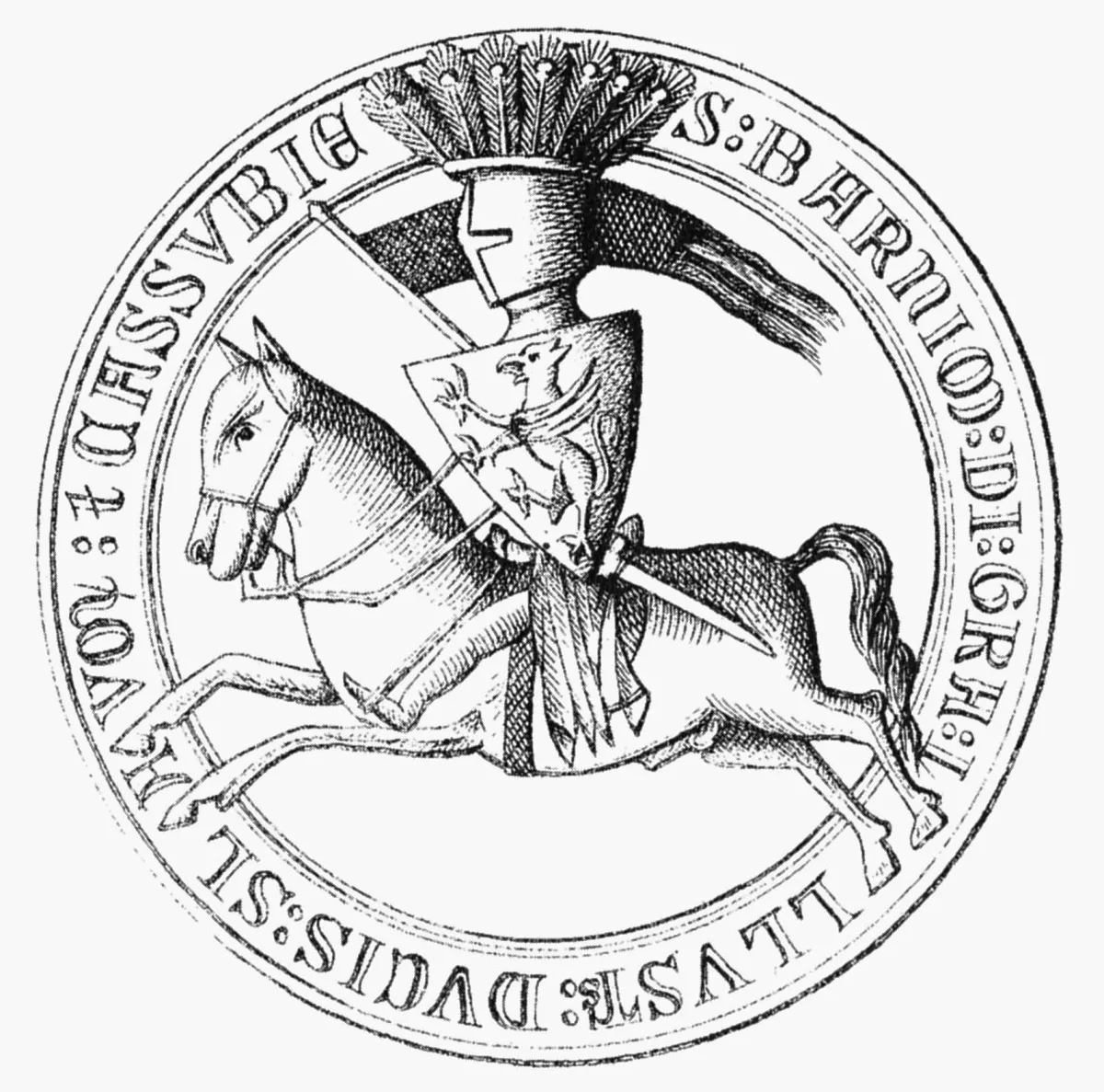
The Duchy of Pomerania, which the Griffins ruled for more than five centuries, was not a unified state with a single capital. It began as the fief of a Polish duke, was divided into districts many times and many times reunited. Szczecin was one of several centres, and it is from it that one of the lines of the dynasty takes its name. The dates of the partitions do not always agree in the sources, so where there are discrepancies, we write about them plainly.
Warcisław I and the homage paid to Bolesław the Wrymouth
According to Wikipedia, Bolesław the Wrymouth took control of Pomerania in three campaigns, in 1116, 1119 and 1121, and divided it into four parts. Gdańsk Pomerania remained under the direct control of Poland, the Duchy of Słupsk with Słupsk and Sławno went to Racibor, and West Pomerania with Kamień, Kołobrzeg and Białogard was taken by Warcisław I. All three parts were Polish fiefs or were subject to Poland.
The entry on Warcisław himself states that the Pomeranian duke was defeated in the battle of Niekładz near Gryfice in 1121, although Wikipedia also allows the year 1119. The fighting for Szczecin lasted, according to this entry, in 1121-1122. The captured Warcisław paid feudal homage to Bolesław the Wrymouth, undertook to pay an annual tribute and to supply troops. The entry gives neither a single day nor a single year for the homage, and the summary of facts from Wikipedia about the Griffins speaks generally of the years 1120-1123. It is therefore safer to say that the homage falls at the beginning of the 1120s rather than on one certain date.
The Encyclopaedia of West Pomerania (Pomeranica) places the beginning of Warcisław's rule even earlier: it gives the years of activity from 1106, no later than from 1124, to 1135. Wikipedia, in the entry sorting out the names of the Warcisławs, speaks of power from 1121. Both sources give his death in 1135 with the reservation that this is a probable date, and Pomeranica adds that the duke was murdered and buried in St John's Church in Słupia.
Dependence on Poland was not permanent. Wikipedia writes of Warcisław's agreement with Emperor Lothair III in 1127 and of the recognition of the German ruler's overlordship, and a year later, according to the same entry, Pomeranian troops plundered Płock. After that expedition the duke again submitted to Poland as a vassal. Such a pattern of dependence, changing with the strength of the neighbours, accompanied the Griffins over the following centuries.
A trace of that era remains in Szczecin. According to the description of the site, before 1124 a Slavic stronghold with the wooden court of Duke Warcisław I stood on Castle Hill. In its place there later rose the Ducal Castle (the Castle of the Pomeranian Dukes), and after the destruction of the Second World War, in 1946, a crypt with the sarcophagi of the Pomeranian dukes was discovered there.
The partition of 1160 and the return of unity
Wikipedia links the first lasting partition of the duchy with the year 1160. According to the entry on the Duchy of Szczecin, a state with its capital in Szczecin came into being then, and its first ruler was Bogislaw I. Alongside it existed the Duchy of Demmin, and the entry on the Duchy of Pomerania counts both among the districts of the years 1160-1264.
In 1264 Barnim I, Duke of Szczecin, united the duchies of Szczecin and Demmin, recreating the Duchy of Pomerania. This sentence from Wikipedia is further reinforced by the list of rulers in the same entry: Barnim I ruled in Szczecin in 1220-1264. The unity lasted until the end of the 13th century.
The year 1295: Szczecin and Wolgast
The best-known partition is that of 1295, after which West Pomerania split into the duchies of Szczecin and Wolgast, that is, with its capital in Wolgast (today in Germany). The first ruler of the Duchy of Szczecin was, according to Wikipedia, Otto I, who ruled until 1344. Pomeranica records the same: in 1295 the duchy was divided into the Szczecin and Wolgast duchies, and Otto I founded the line of the dukes of Szczecin.
There is, however, a slip in the description of this date that is worth knowing. Wikipedia in the entry on the Griffins writes that the partition took place after the death of Barnim I in 1295. Meanwhile the entry on the Duchy of Szczecin and Pomeranica state that Barnim II ruled in 1274-1295, and that 1295 is the year of his departure and of the partition. The date of the partition itself agrees in all three texts. Only the question of which Barnim the sentence concerns differs.
Wolgast did not stop at one duchy. Wikipedia records that the Wolgast line divided several more times, because in the 14th century there were many male heirs. The entry on the Duchy of Pomerania lists the Duchy of Wolgast in 1295-1478, and separately the Duchy of Słupsk, the Duchy of Stargard from 1377-1478 and the Duchy of Barth.
Słupsk, Stargard and further districts
The Duchy of Słupsk has no single agreed date of origin. According to the entry on the Duchy of Pomerania it existed from about 1210 or from 1368 to 1478. A separate entry on the Duchy of Słupsk puts the beginning in 1368, when Słupsk received from Duke Bogislaw V the privilege of a mint, which Wikipedia calls the formal separation of the duchy from Wolgast. The permanent ducal seat was, however, in Darłowo. The entries do not explain where the difference between these dates comes from.
Pomeranica indicates that the district capitals of the Griffins lay in Szczecin, Wolgast, Barth, Darłowo, Demmin, Słupsk and Stargard Szczeciński. Wikipedia adds Kamień to this list. From the 14th century, according to the same source, a division into two parts became established, the Szczecin part and the Słupsk-Wolgast part.
Reunification and the end of the dynasty
After the Szczecin line died out in 1464, Bogislaw X remained the only male representative of the dynasty after the death of Warcisław X in 1478. Wikipedia writes that he united the Duchy of Pomerania and did not allow Pomerania to be annexed to Brandenburg. In 1478 the Duchy of Szczecin was incorporated into the united state. The entry on the Duchy of Szczecin then states that the duchy was recreated on 21 October 1532 and existed until 1625, when Bogislaw XIV again united it with the rest.
The same entry contains inconsistent records concerning the interval. The infobox gives the years of existence as 1295-1523 and 1532-1625, the introduction speaks of a break in 1523-1532, and the list of rulers begins the third state in 1531. The entry on the Duchy of Pomerania, in turn, gives the unity of the state in 1478-1531. The date 1532 has a separate sentence in the entry with the exact day, and for the other dates of this period it is safer to speak of the beginning of the 1530s.
The last male representative of the dynasty, Bogislaw XIV, died in 1637. Wikipedia describes the fall of the duchy in the Peace of Westphalia of 1648, which divided the lands between Sweden, with Szczecin, and Brandenburg, with Słupsk. The last female representative of the Griffins was Anna de Croy, who died on 7 July 1660 in Słupsk, and according to Pomeranica the last known male descendant of the dynasty remained the Jesuit Ernest de Croyengreif, who died childless after 1680.
Be the first! Add a comment.
You need to log in to add a comment.
Log in