
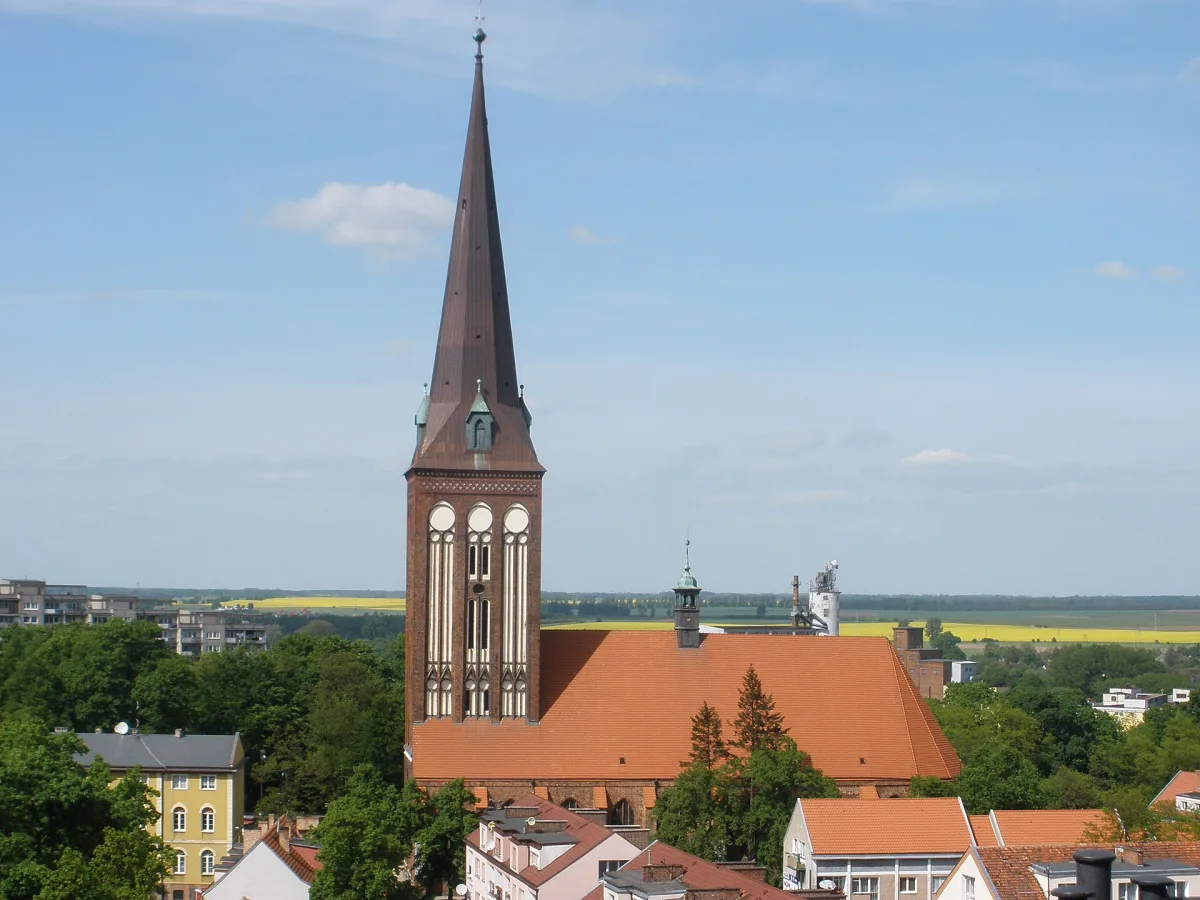
Stargard, a town on the Ina River with medieval defensive walls and Gothic churches in the Old Town, found itself on the front line in 1945. According to Wikipedia the town was taken on 5 March 1945 by units of the 61st Army and the 2nd Guards Tank Army of the 1st Belorussian Front. The rebuilding of the Old Town went on over the following decades, and the name of the town was still changing in 1946 and 1950.
February and March 1945
The Wikipedia article on the history of Stargard describes how from 2 to 28 February 1945 an evacuation of the inhabitants was under way, ordered to the Greifswald district, in connection with Operation Sonnenwende being carried out near the town. The taking of the town on 5 March is marked in Stargard as a separate anniversary alongside the town holiday of 24 June, according to the article on the town. Already on 23 March the Soviet town commandant appointed Polish authorities, and according to Wikipedia the previous inhabitants were expelled to Germany and replaced by settlers, among others from the former Eastern Borderlands and by people resettled under Operation Vistula.
How much of the Old Town remained
Wikipedia gives the scale of destruction in the article on Stargard as 72 per cent: according to it the town suffered very heavy destruction, and the historic part, that is the Old Town, burned down completely. The same percentage is repeated in the article on the history of the town. Other articles on the town give no different figure, and none explains what the indicator refers to: the whole town, residential buildings or only the buildings within the walls.
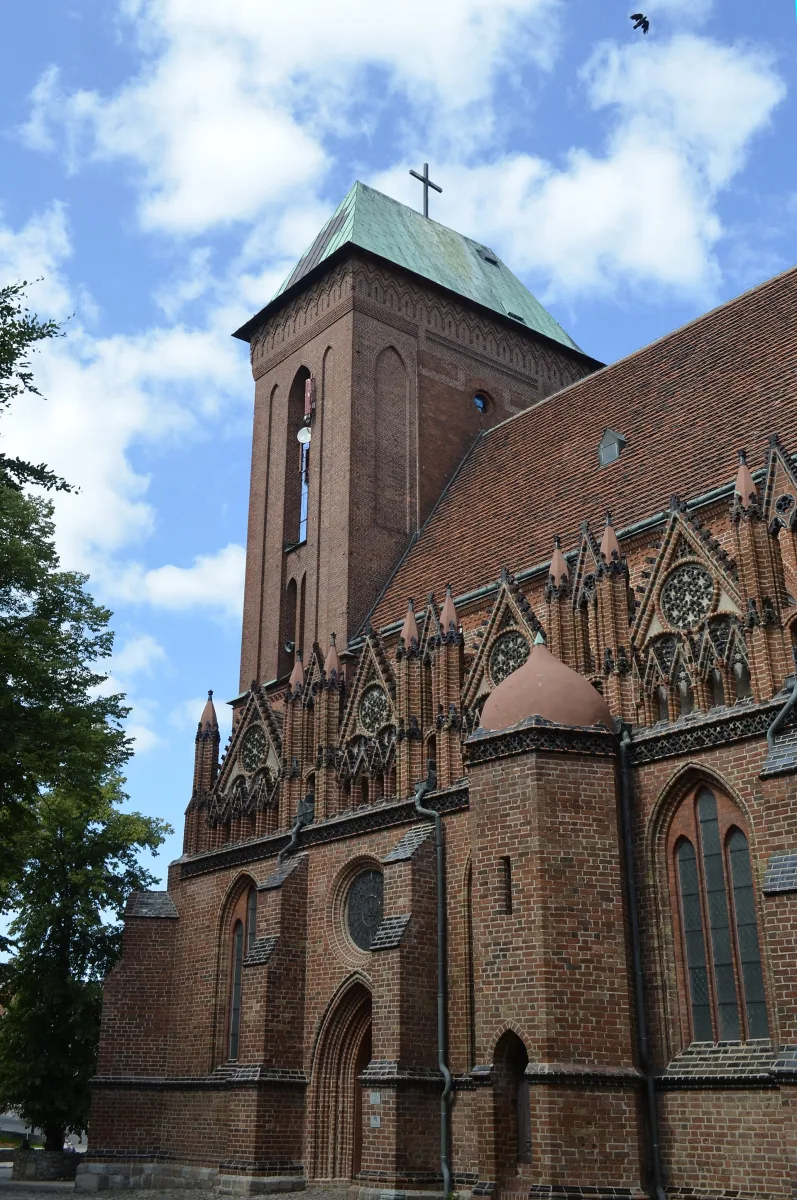
The descriptions of individual buildings are not as clear-cut as the sentence about the burning of the whole old town. The Wikipedia article on the Old Town says that of the historic buildings only St John's Church survived intact, while the other buildings were damaged or completely destroyed. Meanwhile the article on St John's Church itself says that after 1945 the roof was first repaired and two artillery shells that were lodged in the tower were removed. St John's Church thus came through the fighting in a much better state than the neighbouring buildings, but not without damage.
The Collegiate Church of St Mary, according to its article in Wikipedia, suffered in a fire: the fire damaged the church, destroyed the spire of the north tower and the roof, and the interior was devastated. After a makeshift rebuilding in 1946-1948 the church served as a warehouse, and in 1957 it was consecrated again. The spire of the tower was restored in 1962. Such was the fate of the Collegiate Church of St Mary, Queen of the World.
Many burghers' houses on the Market Square and around it were not so fortunate. According to Wikipedia Protzen House, a Gothic townhouse from the 15th century, was destroyed in 1945 and only its gable wall survived. In Rohleder House the west wall, the front façade and the vault of the main building burned. The granary on the Młynówka from 1685 was, according to Wikipedia, burned during the bombing.
Rebuilding: what succeeded and what did not
The article on Stargard describes a conservation dilemma. The almost complete destruction of residential buildings, with Gothic monuments surviving in varying condition, argued for rebuilding selected, most valuable buildings, not for reconstructing the whole complex. The design provided for keeping the historic street grid, rebuilding the monuments and low new buildings with pitched roofs, adapted to the scale of the town.
In line with these assumptions only the first stage, according to Wikipedia, was carried out, that is the development in the western part of the old town. The eastern blocks bear the mark of a wish to increase the population density, and five ten-storey large-panel blocks were built. The article on the Old Town speaks of five eleven-storey buildings on Szewska Street, so the number of storeys varies from article to article. According to the article on the town the tower blocks distorted the silhouette of the town and obliterated the course of some old streets.
The rebuilding proceeded in stages and took decades. The article on the Old Town states that for more than ten years after the end of the fighting rebuilding was not begun for lack of funds and materials, and clearing of rubble only began in 1958. Other articles, however, show earlier work on individual buildings: the town hall, according to Wikipedia, burned down in 1945 along with the whole old town, its ruins were first secured, and the rebuilding lasted from 1948 to 1961. Protzen House was rebuilt, according to the article on it, in 1957-1959 and made into a music school, while the collective article on the monuments of Stargard gives the years 1951-1959 for it. Rohleder House was rebuilt in 1973, and the granary in 1975-1980.
The defensive walls, gates and towers were also rebuilt, as the article on the Old Town writes, which describes this scope as a result of haste. The defensive walls together with the Collegiate Church of St Mary were designated a Historic Monument in 2010.
The name of the town after the war
According to the article on Stargard the first postwar name was Starogród, then Starogard nad Iną, and from 19 May 1946 the official name Stargard was introduced. From 13 February 1950 it was changed to Stargard Szczeciński. Wikipedia notes that at the same time the name of Starogard near Gdańsk was changed to Starogard Gdański. The article does not say directly why the adjective was added to the name, it indicates only that both changes took place at the same time.
The adjective “Szczeciński” for decades aroused opposition among the inhabitants. According to Wikipedia, in 1999 the Society of Friends of Stargard began a campaign for a return to the shorter name, pointing out among other things that it would make pronunciation easier for foreigners and strengthen a sense of local identity. In consultations in January and March 2011 nearly 58 per cent of those voting declared for shortening the name, at a turnout of 15.7 per cent. The first application was not accepted by the ministry, because it lacked, among other things, applications from the county council and the rural municipality council, and in the consultations of March 2012 almost 90 per cent of the inhabitants of the rural municipality were against changing the name of the municipality and of the county seat.
The matter was settled only by a regulation of the Council of Ministers of 28 July 2015, confirmed by a regulation of the Minister of the Interior and Administration of 17 December 2015. It came into force on 1 January 2016 and restored the name Stargard, introduced for the first time in 1946.
Be the first! Add a comment.
You need to log in to add a comment.
Log in