
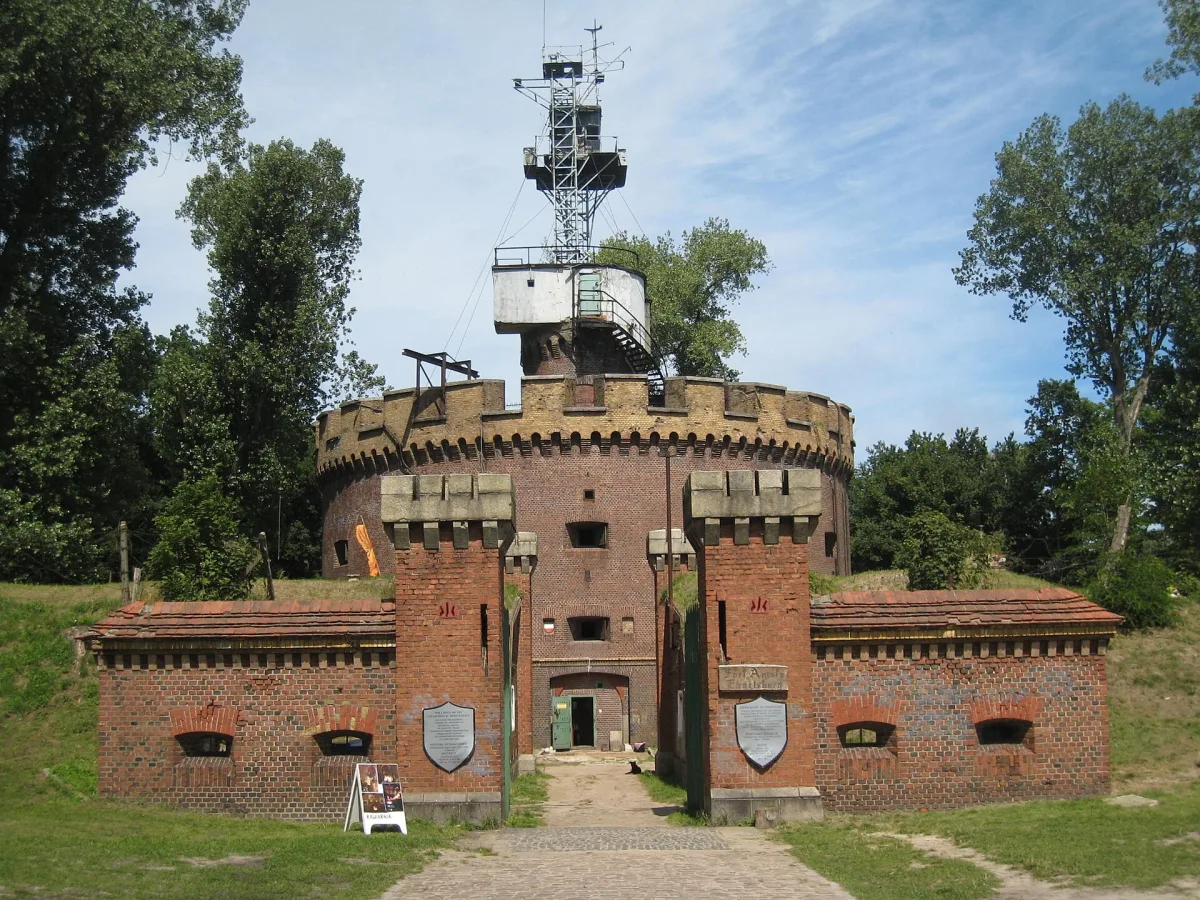
Świnoujście Fortress is not a single structure with a gate and walls, but a group of forts arranged around the mouth of the Świna. According to Wikipedia it was designed by Johann Leopold Ludwig Brese and consisted of four forts, of which three have survived to this day. Below we put this system together as a whole: where it came from, how it was built, which fort is called what, and what happened to the one that no longer exists.
Where the decision to build came from
According to the Fortress History Museum in the Western Fort, in 1815-1848 the fortifications of Świnoujście consisted of old wooden forts and improvised artillery positions. In 1846 the Prussian government took the decision to build a fortress, but work could not be started before the first war with Denmark in 1848-1849. A Danish frigate blockaded the port then, and the earthen ramparts thrown up in haste were later used in the permanent fortifications. For this reason, as the museum states, the year 1848 is usually regarded as the start of construction of the forts.
Wikipedia regards as the designer of the fortress Johann Leopold Ludwig Brese, a Prussian general of infantry and engineer, from 1854 Brese-Winiary (1787-1878). The entry about him lists Świnoujście alongside the fortresses in Poznań, Königsberg and Giżycko, and the entry on the fortress itself says outright that the author of the design was Brese. The caption under the portrait of the general on the website of the Fortress History Museum likewise calls him the designer of the fortress.
Four forts and their numbering
The numbering of the forts is not entirely consistent in the sources, so we give it according to Wikipedia and mark the differences. According to this service Fort I stood first and was demolished, Fort II is Gerhard Fort, also called the Eastern Fort and Werk II, Fort III is Angel Fort, and Fort IV is the Western Fort, in German Westbatterie. The museum in the Western Fort uses different designations: according to it Werk I is the first fort, Werk II is the land defence fort on the western bank of the harbour canal, and the two coastal forts bear the names Ostbatterie and Westbatterie. It calls the Western Fort Werk IV.
The construction dates also vary between Wikipedia and the museum. Wikipedia gives the years 1848-1859 for Gerhard Fort, 1854-1858 for Angel Fort and 1856-1861 for the Western Fort. The Fortress History Museum writes that Werk I was built in 1849-1856, that in 1854 construction began on a redoubt fort on the western bank of the canal, and that two years later the building of the Ostbatterie fort and the Westbatterie fort was begun at the same time. In 1863, according to the museum, Świnoujście was declared a third-class naval fortress.
Fort I: a work that no longer exists
Fort I is, according to Wikipedia, a large polygonal fort, built in 1848-1860 on the site of an old Swedish and Prussian redoubt. It was to have about 70 guns. The museum in the Western Fort gives the construction of Werk I as 1849-1856, so the two accounts give different dates for the completion of the work. In 1864 the fort was rebuilt: according to Wikipedia the southern powder magazine was removed, and the northern stretch of rampart with the second powder magazine was turned into a two-storey vaulted basement protected from the sea by a double rampart. The fort was blown up and demolished in the 1970s in connection with the expansion of the port in Świnoujście. The entry in the heritage register was struck off.
Expansions after 1871
After the Franco-Prussian War a law of the Reichstag of December 1871 approved the modernisation of all the forts, and work continued until 1881. Wikipedia writes that in Gerhard Fort in 1876-1877 the whole was rebuilt with money from the indemnity received from France, and the main armament was moved to new artillery terraces. The Western Fort was, according to the museum, expanded in 1878-1887 into a heavy coastal battery with casemates. The next stage was begun in 1898 by Admiral Alfred von Tirpitz's naval armament programme, and the most intensive work fell in 1905-1914, when elements of steel and concrete appeared. After the Treaty of Versailles the fortress had to be partly disarmed, and according to the museum, after the Paris Agreement of 1926, which allowed the Weimar Republic limited fortification work on its eastern borders, the forts came to life again.
The year 1945
Wikipedia writes that Soviet troops reached the fortress in 1945, and the town was taken on 5 May. The museum in the Western Fort adds that on the order of Admiral Dönitz, on 4 May 1945 almost all Wehrmacht units left the fortress, which spared both sides fighting for its capture. For Angel Fort, Wikipedia states that the garrison evacuated by ship without a fight. All the forts were then used by the Russians, according to the museum until 1961, and Angel Fort until as late as 1992. Wikipedia states that the Western Fort was handed over to the town in 1962.
What remains today
The three surviving forts lie close to one another. Angel Fort has a three-storey rotunda with a terrace, and the Western Fort houses the Fortress History Museum. Gerhard Fort is, according to Wikipedia, one of the best-preserved Prussian coastal artillery forts in Europe, and since 2010 it has housed the Coastal Defence Museum. The whole fortress is today divided among separate managers, so access and visiting rules are decided by each fort separately.
Be the first! Add a comment.
You need to log in to add a comment.
Log in