
The Jewish community of Szczecin left in the city three places of which reliable descriptions have survived: a cemetery founded in 1821, the New Synagogue from 1875, and a section of the Szczecin Central Cemetery created in 1962. The first two places no longer exist in their former form, and the third is in use. The data below come from Wikipedia entries on these places.
The cemetery on Ojca Beyzyma Street
According to Wikipedia, the Jewish cemetery in Szczecin was founded in 1821, and its original area was 173 m². It was later enlarged several times, among others in 1877, 1891 and 1917, until it covered the area along today's Soplicy and Ojca Beyzyma streets. In 1899 a pre-burial house was built.
In 1938, during Kristallnacht, the pre-burial house was burned down and the cemetery was desecrated. The entry states that during the Second World War the cemetery itself did not suffer. From May 1946 burials organised by the Polish Jewish community took place here.
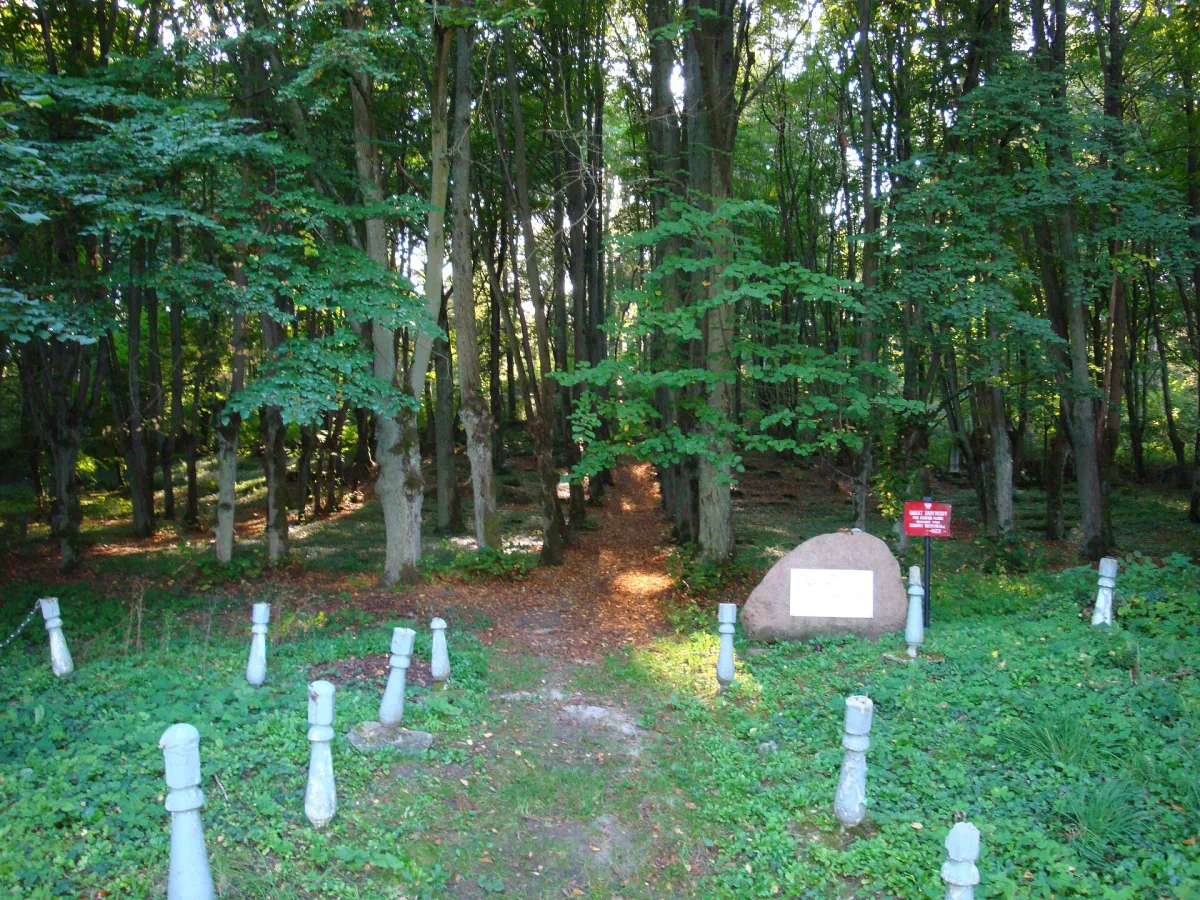
In 1962 the cemetery was closed. In 1982 the gravestones were removed and an exhumation was carried out, and the ashes were moved to a separate section of the Central Cemetery. In 1988 a monument designed by Zbigniew Abrahamowicz, documenting the past of this place, was erected on the site of the former cemetery, now a park. On the site of the former Jewish cemeteries in Szczecin there are no gravestones today, but a park with a monument.
The New Synagogue on Grüne Schanze
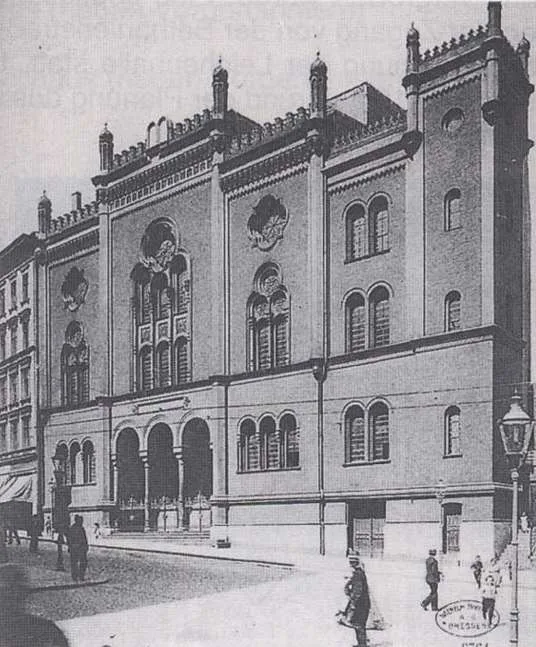
The New Synagogue stood on Grüne Schanze, on a plot whose address today is Dworcowa 9a. According to Wikipedia, it was built in 1873-1875 to a design by the Szczecin architect Konrad Krühl, on the site of an older, wooden house of prayer known as the Old Synagogue. The ceremonial opening and the bringing in of the Torah scrolls took place on 3 May 1875.
The brick building was raised on a rectangular plan in an eclectic-Moorish style. From the vestibule one entered the prayer hall, surrounded on three sides by galleries for women, and the whole could hold 1,500 people. The facade was crowned with tablets of the Decalogue and pinnacles. In the following years an organ, electric lighting and central heating were added.
On the night of 9 to 10 November 1938 Nazi paramilitaries burned down the synagogue. In 1941 its ruins were blown up and removed. On the site of the New Synagogue there is no building. It is recalled by a commemorative plaque next to the building of the Pomeranian Library (Książnica Pomorska), and on the facade of the Library there is a mural depicting the synagogue.
From 1940 to section no. 62
On the night of 12 to 13 February 1940 the Jews of Szczecin were taken to the goods station and deported to the General Government. According to dzieje.pl, citing the Bundesarchiv, there were 1,111 people in the transports from Szczecin and Piła.
After the war religious life was organised anew. According to Wikipedia, from 1946 to 1993 the Congregation of the Mosaic Faith in Szczecin operated, and in 1993 it was transformed into the Jewish Religious Community. The community has its seat at Niemcewicza 2, where there is a house of prayer with services on the Sabbath and holidays. Its remit covers north-western Poland.
In 1962, after the closure of the old cemetery and after the city authorities refused to allow a new one on a separate plot, a Jewish section marked with the number 62 was created in the Central Cemetery. The first burial took place in 1962, and the section also contains graves from the years 1946-1962 exhumed from the old cemetery.
The section covers about 0.25 ha, and about 150 gravestones of marble, granite, sandstone and other stones stand on it, with inscriptions in Polish, Hebrew and Yiddish. It is managed by the Jewish Religious Community in Szczecin. According to Wikipedia, it is the only active Jewish cemetery in the West Pomeranian Voivodeship. Buried here are, among others, a physician and professor of the Pomeranian Medical Academy and an economist, a professor of the University of Szczecin. The rules for entering the cemetery are given by its management.
Be the first! Add a comment.
You need to log in to add a comment.
Log in