
The war cemeteries in Szczecin and West Pomerania were created at different times and for different reasons. Some were established for soldiers who died in prisoner-of-war camps, others after 1945, when remains from scattered graves were gathered in one place, and still others only after 1991, when burials of German war victims became possible. This text brings together places where the fallen, prisoners and those who died in captivity are buried, according to data given by Wikipedia, the Volksbund and local studies.
The German war cemetery in Glinna
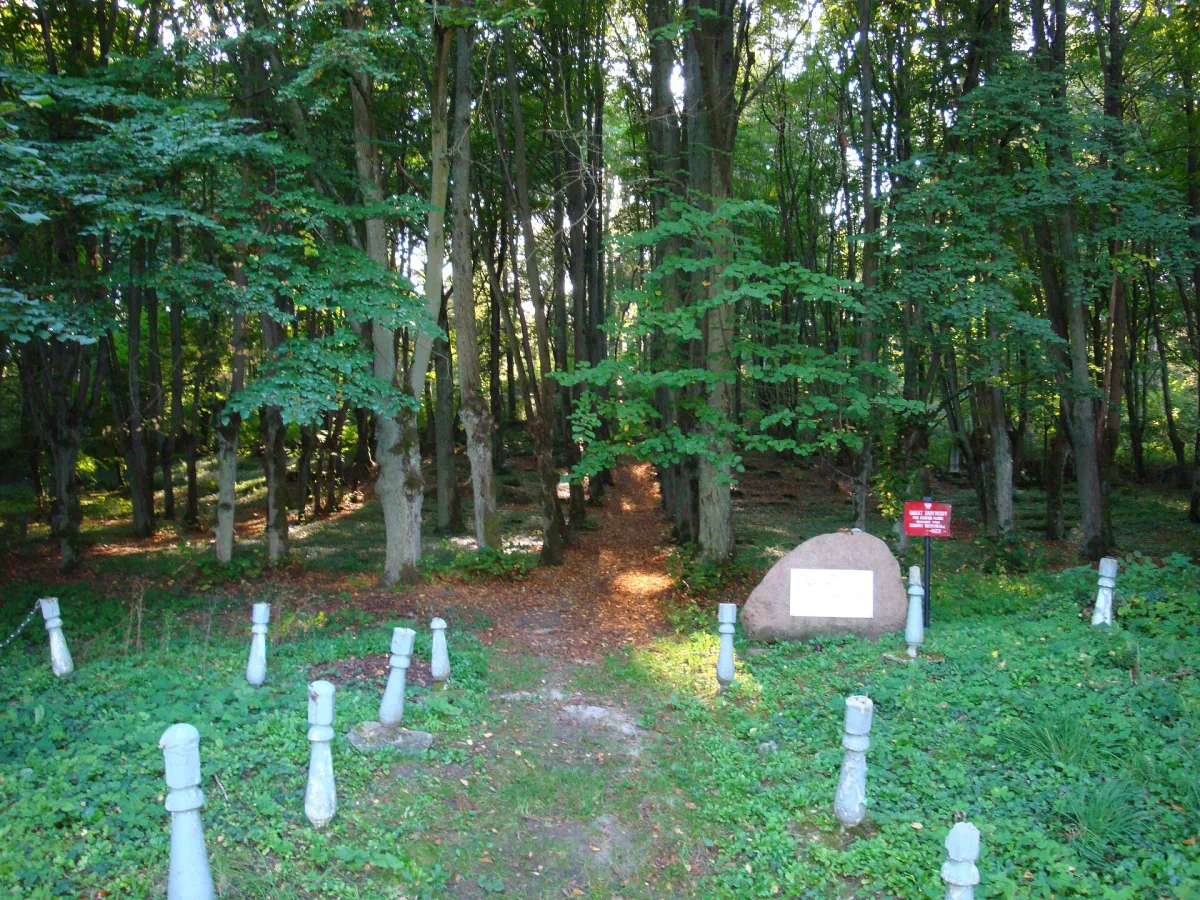
The German war cemetery lies in Glinna, in Stare Czarnowo municipality, on the edge of the Beech Forest. It was created by the Volksbund Deutsche Kriegsgräberfürsorge (the German War Graves Commission) as a collective place of secondary burials of German victims of the Second World War, above all soldiers who fell or died on Polish lands. According to the Volksbund's records, 30,076 people are buried here, and the cemetery is one of 13 established by this organisation in Poland since 1991.
In the autumn of 2000 Polish and German soldiers fenced off the site and together put up a wooden cross. In the same year the first remains exhumed from the Szczecin Central Cemetery were moved here. The main work took place in 2001-2003, and the official opening was held on 15 July 2006. Burials continued after the opening: according to the Volksbund, in April 2019 another 1,183 dead were laid to rest here.
The site, with an area of about 3.5 ha, was made available free of charge by Stare Czarnowo municipality. The main avenue leads to a large wooden cross, and on either side of it lie the plots of mass graves. Stone slabs give surnames, first names and dates of birth and death in alphabetical order, without military ranks or unit names. At the entrance stands a building with an exhibition and books with the names. Space has been planned for about 32,500 people.
In a separate field lie 2,116 people from a grave discovered in 2008 in Malbork. According to research by the Gdańsk branch of the Institute of National Remembrance (IPN), they were most probably German civilians, mostly women and children, who died or were killed in February and March 1945. They were buried in Glinna on 14 August 2009. After this burial the previous name “Cemetery of German Soldiers” was changed to “German War Cemetery”. The rules for visits are given by the cemetery's custodian, the Volksbund.
The war plot in the Central Cemetery
The Central Cemetery in Gumieńce was opened on 6 December 1901 as a municipal cemetery. The war plot lies on its main axis, between the chapel and the Monument to Brotherhood in Arms. According to Wikipedia, 3,379 soldiers are buried in it: 367 Polish, including 203 unknown, and 3,012 Soviet, including 2,586 unknown.
The plot was created gradually in 1946-1954. Soldiers exhumed from temporary burial places in Szczecin Pomerania were buried in it, especially from the areas around Szczecin, Dobra, Gryfino, Kołbaskowo, Nowogard, Łobez and Płoty. The remains of soldiers who fell in Mecklenburg during the Berlin Offensive were also laid here. The last burial took place in 1983. The plot consists of four sectors separated by an avenue with a yew hedge. Here stand two cannons, a plaque in honour of those who fell on the Oder and the Baltic, an obelisk with an inscription in Russian, and an Orthodox cross erected in 1994.
After 1945 the former garrison cemetery and military land were incorporated into the cemetery area. Of the former military necropolises of Szczecin, mainly traces on squares remain today.
Former garrison cemeteries and French prisoners
The military cemetery on St Adalbert Street was established around 1750 and was the first military cemetery in the city. Among others, 104 French prisoners from the Franco-Prussian War were buried there. It was closed to burials in 1900, and in 1913 the bodies from 577 graves were exhumed and moved to the older part of the cemetery. After the Second World War the site was levelled and turned into a square, without exhumations. It is recalled by a single boulder from the gravestone of the French prisoners.
The garrison cemetery on Kopernika Street was put into use on 25 March 1846 for soldiers of the Prussian regiments stationed in the nearby barracks. It was closed before 1939. Today in its place is a square with old trees and a fragment of the cemetery wall.
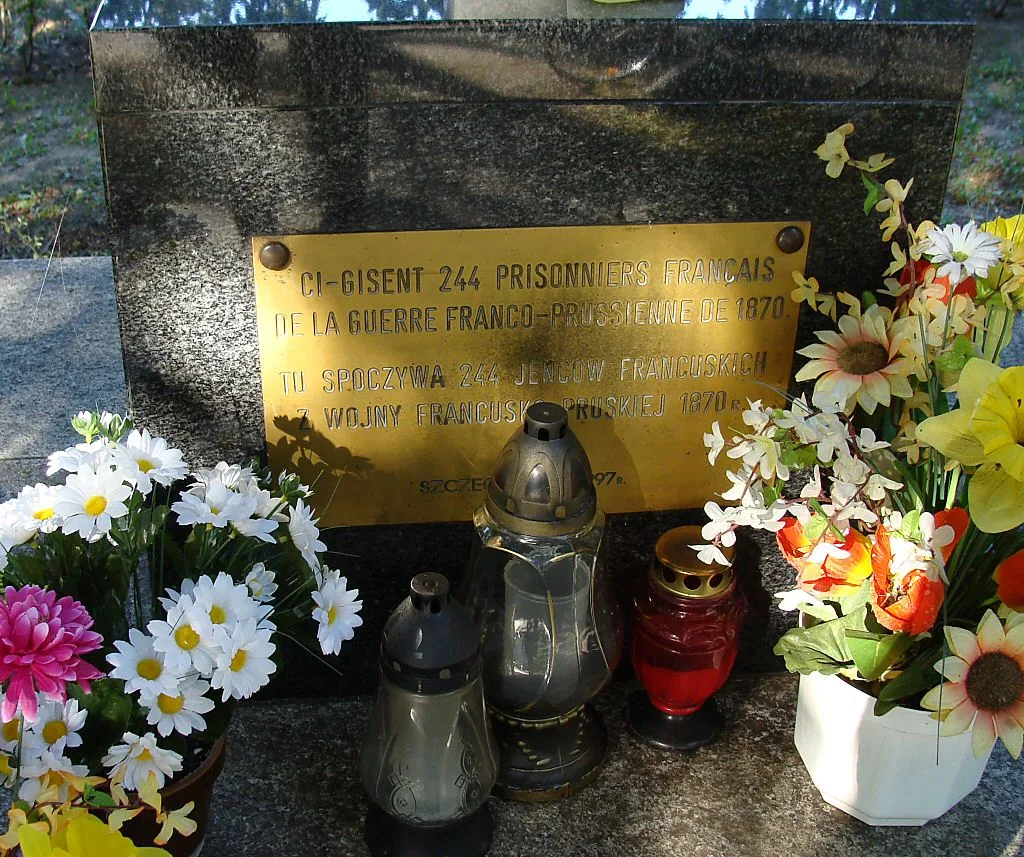
In the northern part of the Zawadzkiego housing estate, on Litewska Street, lies the cemetery of French prisoners. During the Franco-Prussian War a camp was set up on the Krzekowo training ground, in which about 1,700 French soldiers were held. According to Wikipedia, more than 600 people died there, and the bodies of 248 soldiers were laid in the cemetery. The number of those buried is sometimes given differently: a plaque unveiled in 1997 lists 244 people. The cemetery is entered in the heritage register, and in the middle of the lime-planted site stands a cross.
Prisoners in camps and post-1945 cemeteries in the region
The war cemetery in Stargard on Reymonta Street was established in 1914 as a burial place for prisoners. According to Wikipedia, 5,004 prisoners of various nationalities now lie there.
In Sosnowice near Golczewo, construction of a German prisoner-of-war camp began in 1941. According to Wikipedia, a typhus epidemic broke out during construction, and at least about 300 people died, although neither the exact number of victims nor the prisoners' details have been established. The prisoner-of-war cemetery has ten plaques and three granite crosses: Catholic, Orthodox and Greek Catholic. The plaques are dedicated, among others, to the Dutch, Italians, French, Poles, Russians, Ukrainians and Belarusians.
In Drawsko Pomorskie, on 11 Pułku Piechoty Street, lies the war cemetery, adjoining a municipal cemetery from 1850. According to Wikipedia, 3,458 soldiers of the 1st Polish Army who fell in the Pomeranian operation in February and March 1945 are buried here. American and British prisoners also lie here.
The Soviet Soldiers' Cemetery in Chojna was laid out in 1950-1954 next to the ruins of the chapel of St Gertrude from 1684. Plans for a joint necropolis appeared in 1946, and Chojna was chosen because the Chojna county had the most scattered soldiers' graves. According to Wikipedia, 3,985 soldiers are buried here, of whom only 972 are known by name. Their names are carved on 22 plaques of black marble. The last burial took place in 2006, when the remains of 91 soldiers exhumed in West Pomerania were laid to rest.
In a forest near Borne Sulinowo lies a Soviet cemetery with 344 graves, including 146 people whose identities have not been established. It was created in 1945 after the Soviet military base was set up and was in use until its closure in 1992. Soldiers and civilians connected with the garrison were buried here, including members of their families. In 2007 the remains from the closed Soviet military cemeteries in Kołobrzeg and Białogard were moved here.
War cemeteries are places of rest, and the rules of entry and care are set by their administrators.
Be the first! Add a comment.
You need to log in to add a comment.
Log in