
Jews in Szczecin before the deportation
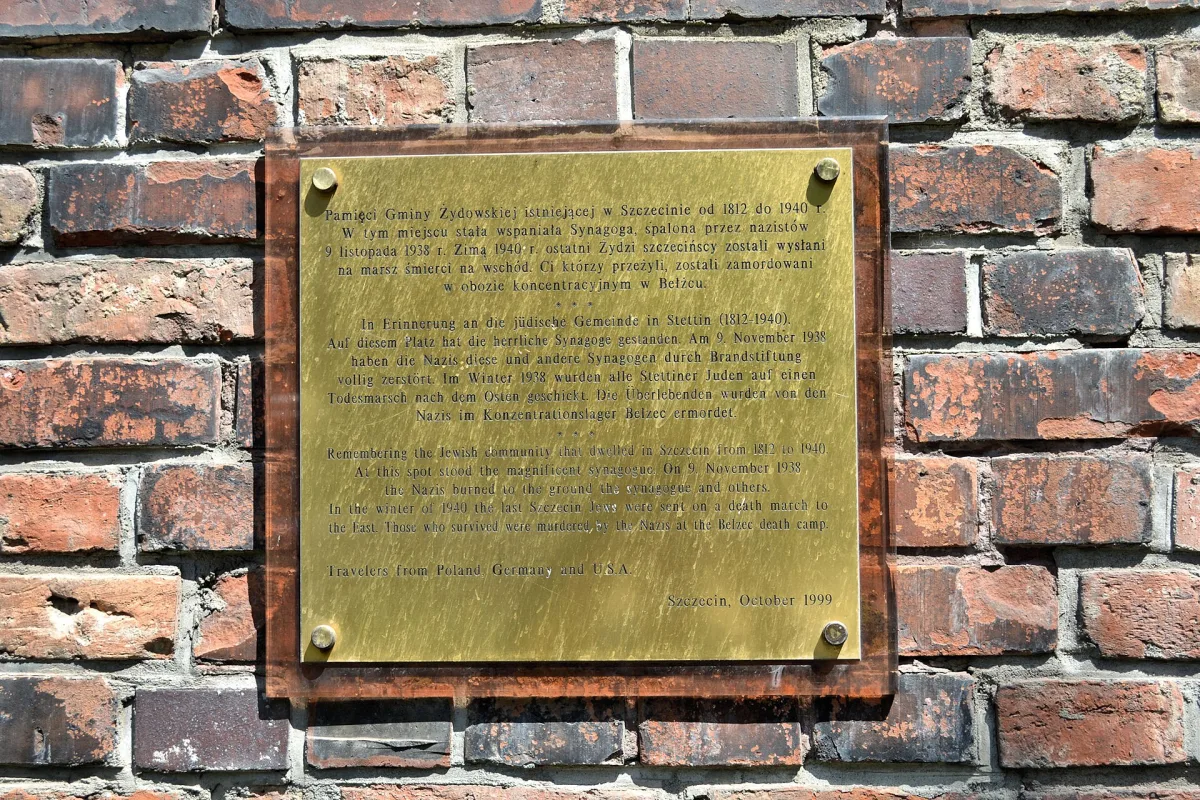
According to Wikipedia, 6,300 Jews lived in Szczecin in 1927 and 2,701 in 1933. On the night of 9 to 10 November 1938, Nazi paramilitaries burned down the New Synagogue, and a commemorative plaque on the building of the Pomeranian Library (Książnica Pomorska) now marks its site. According to an article by Magdalena Dźwigał of the Institute of National Remembrance (IPN), published on the dzieje.pl portal, the chapel at the Jewish cemetery was also destroyed at that time, and members of the Szczecin community were taken to Sachsenhausen.
The order and its background
The formal decision on the expulsion was issued on 30 January 1940 by Reinhard Heydrich, head of the Reich Security Main Office. The IPN article notes that this step overturned the previous ban on deporting German citizens from their own country. According to this source, the Szczecin deportation was the first action of this kind directed against Jewish citizens of the Third Reich.
The author points to several reasons, of which the key ones were said to be linked to the war economy. In Szczecin a shipyard producing vessels for the navy was reopened, and in Police the Hydrierwerke Pölitz plant was being built. Both investments required labour and housing, and at the same time the city was to take in about 23,000 Germans evacuated from the Baltic states, Galicia and Volhynia. The ambitions of Gauleiter Franz Schwede-Coburg also played a part: he wanted to be the first to “cleanse” his province of Jews.
The night of 12 to 13 February 1940
According to the same article, the operation was kept strictly secret. The details could be reconstructed thanks to copies of the order of the Szczecin state police found in archives in Washington and Moscow. Members of the SA, SS and the Nazi party, directed by the Gestapo, burst into flats. The occupants were given an order which, within seven hours, required them to prepare for departure under the supervision of the intruders.
The order specified what could be taken: a small suitcase with dishes, clothing and underwear, documents, and one or two blankets. Money, securities and valuables had to be left behind, and all property had to be listed on a form. Each deportee had to hang a tag with their name and year of birth around their neck. Taking food was not permitted, and the provisions promised for the journey turned out, according to the article, to be a lie.
Among the deportees were children, pregnant women, and sick and elderly people. They were taken from Szczecin and other places in the Szczecin administrative district, including Dąbie, Wolin, Anklam, Greifswald, Stralsund and Wolgast. They were driven to the goods station in ten lorries and seven buses. The commander of the Szczecin military district reported to Berlin that he had not been informed of the preparations.
How many there were: differing figures
The IPN article estimates that the deportation covered about 1,100 people, or 30 per cent of the Jews of the Province of Pomerania. According to the Memorial Book of the German Federal Archives (Bundesarchiv), cited in the same text, 1,111 people were expelled to the Lublin district on 12 February 1940 in transports from Szczecin and Piła. This figure therefore covers both transports. German Wikipedia, citing the historian Scheffler, states that between 825 and 842 people in this transport came from Szczecin alone.
The journey and the fate of the deportees
The transport travelled for four days in unheated wagons, in frost of more than 30 degrees, and reached Lublin. According to the IPN article, 71 people died during the journey. The deportees were separated and sent to nearby towns and villages. According to the Bundesarchiv list, 585 people went to Piaski and 157 to Głusk and other villages; the rest were placed in camps in Lublin and its surroundings. Older people were sent mainly to Głusk, women with children to Piaski. Wikipedia, in its entry on the Piaski ghetto, citing the work of Robert Kuwałek, states that more than 800 Jews from Szczecin were settled in Piaski in February 1940, which is a higher figure than in the Bundesarchiv list.
The IPN article describes the conditions as extremely harsh: by 12 March 1940, another 230 people had died because of the lack of housing and food. The deportees were able to contact relatives in Germany, and their letters were published after the war. The last information about the Jews of Szczecin dates from May 1942. According to the article, men fit for work were then taken to the ghetto in Lublin, and from there to the camps at Sobibór and Majdanek, while women and children were moved to Bełżec, where they were murdered on 28 October 1942.
The significance of this deportation
According to the Bundesarchiv Memorial Book, this was the first and only organised deportation of Jews from Szczecin. The IPN article adds that it became a testing ground for subsequent deportations, which in the following years covered almost the whole of Europe.
Be the first! Add a comment.
You need to log in to add a comment.
Log in