
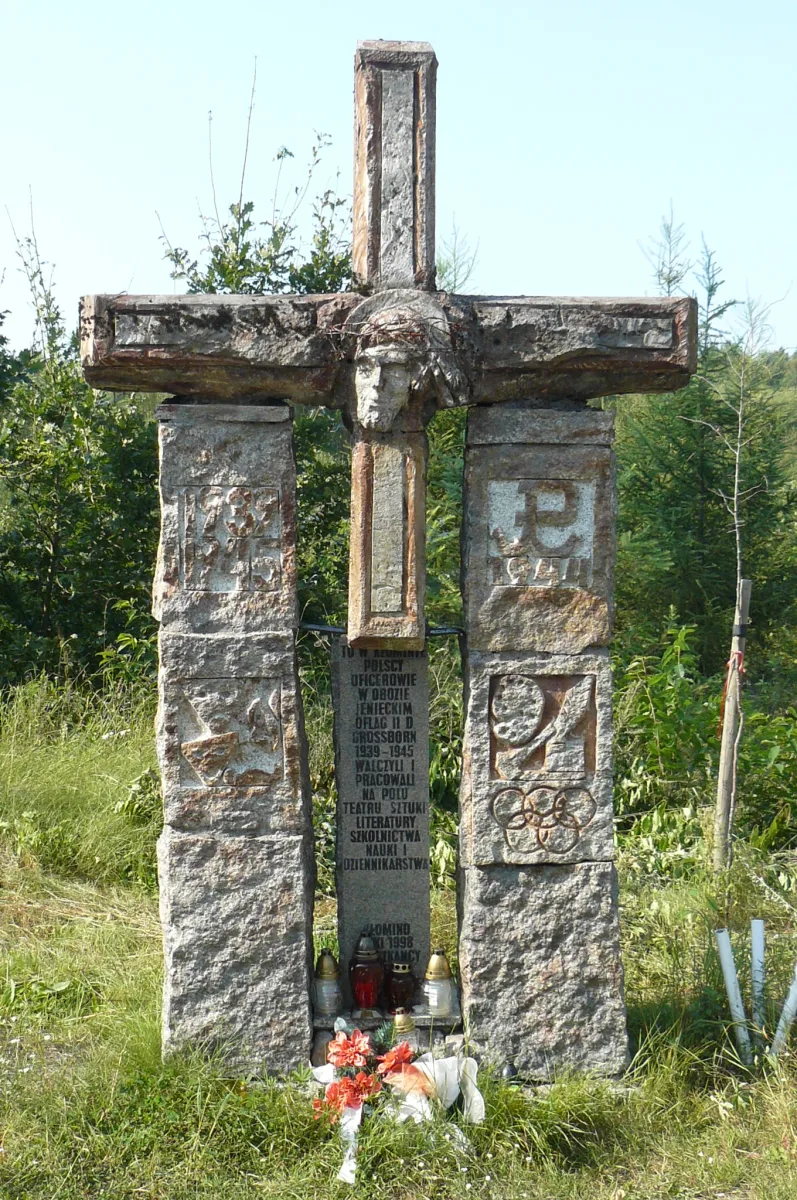
The officers' camp near Kłomino
Oflag II-D Gross-Born, a German prisoner-of-war camp for officers of the Allied states, was established on 1 June 1940 near present-day Kłomino, at the southern edge of the training ground, on the site of an earlier stalag. According to Wikipedia the camp operated until 1945 and stood on a hill called Hundsberg, that is, Dog Hill (Psia Górka). The entry on Borne Sulinowo records the same beginning: in September 1939 a transit camp was organised in this area, from 9 November it was a camp for other ranks, and on 1 June 1940 it was converted into an officers' camp.
At first only French prisoners were held in the camp. According to Wikipedia, in February 1941 there were 3731 of them, including 3166 officers and 565 orderlies, and in April 1942 there were 2826 (2408 officers and 418 orderlies). An orderly is a soldier assigned to an officer to attend to his needs. The camp was known for escapes: the first took place, as the same Wikipedia entry states, as early as 15 August 1940.
The prisoner exchange of 1942
The Central Museum of Prisoners of War (CMJW) links the exchange of prisoners with the events of 14-16 May 1942, when the Germans took the French prisoners away from Oflag II-D and put Poles in their place. Wikipedia speaks of mid-1942 and states that on 1 June 1942 there were 2818 Poles brought from the oflag in Choszczno (2544 officers and 274 orderlies). The number of Polish prisoners rose considerably in 1944-1945. According to Wikipedia, on 1 January 1945 there were 5391 Poles in the camp (5014 officers and 377 orderlies). The entry also mentions about 26 thousand Soviet prisoners, without stating in which period they were in the camp.
A large proportion of the participants in the Warsaw Uprising were taken to the camp after its fall. Wikipedia does not give their number. Among the prisoners were, for example, the writer Leon Kruczkowski, the poet Witold Wirpsza, who described his experience of the oflag in the novel “Pomarańcze na drutach” (Oranges on the Wire, 1964), and the sprinter and Olympian Zygmunt Weiss.
The Odra organisation and cultural life
A Polish conspiratorial organisation, Odra, operated in the camp. According to Wikipedia it was founded in November 1939 by Colonel (staff graduate) Witold Dzierżykraj-Morawski, who at Gross-Born was also the senior officer of the camp. The organisation's headquarters was first in Oflag II C Woldenberg in Dobiegniew, and then in Gross-Born. Odra mainly carried out intelligence work: it reconnoitred German fortifications in Pomerania, including the Pomeranian Wall, trained its members, monitored radio traffic and helped escaped prisoners. According to Wikipedia it most probably had about 850 members, although some post-war memoirs speak of about 4 thousand.
In September 1944 the Germans broke up the organisation. According to Wikipedia the headquarters staff were arrested at that time together with Colonel Dzierżykraj-Morawski, and its members were murdered after torture on 9 November 1944 in Mauthausen-Gusen. By the end of September about 300 members had been apprehended. The reasons for the exposure are not clear-cut: Wikipedia presents two hypotheses, one based on post-war testimony of a Gestapo agent, the other on the arrest of the head of communications of the Pomerania District of the Home Army in June 1944. Command of the organisation was taken over after the arrest by Colonel Ignacy Izdebski.
The prisoners organised cultural, educational and sporting activities. According to Wikipedia, underground periodicals were published, including “Za Drutami”, “Znaki”, “Alkaloidy” and “Przegląd Teatralny”, and in the summer of 1944 a competition described as the 12th Olympic Games was organised, with about a hundred competitors in 16 disciplines. Wikipedia also states that there was an Abwehr cell in the camp, which handed prisoners suspected of anti-Nazi activity over to the Gestapo in Piła.
The march in January 1945 and the memory of the camp
With the front approaching, on 29 January 1945 the Germans evacuated the prisoners westwards, to the camp at Sandbostel. According to Wikipedia the route was over 700 km long, the march took place in very poor conditions and at least a dozen or so prisoners died of exhaustion. Because of the chaos, between 700 and 1200 prisoners remained in the camp. The camp was liberated by soldiers of the 18th Infantry Regiment of the 1st Army of the Polish Army during the fighting to break through the Pomeranian Wall.
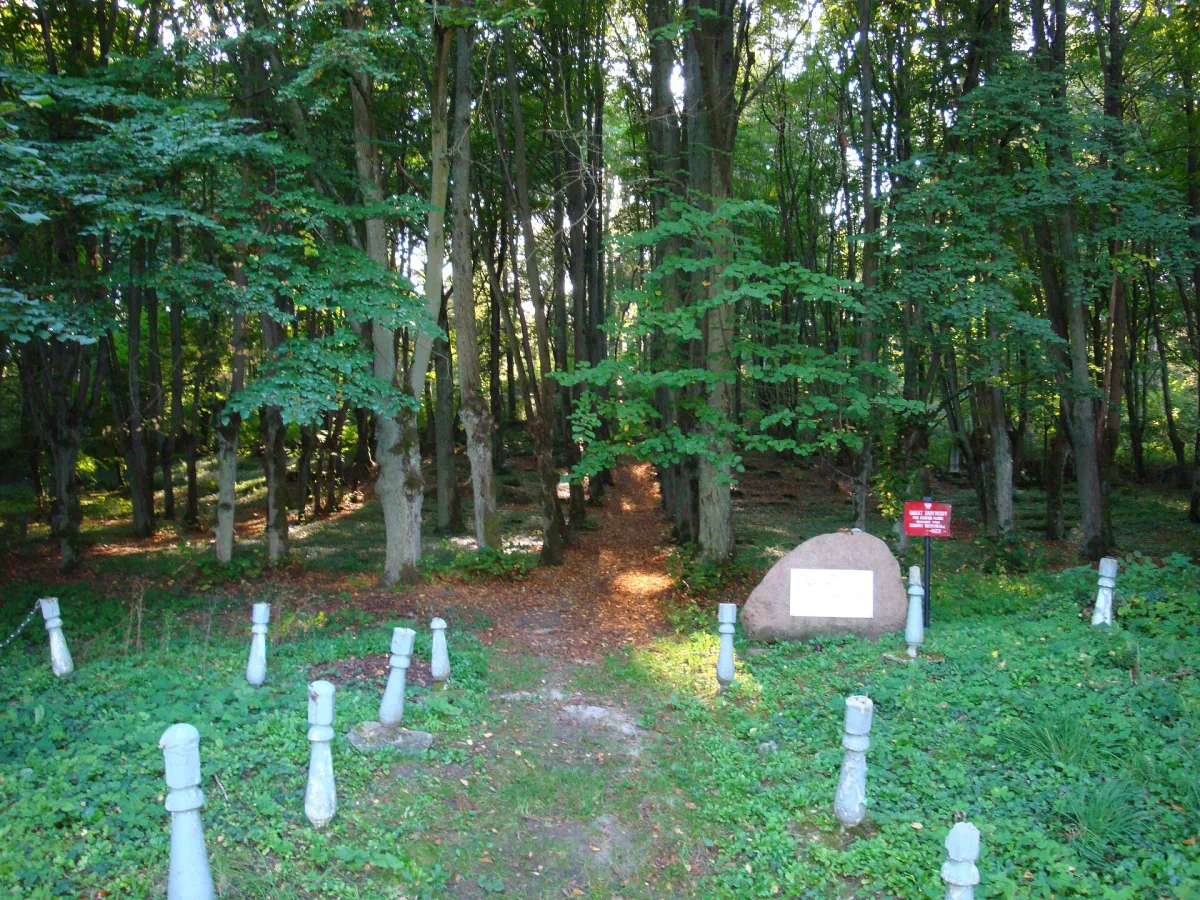
Prisoners who died were buried in the cemetery next to the camp. In a footnote Wikipedia describes the case of a Polish officer who died in January 1944: he was buried in the camp, exhumed in 1948 to Nadarzyce, and in 1953 moved to the war cemetery in Wałcz at Bukowina. Two monuments stand today on the site of the former camp. According to the descriptions on Wikimedia Commons, one is dedicated to the Polish soldiers of the oflag (by Zygmunt Wujek, 1998), the other to French officers from Oflag II-D Gross-Born and Oflag II-B Arnswalde (by the same author, 1990s). CMJW also describes a meeting of the families of Polish and French prisoners of Oflag II-D Gross-Born and Oflag II-B Arnswalde, which took place in Borne Sulinowo and Choszczno. A school in Borne Sulinowo bears the name of the oflag, and the local museum deals with the history of the garrison; the rules for visiting are given by the institutions themselves.
Be the first! Add a comment.
You need to log in to add a comment.
Log in