
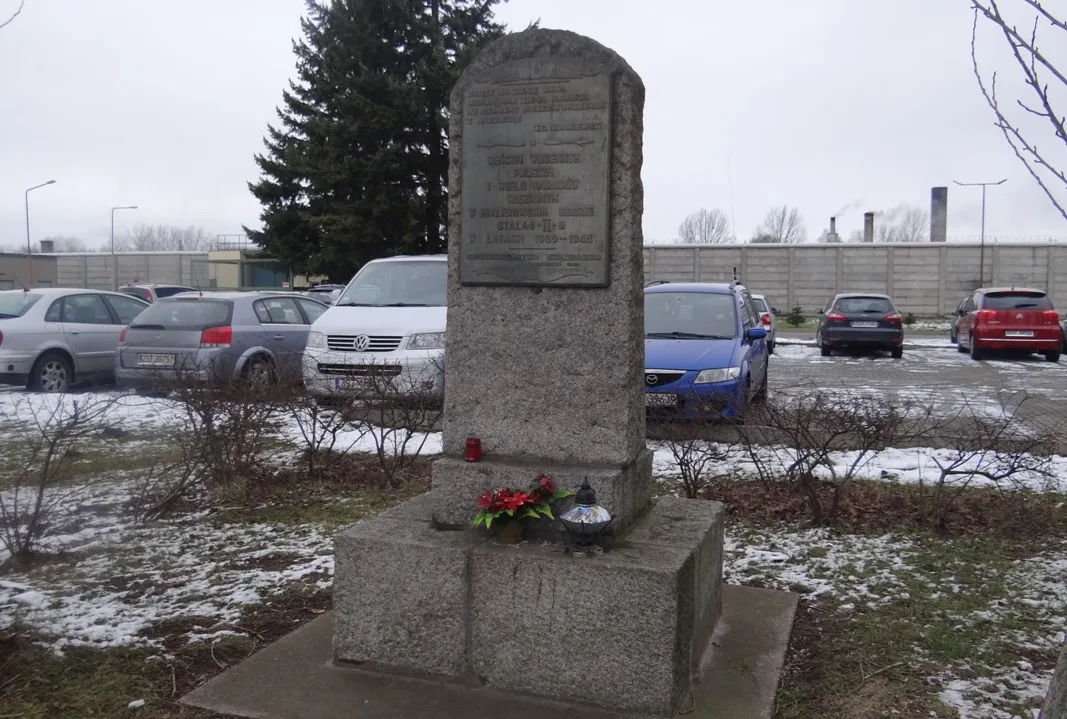
From transit camp to stalag, 1939
Stalag II-D was a German prisoner-of-war camp for other ranks and non-commissioned officers, located in Stargard. According to the exhibition “Stalags in Military District II” at the Museum in Stargard, whose authors are Andrzej Bierca and Piotr Tarnawski (an account by the PAP agency published on the dzieje.pl website), Wehrmacht Military District II covered roughly today's West Pomeranian Voivodeship and Mecklenburg-Western Pomerania. Already in the first days of September 1939 transports of Polish prisoners of war and civilians began to arrive there. At first everyone was placed in transit camps, dulags. There were two in the district: Dulag E in Gross Born, today Borne Sulinowo, and Dulag L in Stargard.
The dates given for the founding of the stalag vary from one publication to the next. The Museum in Stargard, according to dzieje.pl, gives October 1939 and a site between today's Żołnierza Avenue and Szczecińska Street. The Polish-language Wikipedia writes that the camp was established in September 1939 on a military training ground, which is consistent with the transit camp having operated earlier. The officers were moved to oflags at the end of 1939. According to the English-language Wikipedia, which cites a study by Jolanta Aniszewska, officers stayed in the Stargard camp until December 1939, and Polish civilians until January 1940.
Polish prisoners and the barracks of 1940
According to the museum, as of 12 December 1939 nearly 12,568 Polish prisoners of war were registered in the camp, of whom 10,999 worked outside it. In 1940 their number fell markedly. The museum gives the reason: voluntary or forced transfer from the status of prisoner of war to that of civilian worker. For those who most strongly opposed this action a punishment company was formed, working on the construction of a motorway near Chociwel.
For the first months the prisoners lived in the open or in tents, during a very harsh winter. According to the museum they spent part of the winter of 1939/1940 in large tents, sleeping on straw spread on the ground. Barracks were built from January 1940, first wooden, prefabricated ones, then brick ones, each for 250-300 prisoners. They were put up by the Polish prisoners themselves. Barbed-wire fences separated the individual parts of the camp, and guardhouses stood at the gates. The prisoners usually reached the camp by train and marched from the railway station in Stargard through the streets of the town. Soon after the outbreak of the war one of the largest prisoner-of-war hospitals in the district was set up in the town, in buildings on today's Limanowskiego Street.
Prisoners of other nations
According to Wikipedia, in May and June 1940 French and Belgian soldiers captured in the Battle of France were brought to Stargard. In summer 1941 Soviet prisoners of war captured after the attack on the Soviet Union arrived. In September and October 1943, after the capitulation of Italy, Italian prisoners of war were brought in. According to the Polish Wikipedia, in 1942 a group of about 450 Yugoslav prisoners of war was formed, sent to railway work in Szczecin and then transported to a camp in Norway.
The Museum in Stargard additionally lists Dutch, British, Serbian and American prisoners of war. Among the prisoners in the camp, as the museum states, the French and Soviet were the most numerous. For the Canadian prisoners there are two versions: the Polish Wikipedia writes of soldiers from the Dieppe raid, brought in August 1942, the English Wikipedia of their transfer to Stargard from Stalag VIII-B in January 1944. The English Wikipedia, citing Aniszewska, also gives about 4600 prisoners from Africa, Moroccans, Tunisians and Senegalese, who from summer 1940 were gradually taken away to camps in southern France, and states that after the Warsaw Uprising in 1944 many Polish civilians were sent to the camp. Among the last to arrive were American non-commissioned officers, who came by rail on 19 January 1945.
Work detachments
Most of the prisoners did not live in the main camp. According to the museum there were on average about 3000 prisoners on the site of the stalag, and the rest worked in detachments, most often in agriculture but also in industry. The museum estimates that for the French prisoners alone 1000 to 2000 work detachments were set up. The English Wikipedia, citing Aniszewska, speaks of more than 1500 branches in the region. Prisoners who died during work were, according to this source, buried near their places of work.
Evacuation and liberation
According to the museum the evacuation of the camp began in early February 1945, and the prisoners were driven across the Oder. The English Wikipedia, citing the recollections of American prisoners, gives the date of the first march as 29 January 1945 and about a thousand people in the column (about 500 Russians, 200 French, 100 Americans and 25 Canadians), and also states that some of the sick remained in the camp infirmary. According to the Polish and English Wikipedia, on 25 February 1945 most of the remaining prisoners marched west ahead of the Soviet offensive. The town was taken by Soviet troops on 5 March 1945, as the Polish Wikipedia states in its article on the history of Stargard. The later dates of liberation of the remaining prisoners vary: the Polish Wikipedia gives the middle of March 1945, the English one the middle of April 1945.
The number of dead and the place today
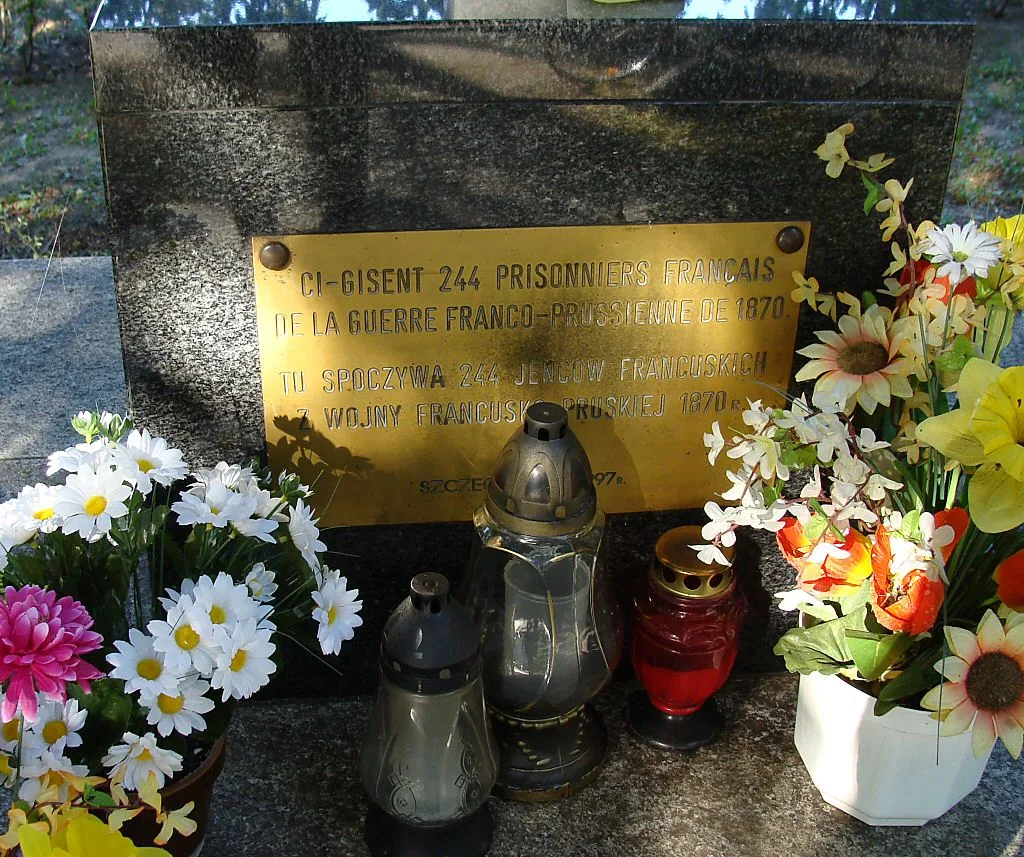
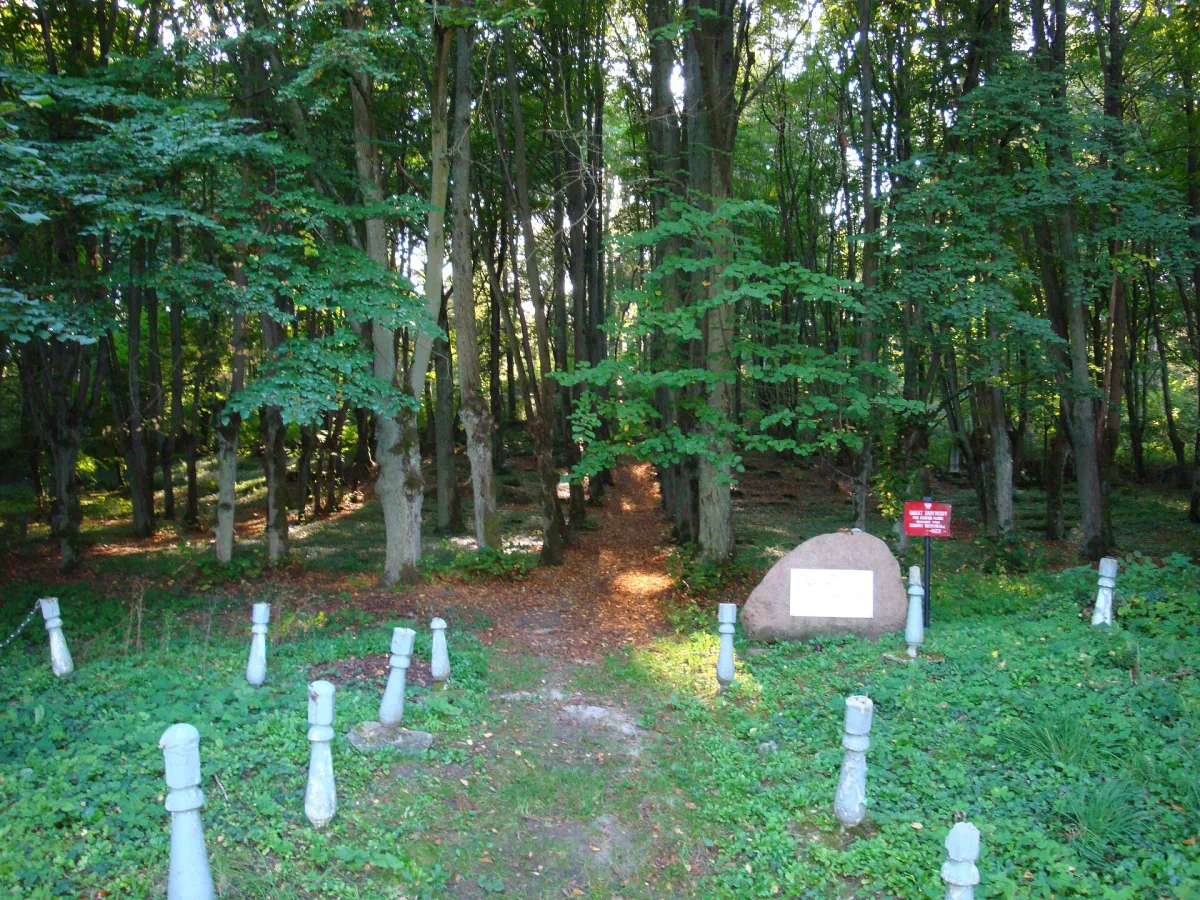
The English Wikipedia states that about 6000 prisoners and civilians died in the camp, citing a publication of RMF. In the war cemetery in Stargard, according to the Polish Wikipedia, on the basis of incomplete data, 369 prisoners of war from the wartime period were buried, including 132 Soviet and 68 French. The two figures describe different groups and cannot be compared with each other.
On the site of the former camp today stands Stargard Prison. According to the museum some of the barracks built by the Polish prisoners still stand on the prison grounds. According to the English Wikipedia, research was carried out on the site of the former camp in 2021-2024, during which mass graves were discovered: in 2021 a grave of several dozen prisoners, in 2022 a grave of more than a hundred people, including civilians, in 2023 two graves of about a hundred people, and in 2024 a grave with almost two hundred prisoners. The rules for visiting places connected with the camp are provided by the institutions that look after them.
Be the first! Add a comment.
You need to log in to add a comment.
Log in