
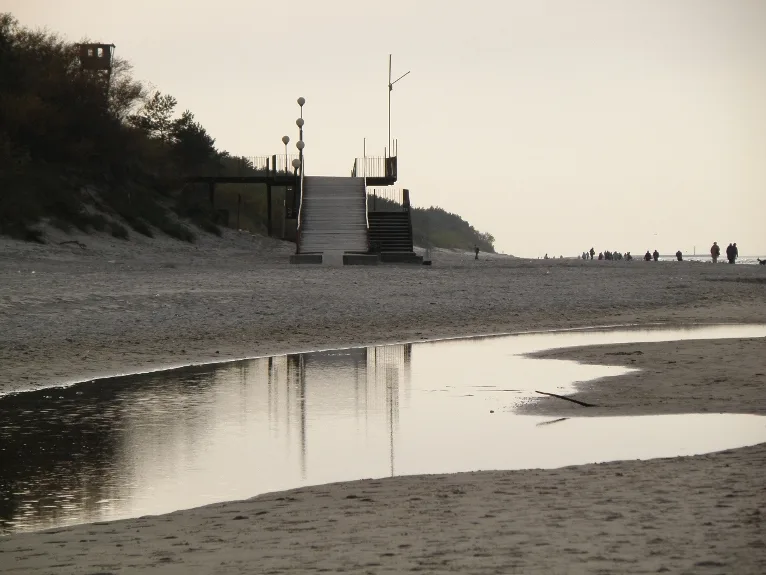
A moraine ridge above the sea
A cliff is a steep wall of the shore cut into the land by the sea. A dictionary describes it as a form created by abrasion, that is, the wearing away of the shore by rock fragments moved by waves. On Wolin the cliff wall is built of deposits from the Ice Age. According to Wikipedia the Wolin Range is a high, wooded moraine ridge which ends at the sea in a cliff, and in the coastal belt forms the highest cliff coast in Poland.
Wolin National Park, which covers this stretch, describes its landscape as follows: a range of end moraine hills bordering the sea and the Szczecin Lagoon dominates. Moraine hills occupy about 75 per cent of the park's area, and the highest of them, Grzywacz, is 115.9 m above sea level. At the shore itself the range breaks off in a cliff, which the park's website describes as the highest of the active ones, at 93 m. Wikipedia, in the entry on the park, gives 95 m, so the height of the cliff is best treated as approximate. The summit of the Gosań hill itself is, according to the Military Topographic Map cited by Wikipedia, 93.4 m above sea level.
The geological structure of the Wolin Hills is studied by the University of Szczecin. The programme of its field session speaks of Pleistocene and Holocene deposits exposed in the Wolin cliff and of moraine hills from the last glaciation, that is, the Vistulian, which after the retreat of the ice sheet were shaped by denudation and aeolian processes. The western edge of the island is, according to the same programme, a zone of glaciotectonically disturbed Quaternary and Mesozoic formations, mainly chalk. It was the ice sheet that piled up and broke the older layers into thrust slices, which can still be seen in the relief today as ridges and the depressions between them.
How a living cliff works
Wikipedia distinguishes cliffs according to whether waves still reach them. A living cliff, also called active, lies in the zone of wave action and is destroyed by it. At its base an abrasion notch forms, and when it deepens, the wall above it breaks away and the shore retreats. A dead cliff lies beyond the reach of the waves and is usually covered by a thick layer of slope deposits. A rejuvenated cliff is a dead one that the waves undercut again, for example after a rise in water level or during very strong storms.
On Wolin there are several examples. Wikipedia classifies the hill of Gosań as a scree-type abrasion cliff: the sandy-gravelly slope crumbles at the natural angle of repose, and cones of debris form at the foot, from which the waves wash out the sand, leaving only stones. According to this entry the cliff reacts immediately to undercutting waves, drying wind and flowing rainwater. If the slope becomes overgrown with shrubs or trees, the upper part is strengthened and the crown of the cliff becomes vertical.
The neighbouring Kawcza Góra is 61 m above sea level, and just above the cliff, at 56.9 m above sea level, there is a viewpoint. The whole coastal stretch lies in Wolin National Park, so the rules for moving along the trails given by the manager apply here. It is better to keep away from the edge, because it is a wall that continues to slip. Exhibits on the cliffs and the geology of the island are also shown by the Nature Museum of Wolin National Park in Międzyzdroje, where dioramas show, among other things, the coastal cliffs, and the geological exhibition includes Baltic amber.
The pace of the retreating shore
Wikipedia, in the entry on Wolin National Park, states that abrasion of the cliff coast moves the shoreline by about 80 cm a year. The entry does not say from what period and from what measurements this value comes, so it is an order of magnitude, not an exact figure.
Wolin also has a record of the former sea preserved in the terrain. The programme of the University of Szczecin field session says that the road from Zalesie to Lubin runs along the steep slopes of thrust slices, additionally undercut by marine abrasion about 7,000 years ago. This is a fossil cliff, that is, a former shore from which the sea has withdrawn. The same session mentions that the southern cliff of the island, on the lagoon side, is locally and periodically active, an example being Skała Bielikowa. On the lagoon side also lies the Lubin hillfort, which according to the description stands on the highest cliff of the Szczecin Lagoon coast, at 43 to 52 m above sea level, and is a viewpoint.
On the Strażnica hill, 73.9 m above sea level, stands the Kikut Lighthouse, converted in 1962 from a 19th-century viewing tower. The tower is 18.2 m tall, and the light is at 91.5 m above sea level.
Dziwnówek, Trzęsacz and Niechorze
A cliff does not have to be high to be protected. The Klif w Dziwnówku nature reserve covers 4.17 ha and lies along the beach, a few hundred metres east of the buildings of Dziwnówek. It was established on 8 February 2017, on the same day as the Klif w Łukęcinie reserve. According to Wikipedia these were the first reserves of sea shore ecosystems in the West Pomeranian Voivodeship. It includes dunes and wooded areas, from whose erosion the cliff formed, and the aim of protection is to preserve the landscape of the sea shore wall within natural abrasion processes. The retreat of the shore exposes here the remains of tunnels and shelters from the 1950s, built for defence against a landing from the sea.
The Dziwnów Spit shows the other side of the same process. According to the programme of the University of Szczecin field session, an extreme storm in 1913 destroyed the Kurhaus there, one of the largest spa houses on the Baltic. The same session discusses the role of hydraulic engineering structures in changing the sediment balance and the morphodynamics of the coast.
The most famous testimony to the retreating shore is the church in Trzęsacz, which once stood 1.8 to 2 km from the sea. Wikipedia states that in 1750 it was 58 m from the cliff, in 1806 14.5 m, in 1855 about 5 m, and in 1868 one metre. The last service was held on 2 March 1874. The date of the collapse of the north wall is given by Wikipedia as 1900, and by the museum on its website as 1930, so both dates appear in different studies. The history of the church and the process of abrasion are told by the Multimedia Museum on the Cliff, and in the area stands also the Niechorze Lighthouse, built on a high cliff shore. A commission of 1860 also considered the area of Trzęsacz for the lighthouse, but the shipping ministry rejected it and in 1863 construction began in Niechorze.
Be the first! Add a comment.
You need to log in to add a comment.
Log in