
From a medicinal bath to a summer season
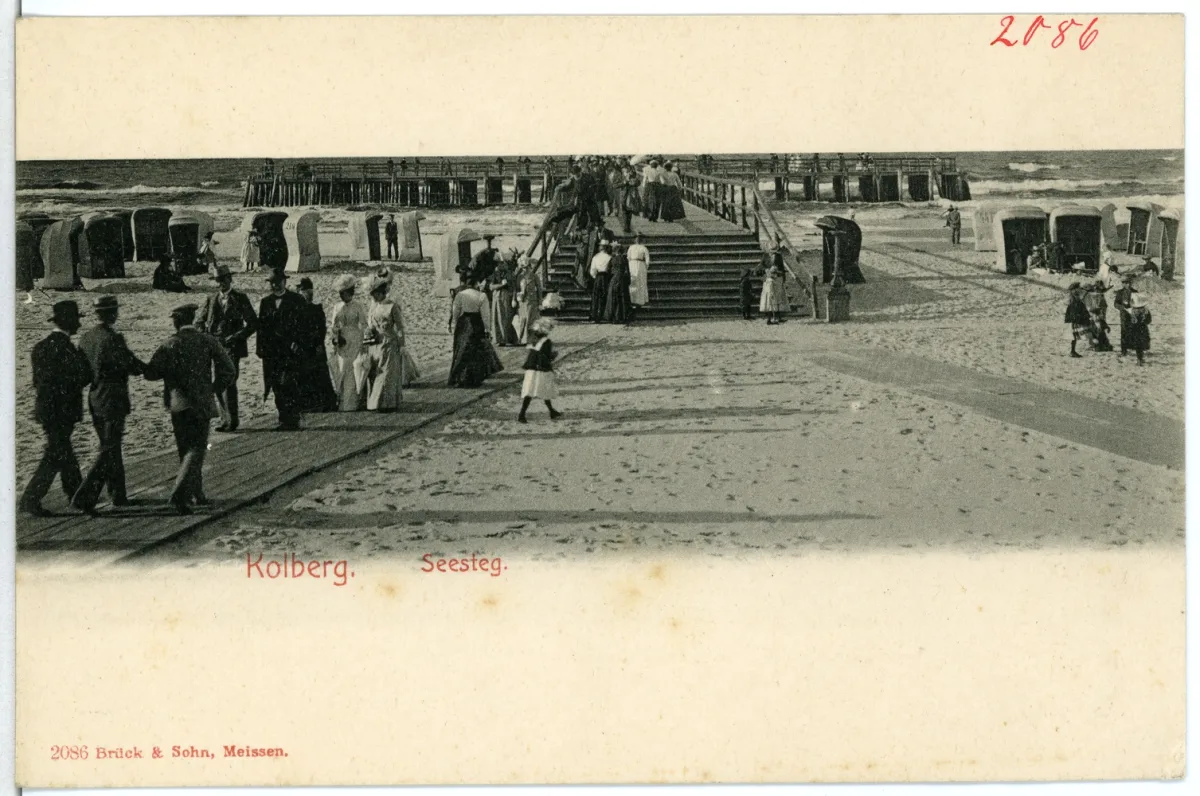
On the western part of the Polish coast, the sea began to be treated as a remedy long before the age of holidays. The earliest date in the region is given by Kołobrzeg. According to Wikipedia, the year the spa there was founded is taken to be 1802, when the Prussian officer and customs councillor Jan Henryk Held came to the town, sentenced to a year and a half in the fortress. The result of his stay was a book about the sea resort, and in 1803 the first sea bathing establishment was built at the mouth of the Parsęta River, open from June to September. From the beginning it had separate bathing areas for women, for men and for families with children.
In Kołobrzeg the fashion for the sea went hand in hand with brine. Wikipedia, in the entry on the spa, writes that it was first used for medicinal baths in the 1830s, and the creator of the brine baths was Gottlieb Keutel. The entry on the town itself gives the year 1830 as the date of the first brine bathing establishment. Both versions fall within the same decade, so they do not exclude each other, but neither entry settles the exact year.
Świnoujście: the season of 1824 and Lenné's park
In Świnoujście the date is sharper. According to Wikipedia the first bathing season was opened in 1824, and as early as 1826 the first spa house was opened, located near the harbour quay. The building was demolished immediately after the outbreak of the First World War. The Oberpräsident of Pomerania, Johann August von Sack, took part in the development of the spa, thanks to whom the design of the Spa Park was prepared by the Prussian landscape architect Peter Joseph Lenné. In 1827 he sent from Sanssouci about 1,500 saplings of trees and shrubs, and a year later the park was in essence composed. The land first had to be created: before the park was laid out, hydraulic engineering works were carried out to turn the former coastal shoal into new land stabilised by vegetation.
Wikipedia notes that no planning document by Lenné has survived, but his authorship is regarded as certain on the basis of the layout of the paths, axes, squares and tree plantings, citing an analysis by the landscape architect Małgorzata Haas-Nogal from 2000. Świnoujście began to count for brine later than Kołobrzeg: according to Wikipedia its springs were discovered there in 1897.
Międzyzdroje: separately for ladies and gentlemen
In the first half of the 19th century Międzyzdroje was still a poor fishing village. According to Wikipedia the beginnings of the change are noted from 1832, and the first bathing facilities on the beach were built in 1835. The municipality of Międzyzdroje, in its study of the history of the town, writes of 1832, when the village was parcelled out, and of the first holidaymakers around 1831. The first bathing areas were separate for ladies and for gentlemen, and the separate bathing houses were abolished, according to the municipality, only in 1924, when the beach was opened to everyone.
The scale was modest then. According to the municipality, in 1847 the village had 316 inhabitants and was visited by 382 summer guests. In the following years the number of inns, shops and private lodgings grew, and the roads to Wolin and Świnoujście were widened. In 1860 the Belgian merchant Arnold Lejeune built a spa house with three villas on the promenade, together with a spa park, and the municipality bought back the whole property in 1879. The first pier reaching into the sea, according to the Wikipedia entry on the pier, dates from 1884. By the end of the era the numbers had risen many times over: Wikipedia states that in 1913 20,000 summer guests came to Międzyzdroje. Along the beach, where the first bathing houses were built, the Walk of Fame (Promenada Gwiazd) runs today.
Dziwnów: from spa guests to the largest hotel on the coast
According to Wikipedia, in 1820-1830 the first spa guests began to arrive in Dziwnów, and as early as 1823 the village is known as a spa; the entry bases this second fact on a PPWK tourist map from 1996. The real turning point came at the end of the century. Wikipedia links the construction of the Silvan Spa House (Dom Zdrojowy Silvana) with the opening of the Szczecin - Kamień Pomorski railway line in the summer of 1892. Spa guests taking brine baths used oak tubs in this building.
Even larger was the Kurhaus Ost-Dievenow hotel, built right by the beach. According to Wikipedia it was built in 1895, in 1896 a brine spring named in honour of Prince Bismarck was discovered on its grounds, and this gave rise to brine and peat mud baths. The hotel could accommodate 240 guests in 140 rooms, and a stay in Dziwnów could be bought all over Europe, among other places in Budapest, Prague, Riga, Stockholm, Vienna and Warsaw.
Smaller resorts and the railway
Smaller places followed a similar path. To Rewal the first summer guests began to come, according to Wikipedia, in the 1830s, and in Niechorze the number of summer guests grew from 700 in 1889 to 1873 in 1910 and 3000 in 1923. There the Familienbad bathing pavilion stood on huge piles in the shallows right by the beach and had a slide. In Pobierowo the first sea bathing is dated only to about 1907, when the farmer Frohreich built the Seeblick hotel by the sea.
In Kołobrzeg the railway and the decommissioning of the fortress in 1872 opened the way for the town's expansion. Wikipedia writes of a spa park, a spa district with graduation towers, guesthouses and sanatoria, and also of a pier which from 1881 reached into the sea next to the Strandschloss sanatorium. In the spa district today stands the Kołobrzeg Pier, although it is a reinforced concrete structure from 1971. The first pier was T-shaped and about a hundred metres long, and at its end there was a landing stage for small sailing ships. The Strandschloss itself was opened in 1899 as a spa house.
Be the first! Add a comment.
You need to log in to add a comment.
Log in