
In Szczecin, trade and festivity have for centuries shared the same squares. The two fairs most associated with the city today differ in character: one is tied to the indulgence feast at the cathedral, the other takes place in winter in the courtyards of the castle. What they have in common is that both show regional products, and some of the stallholders are producers from the list of traditional products. Below is a description of the fairs as a custom: when in the year they are held, where, and how they came about.
Rynek Sienny: a place of trade since the Middle Ages
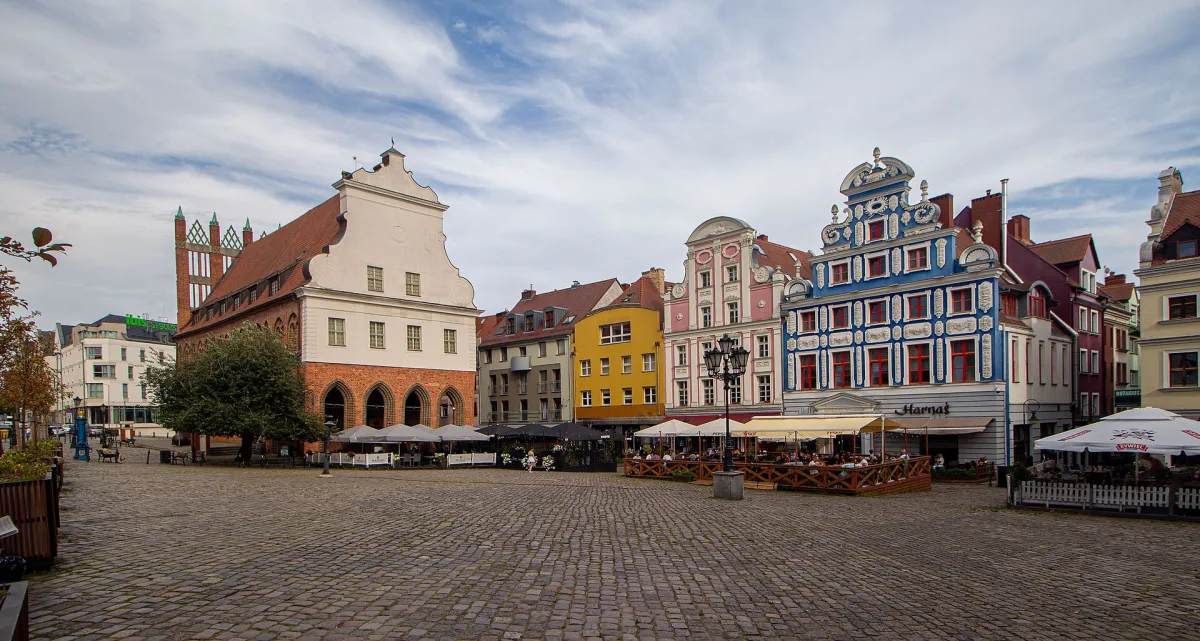
The idea of a fair in Szczecin is not new. According to the Encyclopaedia of West Pomerania, Rynek Sienny (the Hay Market) came into being in the Middle Ages and took its name from the hay that was traded there. At first a wooden town hall stood in the middle, later replaced by a brick Gothic one. In the 19th century the square had its own Exchange building, and according to the same source there were always stalls on the square, selling everyday goods.
After 1945 the square changed names: it was Rzepicha Square (1945-1955), then the Old Market Square (1956-1995). Today it is a place for walks around the Old Town rather than a permanent market, but the history of trade on this square explains why the indulgence fair fell on fertile ground in Szczecin.
The St James' Fair at the cathedral
The St James' Fair is held on the occasion of the feast of St James at the St James' Cathedral Basilica. According to the Encyclopaedia of West Pomerania, the event has been organised since 2009, and its idea draws on the medieval tradition of indulgence fairs. The Encyclopaedia does not, however, point to any specific medieval fair that would be a direct predecessor: it speaks of a tradition, not of continuity.
According to the same source, the most important event remains the indulgence Mass in the basilica. Alongside it, wooden stalls are set up on the cathedral square and on Plac Orła Białego. They are run by folk artists, makers of the region's culinary heritage and craftspeople, including some from outside Pomerania. The Encyclopaedia mentions a stage with folk ensembles, exhibitions and lectures in the basilica, and the “Our Culinary Heritage” competition, in which the best regional dish is chosen. Everything on display can be tasted.
According to the Encyclopaedia, the organiser is the parish of St James the Apostle. Dzieje.pl wrote in 2015 about the St James Foundation (Fundacja Dzieło Świętego Jakuba), which organises the St James' Fair and promotes regional and organic traditional products; the foundation was then admitted to the Culinary Heritage Network of West Pomerania. According to the same text, a shop operated on the square in front of the cathedral where such products were available all year round.
The Christmas fair at the Castle
The winter fair has a different location and a different rhythm. According to RMF FM, it is held in December in the courtyards of the Ducal Castle (the Castle of the Pomeranian Dukes), and the organiser is the castle itself. The exhibitors stand in decorated wooden huts. Among them were members of the Culinary Heritage Network of West Pomerania and producers making products from the List of Traditional Products.
As examples RMF FM lists spelt breads, honeys, fish products, wines, gingerbread and Kołobrzeg pickled cucumber, that is, products suitable, as stated, for the Christmas Eve table or as a festive gift. The programme of the edition described there also included a procession of carol singers, entertainers and a children's theatre, but the programme changes from year to year and is not important here. The sources do not say since when the fair has been held at the castle.
What the two fairs have in common
Both events have the same core: regional food and handicrafts sold directly by the makers, in the setting of a historic monument. One is tied to the church calendar, the other to the festive one, and together they make it possible to see in Szczecin products from the ministry's list, such as honey, gingerbread or smoked fish. Details of organisation, opening hours and the programme should be sought from the organisers, because they change every year.

Be the first! Add a comment.
You need to log in to add a comment.
Log in