
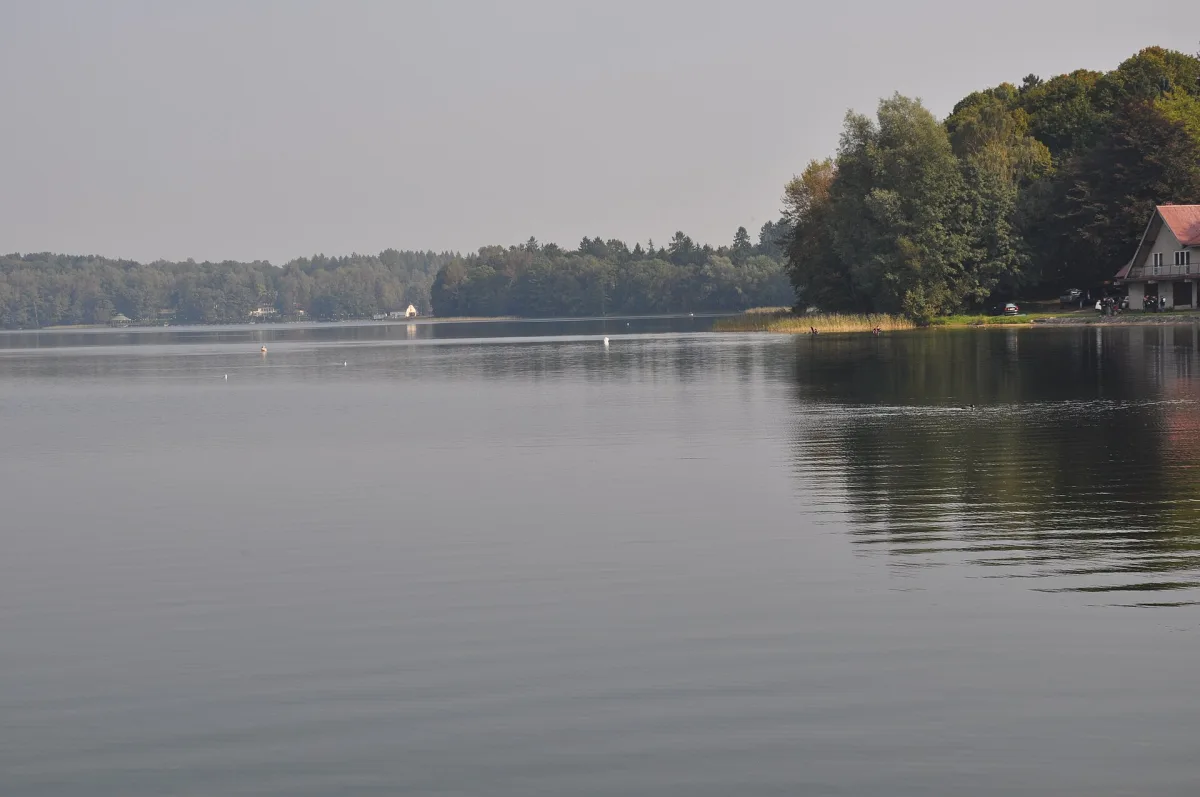
A town on a lake
Ińsko lies in Stargard County, on the south-eastern shore of the lake of the same name, right in the middle of the Ińsko Lakeland. According to Wikipedia a Slavic fishing settlement by the lake was mentioned in 1248, and in 1300 the place was already called a town, although the exact date of its chartering is not known. The former German name was Nörenberg. Wikipedia states that it is linked with settlers from the Nuremberg area.
In 1945 the buildings inside the medieval blocks were, according to Wikipedia, almost entirely destroyed during the fighting. The street plan with a grid layout around the Market Square survives, along with a small fragment of the defensive walls from the second half of the 14th century on Ogrodowa Street. The same article lists among the registered monuments a narrow-gauge railway station from the turn of the 20th century.
Ińsko's Catholics pray today in an unusual church. St Joseph the Spouse of the Blessed Virgin Mary Church is housed in the building of a former mortuary chapel by the cemetery. It was consecrated on 19 March 1945, on St Joseph's day, and adapted for Catholic liturgy. A sacristy, chancel and choir were added later, and the stained-glass windows date from 1993.
Lake Ińsko as a bathing spot and diving site
Lake Ińsko has, according to Wikipedia, an area of 596 ha, a length of 5.4 km, a width of 2.1 km and a depth of up to 42 m. The shoreline is about 32 km long, and the shores are formed in places by steep moraine hills. The website czystejeziora.pl gives the same figures and places the lake's waters in the first purity class. The diving website Nurkomania describes the lake differently: 487 ha in area and a depth of up to 41 m. The values from Wikipedia and czystejeziora.pl agree with each other, but the discrepancy is worth bearing in mind if someone is planning a dive on the basis of a single description.
The town has a municipal beach, from the side of which, as Wikipedia records, large boulders lie in the water. The same Wikipedia calls Ińsko one of the most popular diving sites in the West Pomeranian Voivodeship. It gives three reasons: easy access, good underwater visibility and rich fauna and flora, as well as the facilities of the local diving centres. Nurkomania describes colonies of freshwater sponges at a depth of 20-30 metres and the rare crustacean Pallasea quadrispinosa, a relict of the Ice Age, which now lives in only a dozen or so Polish lakes.
The Trabant on the bottom and other sunken objects
Underwater lie objects placed there specially for divers. Wikipedia lists a sunken Trabant, a Pontiac, a Christmas tree, a sculpture of a swan, an anaconda made of plastic, road signs, a military radio station, a tin garage and a desk with computer equipment. The information about the Trabant has one basis in the available sources, the Wikipedia entry. The entry does not say who sank the car or when, so the Trabant should be treated as an item of the lake's equipment described in Wikipedia, not as a documented story.
Another wreck is described by Nurkomania: a concrete trimaran hull 13 m long, designed and built in 1970, withdrawn from service at the end of the 1990s and sunk in April 2005 at a depth of about 20 m.
An island, beech woods and the highest hill
There are three islands on the lake. The largest is occupied by the Wyspa Sołtyski nature reserve, a forest reserve protecting old stands of beech wood, oak-hornbeam forest and acidophilous oak wood. On the north-eastern shore of the lake lies the Kamienna Buczyna reserve, protecting a landscape of terminal moraine with numerous erratic boulders. Further on, within the Ińsko Landscape Park, is the Głowacz reserve, with a hill of the same name, 180 m above sea level and the highest in the Ińsko Lakeland.
The Ińsko Film Summer
Since 1973 the Ińsko Film Summer (Ińskie Lato Filmowe) film festival has been held in Ińsko. According to Wikipedia the first edition took place in mid-August 1973, and the initiators were Bohdan Kowalski, Doland Paszkiewicz and Kazimierz Dec. The festival takes place every year in August, and screenings are held in the Morena cinema, in the hall of the local school complex and in other places in the town. Since 2005 the main organiser has been the Ińskie Lato Filmowe Association, formed in December 2004.
For years the programme has included screenings of the latest Polish films with meetings with their makers, screenings for children and open-air shows. Among the festival's guests Wikipedia lists, among others, Agnieszka Holland, Jerzy Hoffman and Krzysztof Zanussi. The festival's prize is called the Golden Fish (Złota Rybka). Dates and programmes of further editions are given on the festival's website.

Be the first! Add a comment.
You need to log in to add a comment.
Log in