
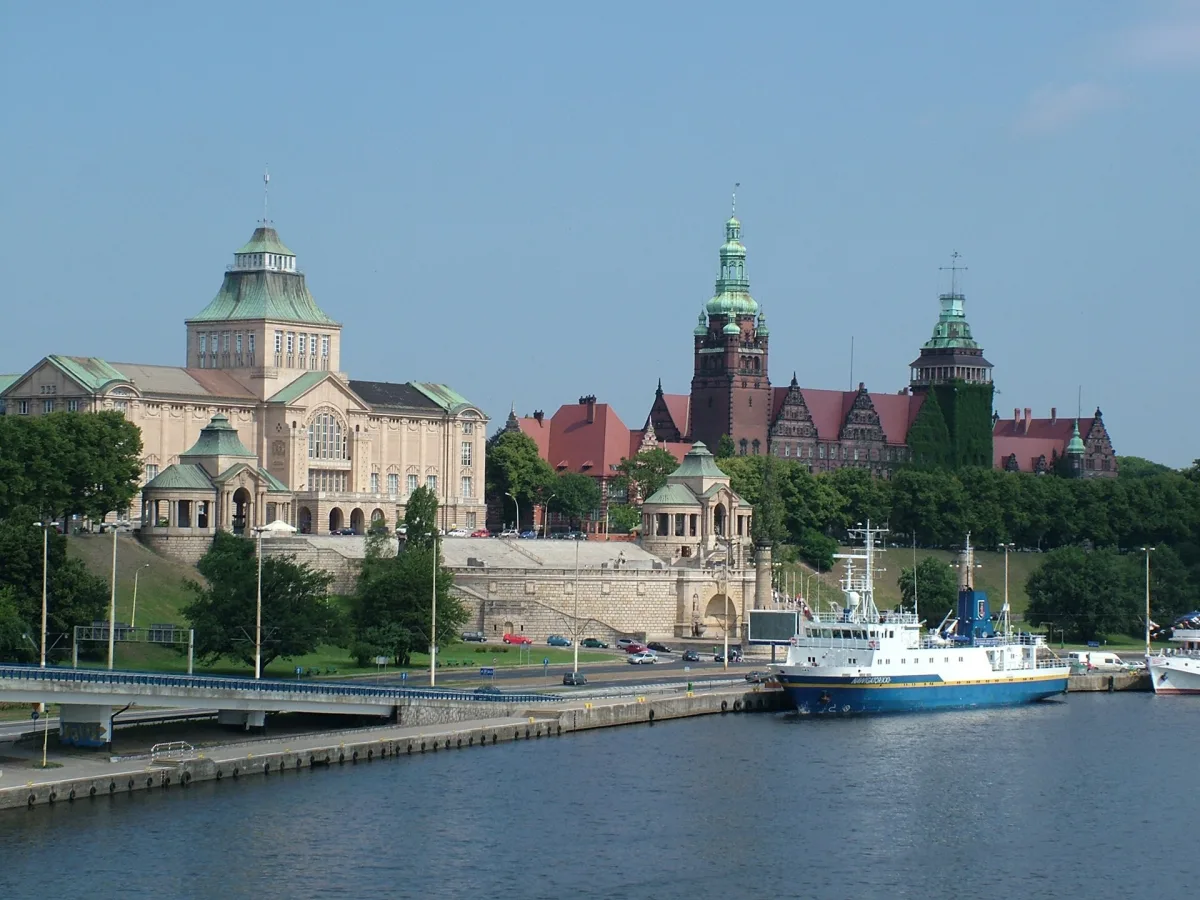
A bluff left by Prussian fortifications
The Chrobry Embankment is a viewing terrace about 500 m long, stretching along the bluff beside the Oder, in the area of the Old Town. According to Wikipedia, together with the Ducal Castle, St James' Cathedral Basilica and the museum building, it forms the town's skyline on the Oder, visible from the bridges and viaducts on the eastern approach roads.
Before the terrace was built, fortifications stood on this site. According to Wikipedia, in 1873 demolition of Szczecin's 18th-century defences began, and the first concept for developing the land left by the demolished Fort Leopold was drawn up in 1876. Another idea followed in 1894, and the decision to carry it out was taken in 1901. The terrain was difficult: during construction of the neighbouring government building the old moats had to be filled in and the peaty subsoil replaced, and the foundations reached in places 11 m below street level.
Haken and Meyer-Schwartau
The original name of the complex, Hakenterrasse, that is Haken's Terrace, commemorated Lord Mayor Hermann Haken. According to Wikipedia, he was born in 1828 in Koszalin and led Szczecin from 1 January 1878 to 31 March 1907, and on the day he left office he was given the title of honorary citizen of the city. He was also the initiator of, among other things, the construction of the public library, the municipal theatre building and the Central Cemetery. He died in 1916 in Berlin and was buried at the Szczecin Central Cemetery.
The designer was Wilhelm Meyer-Schwartau, from 1891 to 1921 municipal building councillor of Szczecin, who was also the author of the layout and buildings of that same cemetery. The construction dates given in Wikipedia need clarifying. The whole complex is dated to 1902-1921, but the viewing terrace itself was formed, according to the entry, in 1902-1907, that is while Haken was still in office. The buildings along the terrace were erected later, up to 1921.
Terrace, stairs and sculpture
The terrace was laid out at a height of 19.3 m above sea level, about 19 m above the level of the Oder (Odra Zachodnia). On top of the embankments runs a tree-lined promenade, ending at its extremities in semicircular small squares. Beneath it run two symmetrical access roads. On the axis of the complex there is a slightly lower semicircular central terrace, resting on a rusticated retaining wall, with viewing pavilions in the shape of oval domes on Ionic columns.
A semicircular niche with an extensive fountain was hollowed out in the wall. In the crown of the wall, under the balustrade, the coats of arms of Pomeranian towns were placed, and in front of the fountain stand two lighting towers styled as lighthouses. Two flights of stairs link the terrace with the Oder quay.
On the central terrace stands a stone sculpture by Ludwig Manzel, known as Hercules Fighting a Centaur. According to Wikipedia, it was funded by the Szczecin consul Kisker and unveiled in 1916, and the sandstone figure is 2.4 m high. The identity of the fighting man is not certain: one interpretation sees in him a Lapith from the centauromachy, another Hercules.
Buildings along the terrace
In the northern part, in 1906-1912, a complex for the Szczecin government district (Regierung) was erected to a design by Paul Kieschke, today the seat of the Voivodeship Office. A separate Wikipedia entry says that the building was put into use in 1911, so the completion dates differ by a year depending on the entry. Kieschke died in 1905 and the design was continued by Paul Lehmgrübner. The complex consists of three connected buildings, two courtyards and two towers. The taller one, 72 m high, is crowned with a figure of a sailor with an anchor, measuring 225 cm.
The centre of the complex is occupied by the City Museum building, today the Main Building of the National Museum. The wing facing the Oder and the side elevations were built, and construction was halted in 1913. The planned wing facing the town was never erected. Further south stand two connected buildings: the former Social Insurance Institution designed by Emil Drews from 1902-1905 and the former Customs Directorate, completed in 1918-1921. Today they house a maritime university. Their red brick elevations, referring to Dutch Renaissance, contrast with the early modernist mass of the museum and the sandstone retaining wall.
Behind the museum a regular square with terraces extends towards the town. A monument to Emperor Frederick III originally stood there, and since 1960 there has been the concrete monument to Adam Mickiewicz by Sławomir Lewiński. From the west the composition is closed by Stefan Żeromski Park, the former Grabowo Cemetery.
After 1945
According to Wikipedia, the complex survived the war without major damage, and post-war changes mainly concerned the interiors. On the office tower, according to a study cited in the entry on the building, a Polish flag appeared in 1945: Piotr Zaremba, the first Polish president of the city, ordered it to be hoisted on 30 April 1945. Part of the museum building was adapted for the needs of the Contemporary Theatre, which according to Wikipedia has operated here on the upper floor since 1 January 1976. The tower's crowning elements were changed and the corner pavilions on the museum roof were removed.
The names of the Pomeranian towns on the wall were replaced with Polish ones, and in the niches on both sides of the fountain figures of Jan of Kolno and Wyszak were placed. After 1989 the greyed elevations of the terraces, lamps and buildings were cleaned, and the dedication plaque in honour of Haken was also restored. The complex of terraces is listed in the heritage register under number A-1326, entered on 18 December 1996. About a kilometre further on stands the Port Gate, one of the two surviving gates of the Prussian fortifications, so a walk from the terrace shows two successive stages in the history of the same city: the fortress and its successor.


Be the first! Add a comment.
You need to log in to add a comment.
Log in