
The West Pomeranian region has many structures that were built to work, not for show: water tanks for steam locomotives, bridges that open for ships, mills driven by wind and water, narrow-gauge railways. All the structures described here can be seen from the outside, and some have open interiors or are still in operation. The rules of entry are given by their managers, so check them at the source before you set out.
Water towers: brick, Fachwerk and a steel sphere
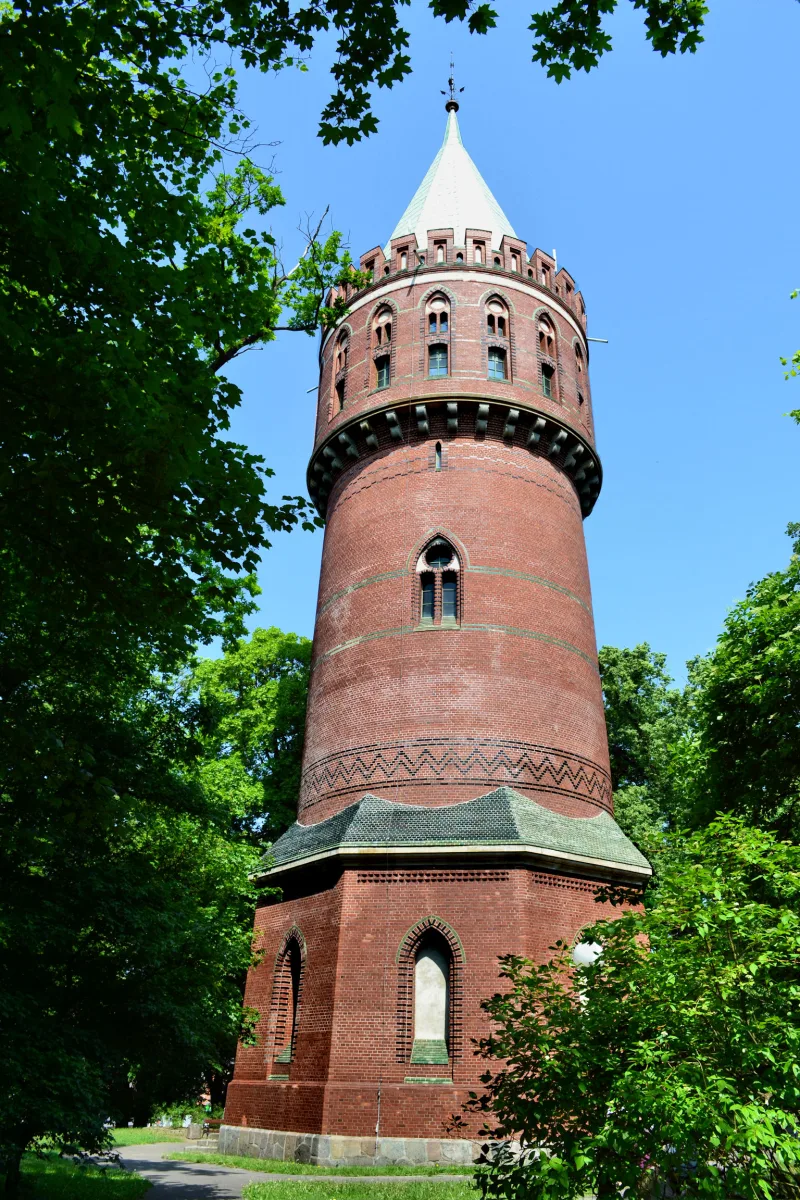
The tallest is the water tower in Stargard. According to Wikipedia it was built in 1896-1897, is 65 metres high and has a tank with a capacity of 500 m³. It stands in Chrobry Park, outside the line of the medieval walls. The chequered decoration of the facade echoes the nearby Red Sea Tower, and the green helmet and the new spire date from a renovation begun in 2007. The previous spire was destroyed in a gale in 2001.
The water tower in Trzebiatów looks entirely different: a railway tower from 1906, taken out of service in 1990. The shaft is of clinker brick, and the head holds a spherical, riveted steel tank. Wikipedia notes that tanks of this type (Klönne) were very rarely installed in towers on the territory of present-day Poland. It stands at the end of Torowa Street, by the station.
The third, the railway water tower in Goleniów, was built in 1912 to supply water to steam locomotives. It has a red shaft and a Fachwerk head with a black frame and white infill, and the original metal tank has survived in the upper part. According to Wikipedia, the adaptation work, co-financed with EU funds, was completed in 2020, and cultural and scout organisations operate in the tower.
Bridges that lift, turn or once used to lift
The drawbridge in Dziwnów spans the Dziwna strait on a voivodeship road. The first, a wooden one with a lifting span, was built in 1956, and the present steel one was opened in 1994. It is opened electrically, and counterweights balance the weight of the roadway. When the span is raised, a navigation channel 16 metres wide is created. The lifting times change seasonally, so check the schedule with the manager.
Not far away, over the same strait, the swing bridge in Wolin is in operation. According to Wikipedia it is one of five existing swing bridges in Poland. Motors on the central pier turn part of the spans through 90 degrees across the bridge. It is about 300 metres from here to the collegiate church and the regional museum.
In Gryfino the drawbridge crosses the East Oder. It is a steel truss of three spans, with a lifting section in the middle one. The first bridges over the East Oder began to be built in 1306, and in 1911-1913 the wooden crossings were replaced with steel ones. The middle part of the bridge was blown up in 1945, and it was rebuilt in 1955. The East Oder at Gryfino has navigation class Vb, which assumes a clearance of 5.25 m, and the bridge has 5.17 m, so according to the description it does not in practice need to be raised.
Szczecin has its own story of drawbridges. Długi Bridge is the first crossing in the city: a wooden bridge with a passage for ships stood here in 1283. In 1903 a modern drawbridge was opened, known as the Hanseatic Bridge, blown up on 20 April 1945. Rebuilt in 1959, it was a drawbridge until 2000, when it was welded shut during renovation.
Windmills and a mill on the canal
The former mill in Stargard is the Small Mill on Gdańska Street: a two-storey red brick building from 1894, driven by the water of the Krąpiel canal. In the interwar period it ground about 20 tonnes of grain a day, and production continued until 1999. Today it houses a hotel, so it is not visited like a museum.
There are several types of windmill. In Wolin stands a brick Dutch windmill from 1850 on a circular plan, behind the cemetery in the western part of the town. In Poradz, by the road from Łobez to Starogard, stands a brick windmill in the shape of a truncated cone. According to Wikipedia it is counted among the best preserved Dutch windmills in West Pomerania, and since 1993 it has been privately owned. The dome with four sails turns together with them, while the body stands still. In a post mill the whole structure turns.
One such post mill is the windmill in Mierzyn on Welecka Street, wooden, from the first half of the 19th century, with sails reconstructed in the 1970s. Wikipedia counts it among the oldest structures of this type in the region. The site is private, so it is viewed from the road. The same applies to the windmill in Nowe Worowo: only ruins of the brick tower remain, and the land is private.
Narrow-gauge railways: tracks that run and tracks that stand in a museum
The Koszalin Narrow-Gauge Railway has a track gauge of 750 mm. The decision to build it was taken in 1897, and services began on 1 November 1898 on the Koszalin - Manowo - Nacław section. Today seasonal tourist trips run from Koszalin to Lake Rosnowo, and the line is entered in the heritage register. The railway's website also gives the option of a guided visit to the locomotive shed by prior arrangement. You will find the timetable on the operator's website.
In Gryfice there is an exhibition of Pomeranian narrow-gauge railways, a branch of the National Museum in Szczecin. The steam locomotive park was created in 1973, and the locomotives and wagons collected there date from 1909-1928. Of particular value are the Tyn6 locomotives from the Vulcan works in Szczecin. On the grounds there is a turntable for locomotives, and the tracks connect with those of the Gryfice Narrow-Gauge Railway.
The latter, today the Coastal Narrow-Gauge Railway, has a gauge of 1000 mm. According to Wikipedia, the first line from Gryfice to Niechorze Wielkie was opened on 1 July 1896 as a Prussian local railway, and the initial 750 mm was regauged to 1000 mm in the early 20th century. Since the beginning of the 21st century it has operated as a tourist railway of the Rewal municipality.
Electricity in Maszewo
Collections of a different kind are gathered by the Community Museum of Energy in Maszewo: tools, instruments and electrical fittings of former power engineers. It is located in the company's premises, not in a separate museum building, so arrange the rules of entry and visiting times with its custodians.


Be the first! Add a comment.
You need to log in to add a comment.
Log in