
An axis from the provincial building to the forest
Plac Jasne Błonia im. Jana Pawła II (John Paul II Square, known as Jasne Błonia, the Bright Meadows) lies north of the building that houses the City Hall. Wikipedia describes it as a broad green space bounded by Ogińskiego, Szymanowskiego and Moniuszki streets, which merges to the north-west into Kasprowicz Park. It is part of a larger plan: the building was constructed in 1924-1927 as the seat of the authorities of the Province of Pomerania and was meant from the start to be linked by a line of sight with the park to the north and with the buildings of the centre to the south. The site for construction was bought, as Wikipedia states, from the commercial councillor Martin Quistorp.
The green itself was laid out in 1925-1927. Along the sides of the broad lawn, with flower beds in the middle, avenues of London plane trees were planted. Visit Szczecin and Wikipedia state that there are 213 of them here and that this is the largest concentration of the species in Poland. These are figures from publications about the square, not the result of a separate tree survey. Wikipedia shows the avenue of plane trees along Ogińskiego Street as a natural monument. The plane trees are joined by crocuses: according to Visit Szczecin they bloom here once a year in their thousands and are a hallmark of the Szczecin spring.
The Quistorp family in the background
The name Quistorp-Aue, by which the square was known before 1945, points to the owners of the land. Johannes Quistorp, according to Wikipedia a Szczecin entrepreneur and philanthropist, gave the city the land on which, in line with his wishes, Kasprowicz Park was created. Visit Szczecin adds that he stipulated that the area should serve residents for recreation.
His son Martin left other traces in the city. In 1899 a villa in Pogodno was built for him, according to Wikipedia, and in 1900-1904, on his orders, as a tribute to his father, the Quistorp Tower was built on Arkona Hill. The tower is a ruin today. The axis from Jasne Błonia through the park to the Arkona Forest therefore runs through areas linked with the Quistorp family.
A square for assemblies
The square served for major ceremonies. According to Wikipedia, in 1946 mass celebrations were held here under the slogan “We keep watch on the Oder”, and in 1959 a meeting of residents with Nikita Khrushchev. Today the character of the square is defined by two monuments, placed on opposite sides of the lawn.
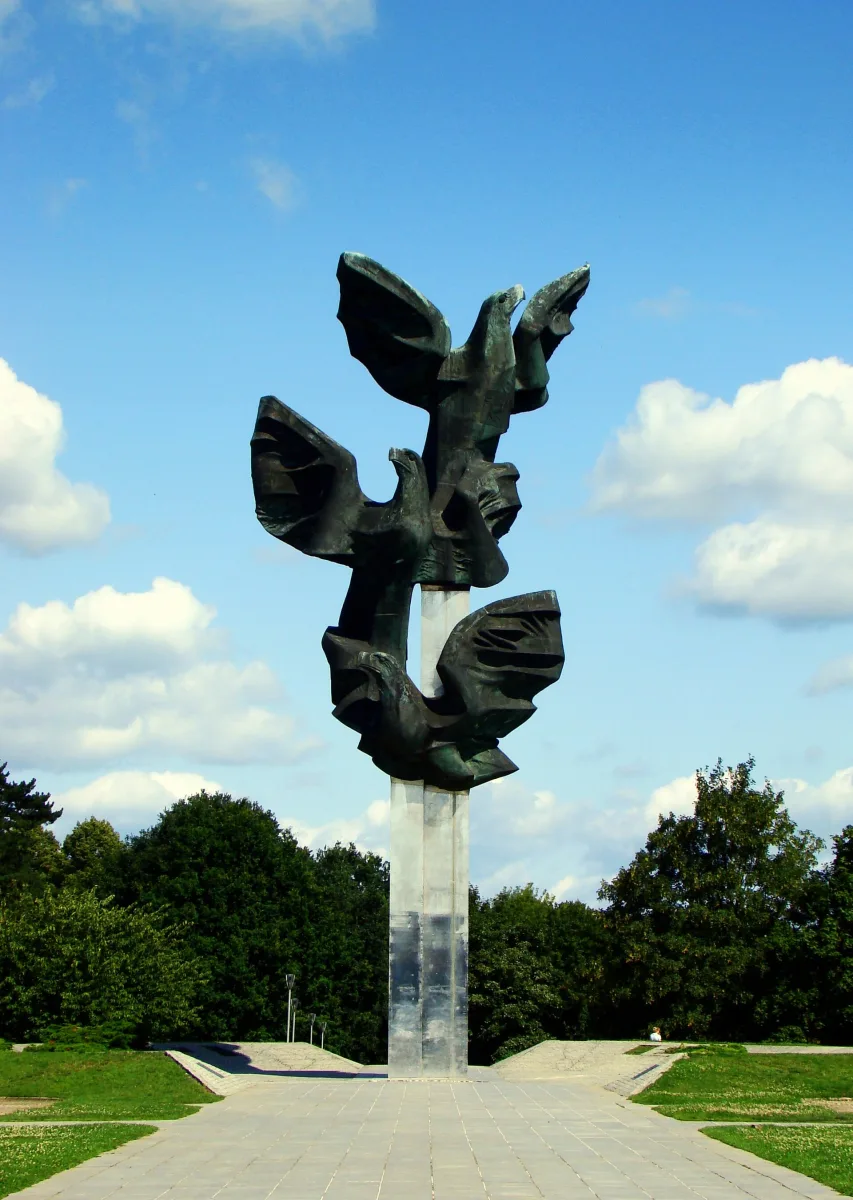
The Monument to the Deed of the Poles, also known as the Monument of the Three Eagles, stands in Kasprowicz Park opposite Jasne Błonia. It was designed by Gustaw Zemła in cooperation with Eugeniusz Kozak and unveiled on 3 September 1979. The decision to build it was taken on 6 September 1972 by the Voivodeship Committee of the Polish United Workers' Party (PZPR) as an expression of thanks for the rebuilding of the city after the war. The name was given in honour of three generations: the Szczecin Polish community from before the war, the pioneers of post-war Szczecin, and the generation that expanded the city, hence the three eagles. The eagles were cast in Warsaw, and the stainless steel column was made by the Szczecin Shipyard. The eagles were transported by barge along the Vistula to Gdańsk, then by sea to Świnoujście and along the Oder to Szczecin. Wikipedia gives the height of the monument as 22.5 m, and in the same entry the total height of the column as 22.75 m.
When John Paul II visited Szczecin on 11 June 1987, he celebrated Mass on the square, which according to Wikipedia was attended by hundreds of thousands of people. A field altar was built next to the Monument to the Deed of the Poles. In 1995 the event was commemorated by naming the square after the pope and erecting his monument, unveiled on 18 June 1995. The author of the design is Czesław Dźwigaj, with the Szczecin architect Stanisław Latour as co-author. The pope is shown as St Peter walking on the waves, against the wind, which refers to the homily about the “wind from the sea”. The monument was not placed where the altar stood, but on the opposite side of the square, near the City Hall building.
A garden at the edge of the park
In the neighbourhood, at the edge of Kasprowicz Park, lies the Rose Garden, restored and opened to the public on 20 April 2007. Together with the square, the park and the monuments, it forms a band of greenery that Szczecin inherited from plans made at the beginning of the 20th century.


Be the first! Add a comment.
You need to log in to add a comment.
Log in