
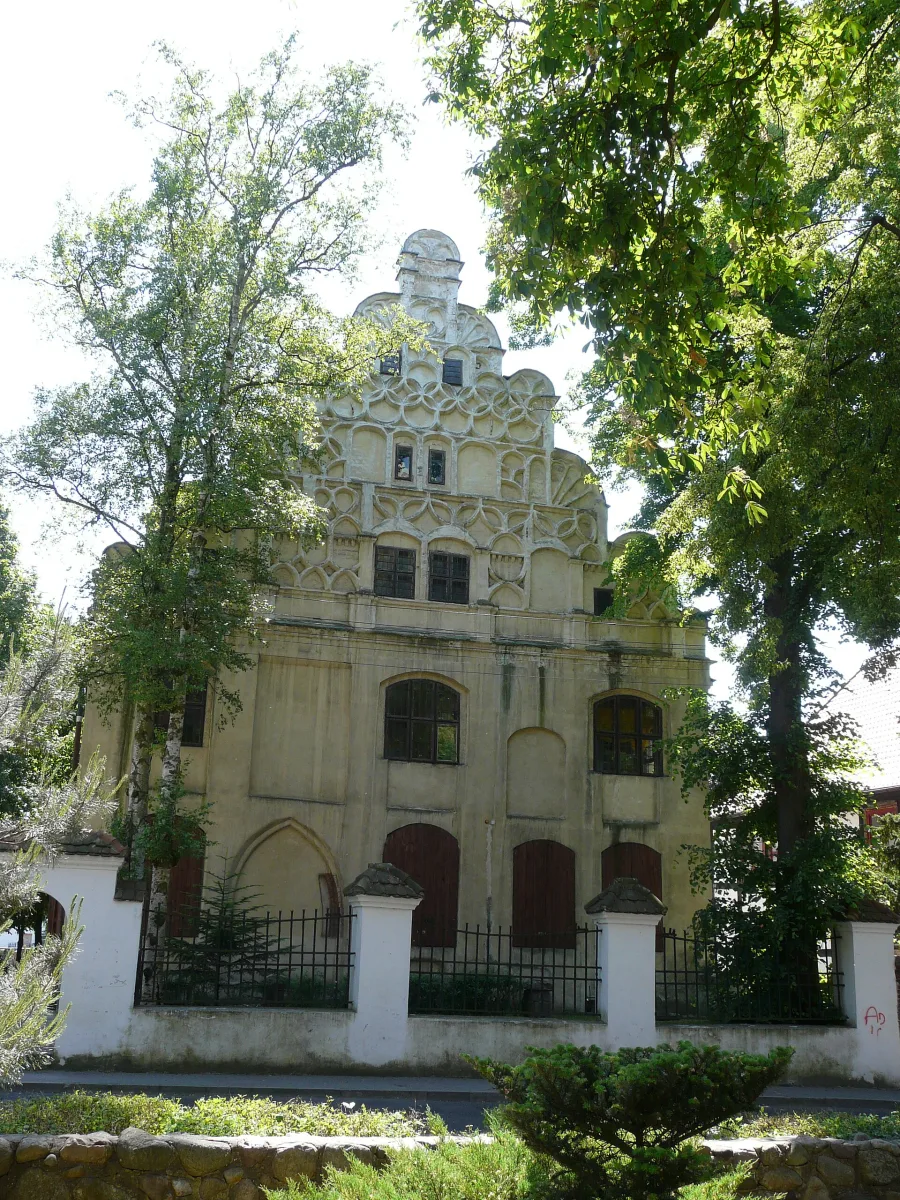
A town between the lagoon and the cathedral
Kamień Pomorski lies on the Kamień Lagoon, in the widening of the Dziwna strait. According to Wikipedia it was granted Lübeck town rights in 1274, and as early as 1175 the seat of the Pomeranian bishopric was moved to it from Wolin. The layout of the medieval foundation was destroyed in 1945, and in the 1960s it was built over with multi-storey blocks. Even so, the whole area of the Old Town was entered in the heritage register, and the cathedral complex was designated a Historic Monument (pomnik historii). The town is therefore explored in pieces: compact groups of historic buildings by Plac Katedralny, the market square with the town hall, the town gate and the park on the hill.
Plac Katedralny begins with the Cathedral of St John the Baptist, the former cathedral of the Kamień bishopric, and next to it stands the Bishop's Palace, a late Gothic manor of the curia rebuilt in 1568. These two buildings mark the axis around which the rest of the route is arranged.
Kleist's House and the bottle of 1745
At Plac Katedralny 4 stands Kleist's House (Dom Kleista), the former residence of the dean of the chapter. Ewald Jürgen von Kleist lived in it in 1722-1747, and he is credited with the first experiment with an electrical capacitor, the so-called Kleist jar. According to Wikipedia it took place in this house on 11 October 1745, and in front of the building stands a boulder with a plaque from 2000, placed on the 300th anniversary of the inventor's birth.
The dating of the building itself differs depending on the source. Wikipedia states that its present appearance dates from 1725, the heritage register speaks of a manor from the end of the 18th century, and the Museum of the History of the Kamień Land describes it as a manor from the second half of the 17th century. The name Kleist's House comes from its most famous resident. Since 2021 a multimedia exhibition, “The Kamień Capacitor”, has been held here, run by the Museum of the History of the Kamień Land.
The museum itself has had its own building since 2015 on Mickiewicza Street, in the so-called Dominican Quarter. According to the museum's website it shows archaeological finds from the Neolithic to the Renaissance, and among the collections it lists the handle of a Viking knife from the 10th century and a gold signet ring of the bishop of Chełmno and Kamień from the turn of the 14th and 15th centuries. The museum also runs a permanent exhibition of sacred objects in the chapter house of the cathedral.
The market square, the gate and the churches
On the Old Market Square stands the town hall, Gothic, arcaded, with a three-arched arcade on the east side. According to Wikipedia it was built in the 13th century, slightly rebuilt in the mid-16th century and destroyed in 1945. After the war it was rebuilt preserving its Gothic form and decoration. The western gable is decorated with tracery similar to the decoration of the gable of the Bishop's Palace. The building is occupied today by the offices of the town council, so it is viewed mainly from the outside.
The Wolin Gate with its tower is, according to the town's infographic, the only surviving part of Kamień's medieval defensive system. Wikipedia, however, also lists fragments of the town walls and the cathedral walls, so this sentence should be understood as describing a complete gate with a tower, not as the only trace of the fortifications. The infographic dates the gate to the 14th century and links it with an initiative of Bishop Friedrich von Eickstedt. The lower, square part of the tower was built in the 14th century, the upper, cylindrical one in the 15th century, and the gate was thoroughly rebuilt in 1691. Wikipedia names the structures separately, as the Wolin Gate (the Wolin Tower) and the Piast Tower, while the town speaks of a single Wolin Tower and Gate.
Since 2001 the tower has housed the private Museum of Stones (Muzeum Kamieni). According to Wikipedia it displays dinosaur fossils, minerals, amber and meteorites, and from the terraces of the tower one can see the town and the Kamień Lagoon. The town infographic gives the height of the terrace as 36 m above sea level and the tower as having six levels.
The Baroque Church of the Assumption of the Blessed Virgin Mary on Mariańska Street stands on the site of the former stronghold of the Griffins. The first mention of the church dates from 1297, and it received its present form around 1755, although some accounts give 1750. The Church of St Nicholas, known as the church on the hill, stands in the town park on Żalnik. The year of its construction is uncertain: the heritage register dates it to the 15th century, and another list gives the entry “before 1335”. The tower is crowned by a helm covered with wooden shingles resembling fish scales.
The spa and the marina
According to Wikipedia, Kamień Pomorski is a spa town, and its treatment is based on brine and peat mud. In 1876 brine springs were accidentally discovered here, and in time peat mud from the surrounding bogs began to be used. The spa uses the Edward III brine borehole, located near the disused “Feniks” natural-treatment establishment, and the peat deposit lies according to Wikipedia about 800 metres south-east of the sanatorium office. There are five spa treatment facilities in the town, among them the “Mieszko” hospital and the “Chrobry” and “Dąbrówka” sanatoria.
From the water side the town presents the Kamień Pomorski marina, a large yacht harbour made up of a seasonal part in the centre and a technical part about 300 metres further on. According to the marina's website it has more than 290 berths, and a fairway 2 nautical miles long links it with Dziwnów. The town hall lies about 200 metres from the marina, the cathedral about 300, so a walk from the quay to the market square and to Plac Katedralny takes a few minutes.
A place of remembrance on Rejtana Street
At the corner of Rejtana and Chrobrego streets there was a Jewish cemetery, founded in the 19th century. In the Nazi period it was destroyed, and in 1968 it was liquidated. According to Wikipedia, on 3 April 2008 a boulder with the inscription “In memory of the pre-war Jewish community in Kamień Pomorski” was unveiled there. The sources do not mention any surviving gravestones.


Be the first! Add a comment.
You need to log in to add a comment.
Log in