
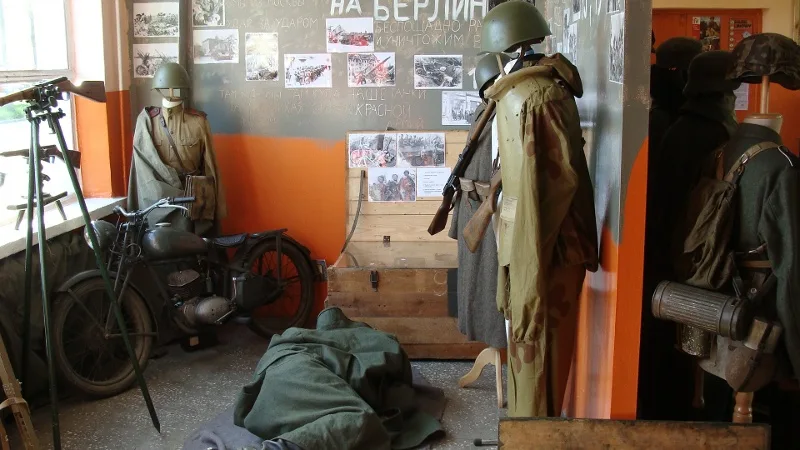
The military museums of West Pomerania are scattered across the whole region: from a bunker near Szczecin, through coastal fortifications, to a shelter from a Soviet base in a forest near Białogard. Some are run by a state museum or a municipality, others by an association or a private individual, and the collections range from the Second World War to the Cold War. Below is a survey of the institutions that collect equipment, weapons and mementoes and tell the military past of the region.
Bunkers and shelters as museum rooms
The Military Technology Museum in Szczecin is being created in the rooms of a bunker in Międzyodrze. It is run by a foundation, and according to its website the displays are created solely through voluntary work, while the adaptation of the bunker continues. The collections concern the army, civil defence, the militia, December 1970, the Solidarity underground and the PRL. The foundation announces opening dates on its website.
In Zalesie near Międzyzdroje, on the island of Wolin, stands the V3 Bunker. It is a private weapons museum in a bunker where V-3 projectiles were stored, on a former German experimental firing range. According to the museum's website the institution has operated since 2004 and is the only display of this German weapon in Poland. The museum's website also states that the V-3 gun was 130 metres long. In the area around the bunker, remains of firing positions have survived.
The deepest look into the Cold War is offered by the Cold War Museum Podborsko 3001, a branch of the Museum of Polish Arms in Kołobrzeg. It is housed in shelter no. 17 in the forests near Podborsko, in Tychowo municipality. According to the museum the shelter was part of a secret Soviet army base, built after the agreement between the USSR and the PRL of February 1967 on three nuclear weapons storage bases in Poland. Site 3001 covered more than 300 hectares, and a garrison of about 150 people served there. The shelters were prepared for 160 warheads, but the museum stresses that today it is not known exactly how many were actually stored. The last warheads were most probably withdrawn in 1988, and the soldiers left in the autumn of 1992. The interior has survived almost untouched, together with a transfer hall with working equipment for moving the carts carrying warheads. It is visited with a guide, and the rules of admission are given by the museum.
Equipment in the open air and in halls
The Air Defence Museum in Koszalin is a branch of the Polish Air Force Museum in Dęblin. It continues the tradition of a museum founded in 1976 at the officer school of the air defence forces, and since 2018 has borne the name of Colonel Stanisław Paszkiewicz. The permanent exhibition shows the development of Polish anti-aircraft weapons, and in the open air stand, among others, a ZU-23-2 gun on a Star 266 lorry, a PRW-9 Zofia radar station, Newa and Dźwina missile systems and a TS-11 Iskra aircraft in naval livery. A government Yak-40 aircraft is also open to visitors. The permanent exhibition also includes a diorama with objects found on the site of the former prisoner-of-war camp Stalag Luft IV in Tychowo.
In Malechowo near Darłowo, the private Tytan Military Vehicles Museum has operated next to Fort Marian since 2012. According to Wikipedia the collections include vehicles from the Second World War and later years, including a T-55AM Merida tank, artillery, command and engineering vehicles, off-road cars and motorcycles. The museum also makes accessible the former German fortifications in Darłówko Zachodnie, built in 1937-1940 for the Kriegsmarine. They served to defend the port and to test ammunition, and were discovered in 2012.
The Museum of Military History in Borne Sulinowo on Towarowa Street collects equipment in a town with a military history: a garrison was built here in the 1930s, from 1945 it was used by the Red Army, and the Soviet troops left in 1992. In photographs from the museum you can see, among others, KrAZ lorries, an American GMC CCKW and a Soviet 2K11 Krug missile system.
Mementoes of the fighting in 1945
Two places tell of the fighting for the Pomeranian Wall and of the crossing of the Oder. The Combat Open-Air Museum of the 1st Polish Army in Zdbice, in Wałcz municipality, was created in connection with a decision of 1980 to establish the Central Memorial Area of the 1st Army. According to Wikipedia part of the plan was carried out and part was never built. Along the slope of Lake Zdbiczno, firing trenches and earth shelters were made, and mortars, guns, tanks and Katyusha launchers were put on display. The article notes that some of the exhibits did not take part in the fighting in this area. A description from 2012 spoke of the poor condition of the open-air museum, so the current state is best checked with Wałcz municipality.
The Museum of Mementoes of the 1st Polish Army in Stare Łysogórki in Gryfino County documents the crossing of the Oder in April 1945. It has operated since 1965 as a unit of Mieszkowice municipality, next to a war cemetery. In 2014-2016 the museum was modernised and the exhumation office of 1945 was recreated in the cellar. The collections include soldiers' uniforms and equipment, documents, decorations, photographs, small arms, rockets and a Katyusha launcher.
The Museum of Military Affairs, Education and the Countryside in Dziedzice in Myślibórz County, a branch of the Regional Museum in Barlinek, has a different character. It is housed in a former school, and its historical part is devoted to the prisoners of Oflag II-C Woldenberg in Dobiegniew: there are camp mementoes, uniforms and militaria. Alongside are an ethnographic section and a reconstruction of a former classroom. The association running the museum also organises ceremonies in memory of the prisoners of the camp.


Be the first! Add a comment.
You need to log in to add a comment.
Log in