
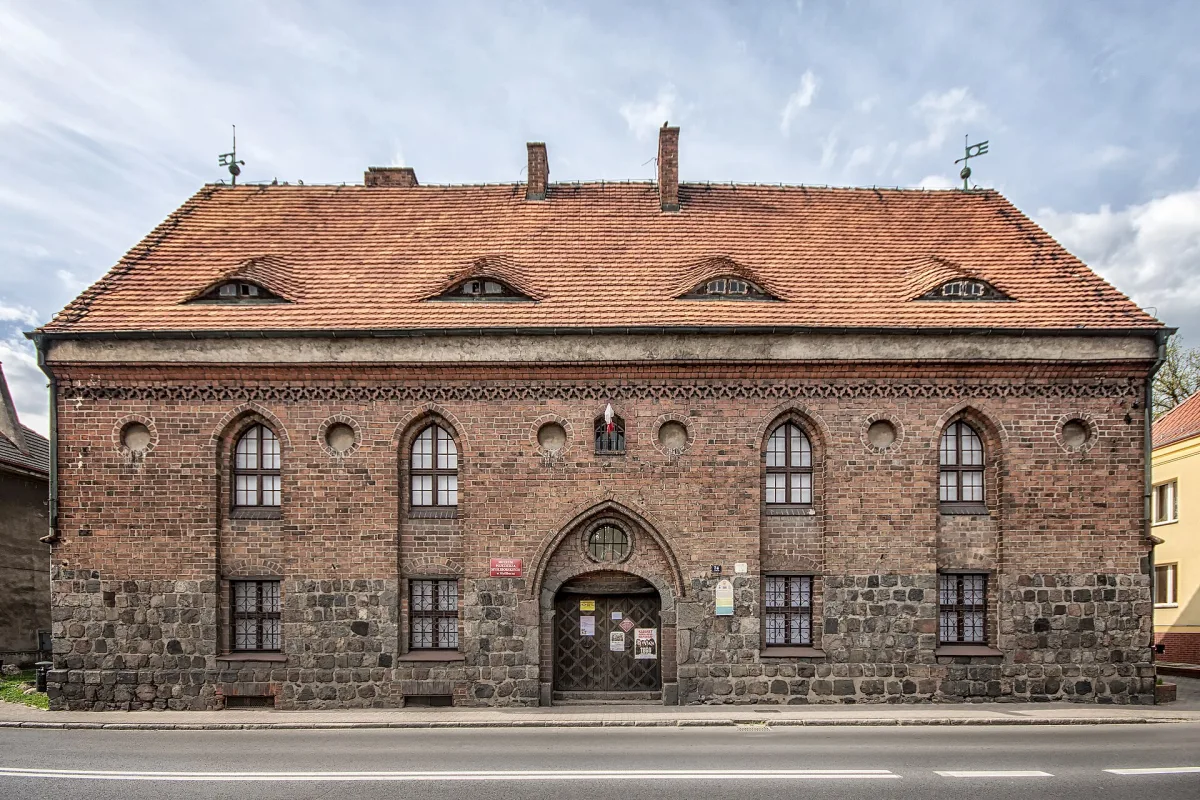
Outside Szczecin and Kołobrzeg, the voivodeship has a dozen or so museums housed in the basement of a cultural centre, in the attic of a former court, in a granary or in a Gothic chapel. They are not large, but each tells the story of one small town and its surroundings. Below is a survey of fourteen such places, arranged by what you will see in them: from archaeology to mementoes of the post-war years.
Archaeology and early strongholds
The Regional Museum in Cedynia is on the ground floor of a mid-19th-century townhouse on Wolności Square and operates within the Cedynia Centre for Culture and Sport. According to Wikipedia it was founded in 1966 as part of the celebrations of the Millennium of the Polish State. The permanent exhibition shows finds from excavations at the Cedynia stronghold, the suburb and the burial ground, and the oldest of them, the remains of a mammoth and a giant deer, date from about 12,000 years BC. Separate displays deal with the Battle of Cedynia and the crossing of the Oder in April 1945.
The Wałcz Land Museum occupies a Neoclassical manor house from the early 19th century on Pocztowa Street, entered in the heritage register. According to Wikipedia it has operated since 1982. The exhibition History of the Wałcz Land runs from prehistory to the post-war years and shows, among other things, grave goods from excavations at Strączno and Tuczno, and exhibits commemorating the breaching of the Pomeranian Wall in 1945. The museum also runs an open-air fortification museum in the former Cegielnia fortified group, with remains of German fortifications from 1932-1935.
The Regional Museum in Wolin stands by the market square, next to the town hall, and tells the story of a town which, according to the museum's website, grew in the early Middle Ages from a settlement on the Dziwna into a large port centre. The permanent exhibition has four rooms: Island, Emporium, Svetovid and Wolin. Among the finds from excavations the museum's website lists a wooden idol from the first half of the 11th century and a gilded bronze horse. The museum opened on 22 July 1966, and since 1993 it has borne the name of the archaeologist Andrzej Kaube.
The history of a town in a few rooms
The Regional Museum in Szczecinek is an example of differing sources: the museum's website gives 1914 as the year of foundation, while Wikipedia traces the museum's beginnings to an archaeological exhibition from 1866. According to Wikipedia, the collection from that exhibition was taken to Berlin. Today the museum is on Szkolna Street, in a brick building from 1879-1880, a former school. Its six displays include a regional room, a nobility room, a garrison room, a hunting room and a room of silverware.
The Myślibórz Lakeland Museum has been housed since 1979 in the Gothic Chapel of the Holy Spirit from the mid-14th century. According to Wikipedia, over the centuries the building was a sheepfold, a brewery, a salt store and a fire station. Four rooms show the history of the town from the early Middle Ages to the post-war years, along with exhibitions of contemporary art.
The Regional Museum in Barlinek is based in Gutenberg House, a former printing works from the mid-19th century. The best-known display is the one about Emanuel Lasker, the world chess champion. The other parts cover archaeology, the history of Barlinek, mainly in the 19th and 20th centuries (with a diorama of the railway station), and the ethnography of the surrounding villages.
The Documentation Centre of the History of the Goleniów Land has operated since 2008 in a small townhouse known as the Yellow House on Pocztowa Street. The exhibition tells the story of the town from before its foundation in 1268 to the resettlement campaign after the Second World War. Here you will see a reconstructed bourgeois parlour from the turn of the 19th and 20th centuries.
Granary, attic and cellars
The Granary Museum in Drawno, also called the Gallery of Mementoes of the Drawa Land, occupies the second floor of a former granary from the second half of the 19th century, in the building of the Tourist Information Centre. According to Wikipedia it was created after regeneration in 2006-2007. Its collections include old photographs, postcards, 19th-century merchants' letters and medieval pottery.
The Karlino Land Museum is on the third floor of the former Royal Court of 1905. The exhibition shows early views of the town, seals and a chronicle written by the pre-war teacher Reinhold Wedig, and from the post-war period the furnishings of a pharmacy from the 1950s and 1960s and mementoes connected with the oil blowout of 1980.
The Regional Museum in Bobolice occupies a floor of the Town and Commune Cultural Centre building. The first museum, the Heimatmuseum, was founded here in 1923, and the present institution has five departments, including militaria and natural history, as well as a separate exhibition of prison art.
The Historical Room in Pełczyce is in the basement of the cultural centre and, according to Wikipedia, was opened in December 2013. It shows archaeological finds from the Lusatian culture period and mementoes from the 19th and 20th centuries: coins, militaria, postcards and farm tools.
The Dobra Land Museum in Dobra also occupies a basement, this time of the library building. The first room covers the history of the town up to the Second World War, with particular attention to the von Dewitz family, owners of the local castle, and the second holds post-war mementoes and items from the resettlement campaign.
The Choszczno Land Museum has been housed since 1998 in a school building on Bolesława Chrobrego Street. According to Wikipedia, the first efforts to create a museum in Choszczno go back to 1925, but after the war the collections were taken to Szczecin and many exhibits were lost. Today the collection includes weapons, pottery, old coins and objects from the burial grounds in Zamęcin and Pomianka.
A museum on a factory site
The Skarb Historical Museum in Police is run by the Society of Friends of the Police Land on the site of the former synthetic petrol plant Hydrierwerke Pölitz AG. The exhibition in two shelters, arranged in 2010, tells the story of the town, the plant and the camps in which prisoners worked on petrol production. Visits are with guides from the society. The place is connected with forced labour, so it calls for quiet and gravity.
Opening hours, admission rules and current exhibitions are given by the institutions themselves, and some of them operate within cultural centres or libraries, so it is worth phoning before a visit.


Be the first! Add a comment.
You need to log in to add a comment.
Log in