
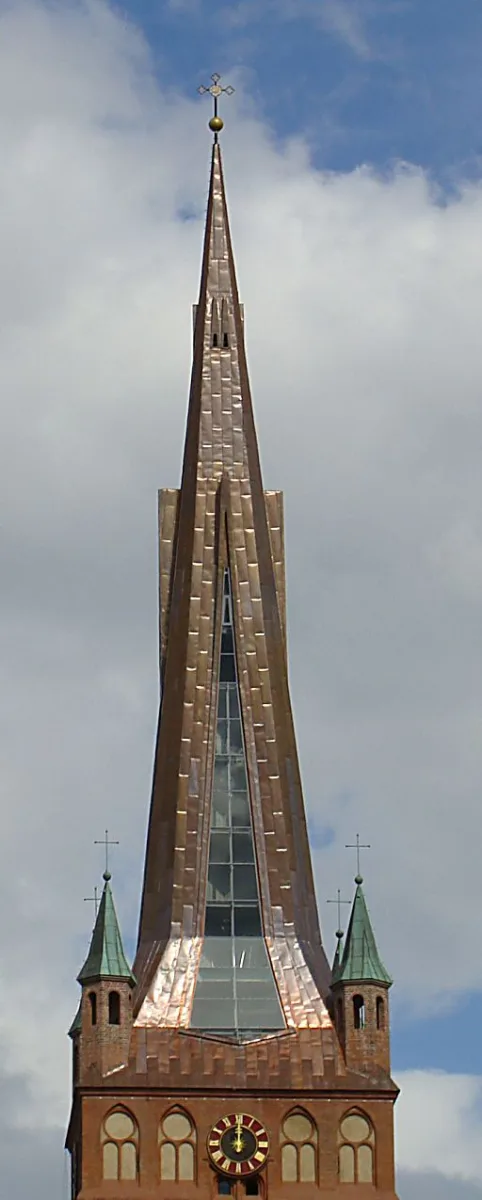
A church from Bamberg on a hill outside the walls
St James' Cathedral Basilica stands in the Old Town. According to Wikipedia the original church was built on a small hill outside the town walls, modelled on the monastery church of the Benedictines of St Michael in Bamberg. The founder is considered to be a wealthy burgher from that city, referred to as Bering, and the Encyclopaedia of West Pomerania calls him Jakob Beringer and writes that he began construction in the early 1180s, with the consent of Duke Bogislaw I.
The date of consecration is not uniform in the sources. Wikipedia gives 25 July 1187, while the Encyclopaedia of West Pomerania speaks of a blessing between March and July 1187, carried out by Bishop Siegfried of Kamień. According to the Encyclopaedia, it is not certain whether the first church was wooden or already of masonry. Patronage over the church was taken by the Benedictine monastery in Bamberg, and in the Middle Ages the church was one of the town's two parish churches, alongside St Mary's Church, which has not existed since 1831.
The present structure is a work of brick Gothic, built in stages. According to Wikipedia, from the second half of the 13th century the twin-towered western massif was raised, work was interrupted around 1320 and resumed roughly half a century later. In 1375 the concept of the chancel was changed from basilican to hall type. Wikipedia writes that the rebuilding of the south wall of the nave, decorated with lesenes, gabled canopies (wimpergs) and glazed moulded bricks, was perhaps directed by Hinrich Brunsberg, a master builder active in Pomerania and Brandenburg. The Encyclopaedia of West Pomerania states outright that he rebuilt this wall in the 15th century. In the spirit of Brunsberg's Pomeranian school of Gothic, according to Wikipedia, the nave of the nearby Church of St Peter and St Paul was built from 1425.
In 1456, for unknown reasons, the south tower collapsed and destroyed the western part of the nave. According to Wikipedia, in the second half of the 15th century the nave was rebuilt as a hall, and in place of the two towers a single, central one was built, under the direction of the master Jan Benecke. The work was completed in 1503 or 1504. In 1534, after the introduction of Lutheranism in the duchy, the church became a Protestant church and remained so until 1945.
The shell of 1677 and the Baroque rebuilding
According to Wikipedia, during the siege of the town by Brandenburg forces, on 16 August 1677, a cannonball started a fire. The church was seriously damaged: the tower, the vaults of the nave and the Gothic furnishings were destroyed, including the altars, pulpit, organ, bells and library. The Encyclopaedia of West Pomerania writes of a Latin inscription from 1693 describing the destruction of the church during the siege, but gives 5 August 1677 as the day of the siege. The exact day therefore cannot be stated unambiguously, while the year agrees.
The bombardment of that year affected not only the cathedral. According to Wikipedia, the Church of St Peter and St Paul also suffered badly, and its rebuilding took 24 years, as did today's Church of St Catherine in Świerczewo, rebuilt in 1696.
The rebuilding of the cathedral began in 1693. According to Wikipedia the interior received Baroque vaults, and in 1711 the main altar designed by Erhard Löffler was made. The Encyclopaedia of West Pomerania adds that the altar was built in 1709-1711, and its polychromy was executed only in 1731-1734. The largest bell, recast by the bell founder Lorentz Köckeritz in 1681, weighs according to this Encyclopaedia 5.7 tonnes. It is the bell known as St James or the Swedish Bell.
The helm of 1894, the bombs of 1944 and the rebuilding
At the end of the 19th century, according to Wikipedia, a general renovation of the church began and in 1894 a slender helm 119 m high was built. During the work, as the Encyclopaedia of West Pomerania states, on 12 February 1894, in a strong gust of a hurricane, the helm of the tower collapsed, destroying the roof and the sanctus bell turret. The tower was rebuilt in the same year, and the Encyclopaedia gives its height as 118 metres, so the two publications differ by a metre.
In 1944, after the bombing, as Wikipedia writes, the roof of the nave and the helm of the tower were completely destroyed, and 75 per cent of the vaults and the interior were burnt out. The Encyclopaedia writes of two night raids by Allied aircraft in the summer of that year, among others on the night of 16 to 17 August. The St James bell was then secured in the north porch of the tower and survived. In 1947-1949 the ruins were secured temporarily and the chancel was covered with a vault.
Consent for the rebuilding was given on 27 April 1971, and by a bull of Paul VI of 28 June 1972 the Szczecin-Kamień diocese was revived. According to Wikipedia the authors of the design were the Szczecin architects Stanisław Latour and Adam Szymski. It assumed rebuilding the church in its historical form, except for the north elevation, which was given a modern form. Because the tower walls had been damaged, the helm was not rebuilt at that time. The chancel was consecrated on 8 October 1972 by Primate Stefan Wyszyński, and the nave was consecrated in 1974: Wikipedia gives 8 November, and the Encyclopaedia of West Pomerania 8 September of that year.
Basilica and archcathedral, the helm of 2008
The rebuilt cathedral was consecrated on 31 May 1982 by Bishop Kazimierz Majdański. Pope John Paul II gave it the title of minor basilica on 23 May 1983, and visited the basilica on 11 June 1987. Since 1972 the church has been the cathedral of the diocese, and since 1992 of the archdiocese, according to Wikipedia and the Encyclopaedia of West Pomerania. The second minor basilica in Szczecin is, according to Wikipedia, the Church of St John the Baptist, which received the title in 2008.
In 2007 the rebuilding of the top of the tower began, to restore its former silhouette. According to both sources, on 12 January 2008 a soaring helm was placed on the tower, in which viewing points were set up. Wikipedia states that after the rebuilding of the helm the archcathedral measures 110.18 m and is the second tallest church in Poland, after the basilica in Licheń, to which it attributes 141.5 m. The tower is therefore lower than in 1894, when the helm was, according to Wikipedia, 119 metres.
The silhouette of the city on the Oder is, according to Wikipedia, formed together by the Chrobry Embankment, the Ducal Castle (the Castle of the Pomeranian Dukes), the museum building and the cathedral itself. According to Wikipedia the remains of the Pomeranian dukes, formerly placed in sarcophagi in the castle crypt, now rest in a stone tomb in the cathedral's Chapel of the Pomeranian Dukes, and the sarcophagi, after wartime damage and conservation, can be seen in the castle museum.
The interior has three historic triptychs: one from Ciećmierz from the end of the 14th century, a Lübeck one from the 1520s, and a triptych made up of several damaged altars with bas-reliefs from around the 15th century in the chancel, among them the Madonna of Mieszkowice. Wikipedia states that the stained glass in six windows was designed by Irena Kisielewska (1983-1990), and in three more by Wiktor Ostrzołek (1990-1991). The organ was blessed on 15 June 2008. According to the Encyclopaedia it has 66 stops and 4743 pipes, and the smallest is 11 millimetres, the largest 10 metres.


Be the first! Add a comment.
You need to log in to add a comment.
Log in