
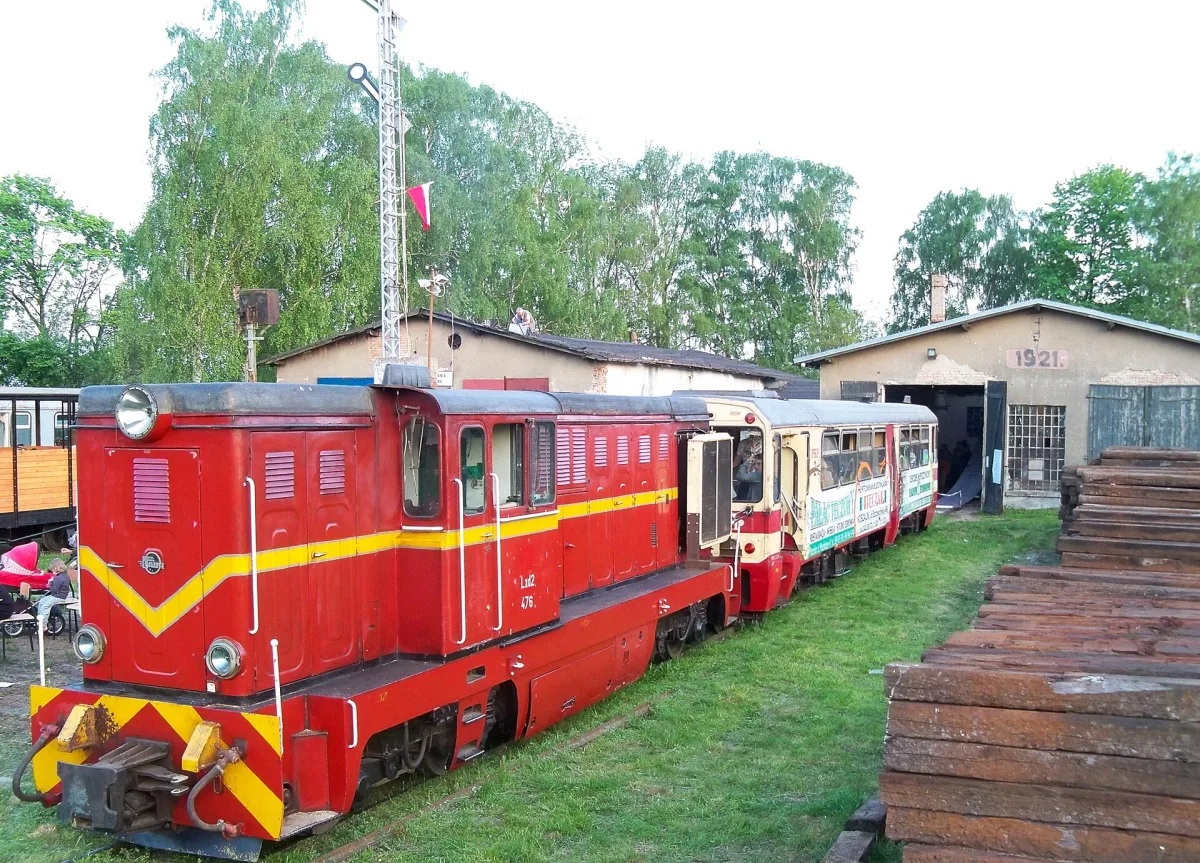
The train that in the season carries tourists between Trzęsacz, Rewal, Niechorze and Pogorzelica has more than a hundred and thirty years of change behind it. It began as a Prussian local railway, in the PKP era it was part of a large network of branch narrow-gauge lines, and before closure it was saved by the municipality. According to Wikipedia it used to be called the Gryfice Branch Railway (German: Greifenberger Kleinbahn), and today it is the Nadmorska Kolej Wąskotorowa (Coastal Narrow-Gauge Railway).
From Gryfice to Niechorze: the beginning in 1896
According to Wikipedia the first, western line from Gryfice to Niechorze was opened on 1 July 1896. Its terminus, Groß Horst, stood in the western part of the village. A year later the narrow-gauge line in Gryfice was connected with the standard-gauge station, and the speed of trains was raised from 20 to 25 km/h.
The network grew quickly. The route to Golczewo was opened in November 1900, and Wikipedia dates the whole line via Łoźnica to the port in Stepnica to 1 December 1903, giving July 1904 as an alternative date. Dargosław and Trzebiatów were connected on 1 November 1907. In 1912 the section from Trzebiatów to Mrzeżyno was opened, serving the developing beach tourism, and on 1 May 1913 Niechorze received a connection with Trzebiatów via Pogorzelica. The Horst Seebad station by the lake was also built then, and according to the article on Niechorze it is still in use. In 1909, as Wikipedia states, the railway had 10 steam locomotives, 20 passenger carriages and 273 goods wagons.
From 750 to 1000 mm
The initial track was narrower. Wikipedia writes that in January 1901 it was decided to build new lines with a gauge of 1000 mm and to regauge the existing sections from 750 mm. During 1901 the routes Gryfice - Niechorze Wielkie and Gryfice - Dargosław were regauged, and trains could run at 30 km/h. It is the metre gauge that makes the Gryfice railway different from the Koszalin Narrow-Gauge Railway, which has a 750 mm track.
Wikipedia states that the railway had a total of 300 km of track and 98 stops, of which 175.6 km survived. The article does not say outright that this was the greatest length of the network in a single year, so it is the sum of all the sections ever built.
After 1945: Px48 locomotives, diesel locomotives and closed lines
After the war the railway installations were handed over to the Polish authorities by the Soviet military administration on 19 August 1945. In August itself the locomotive shed in Gryfice was put into operation and services were resumed on the Gryfice - Niechorze - Trzebiatów route. From the 1960s, however, narrow-gauge railways were being displaced by other means of transport. The first to be closed was the line from Czarnogłowy to Rokita, in 1963 the Trzebiatów - Mrzeżyno section, and by 1969 two more lines.
The rolling stock was nevertheless renewed. From 1971 Polish Px48 locomotives regauged to metre gauge came to Gryfice, and in 1978 Lxd2 diesel locomotives were introduced. In 1990, according to Wikipedia, 126.4 km of line, or 72 per cent, were still in operation. A year later services from Trzebiatów to Dargosław were suspended, and from 1 October 1996 on the further part of this route and on the line from Popiele to Łoźnica.
A single year for the end of scheduled traffic cannot be given here. Wikipedia describes the suspension of successive sections in 1977, 1991 and 1996, and in the infobox it dates the operation of the railway to 1896-1996, listing tourist traffic from 2002 separately. In 1999 the section from Trzebiatów to Pogorzelica was also closed because of the poor condition of the bridge over the Rega.
A steam locomotive for tourists and a saved line
As early as 1992 the first summer tourist trains with a steam locomotive were run on the Gryfice - Niechorze - Trzebiatów route, and from 1994 there was a regular holiday timetable. On 11 May 1995 the Popiele - Gryfice - Trzebiatów railway was entered in the heritage register of the West Pomeranian Voivodeship under number A-1286.
In 2001 PKP decided to close the railway, and its infrastructure was threatened with sale abroad. According to Wikipedia a buyer from Africa was interested. The decision to take it over was made by Rewal municipality, and on 29 May 2002 the railway was reopened as its property. In 2006 the municipality received, free of charge, the right of perpetual usufruct of the land under the line.
Today: Trzęsacz, Rewal, Niechorze, Pogorzelica
After traffic resumed, only the line from Gryfice via Trzęsacz, Rewal, Śliwin and Niechorze to Pogorzelica remained in operation, 39.4 km long. Trzebiatów is no longer on its route. In 2011-2013 the coastal 10-kilometre section from Trzęsacz to Pogorzelica was thoroughly renovated. In 2013 the company Nadmorska Kolej Wąskotorowa was founded, which started services on 1 May 2014, and the first winter runs on 26 December 2014. According to Wikipedia the rolling stock in service is mainly Lxd2 diesel locomotives, and the municipality uses the name Nadmorska Kolej Wąskotorowa Gminy Rewal.
On the coastal section it is worth getting off in a few places. In Trzęsacz you will find the ruins of St Nicholas' Church on the edge of the cliff. In Rewal stands the Church of the Most Holy Saviour with the main part of the triptych from Trzęsacz. The Niechorze Latarnia station is the closest to the Niechorze Lighthouse.
Rolling stock of the former railways can be seen in Gryfice, where the exhibition of Pomeranian narrow-gauge railways operates, a branch of the National Museum in Szczecin. According to the description of the exhibition, it has gathered, among other things, Px48 and Tyn6 steam locomotives and an Lxd2 locomotive, and the tracks of the open-air museum are connected to the tracks of the railway.


Be the first! Add a comment.
You need to log in to add a comment.
Log in