
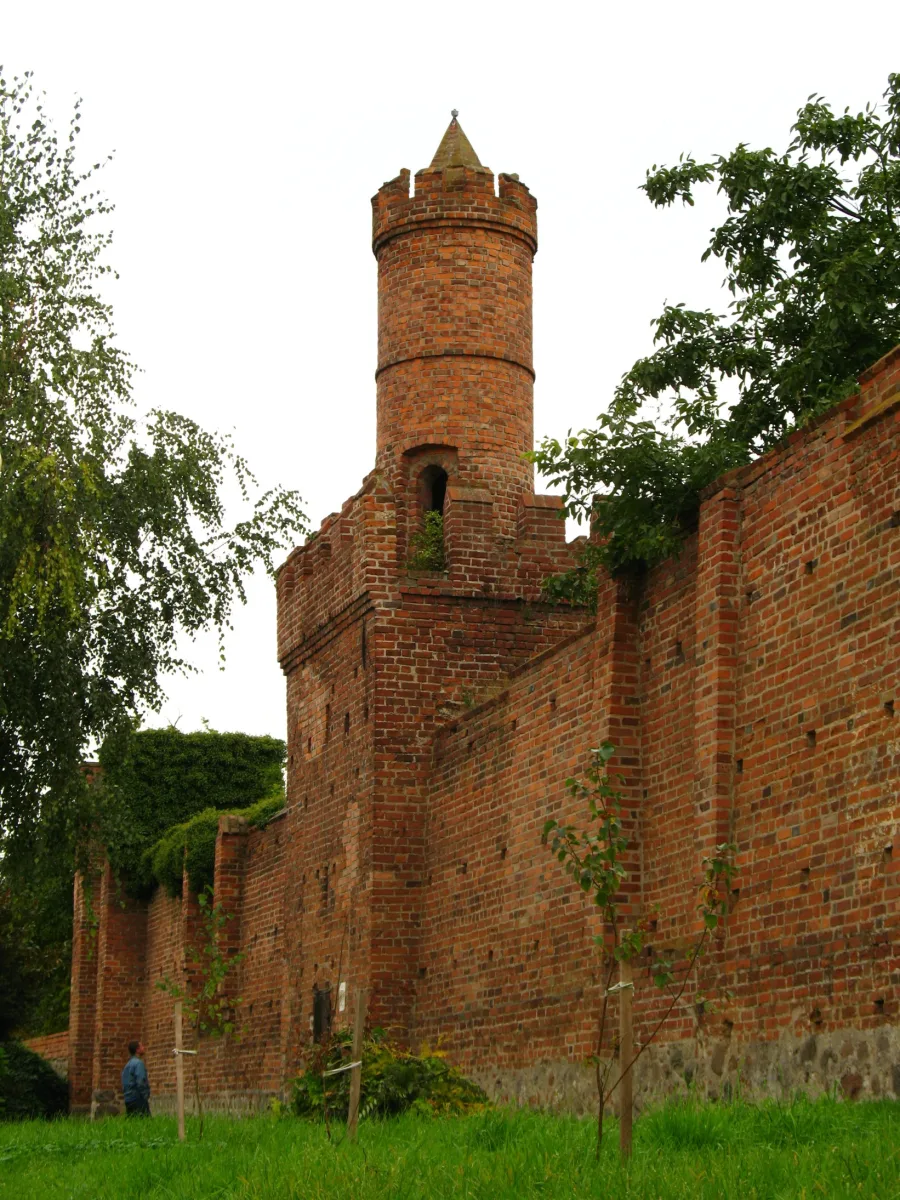
A town behind its walls, called the Rothenburg of Pomerania
Pyrzyce lies about 45 kilometres south-east of the centre of Szczecin, on the agricultural Pyrzyce Plain. According to Wikipedia, the town received its municipal rights in 1263 from Duke Barnim I, and as early as the 13th century it began to build a system of fortifications: walls, a moat and ramparts. Until 1945, because of its well-preserved old town, Pyrzyce was called the Rothenburg of Pomerania, as the same source states.
The walls were tested in battle. Wikipedia says that despite numerous wars the town long remained unconquered, and that the heaviest siege took place in 1478, when Duke Bogislaw X defended himself against the army of Albrecht, Elector of Brandenburg.
How long the walls were and how they changed
The defensive walls date from the second half of the 13th century and, according to Wikipedia, were about 2,000 metres long. In the 15th century they were raised to 7-9 metres, and the gatehouses, towers and watchtowers were extended. The 13th-century ramparts surrounded the town over a length of 2,250 metres and, together with the moat and the mill ponds, formed protection against invasions. After 1650 some of the watchtowers were converted into housing for the poor. In 1830-1845 the ramparts were turned into a promenade, and the moats were partly filled in and used as gardens.
The towers that have survived to this day are the Ice, Monk (ruin), Drunkards', Gunpowder and Owl Towers, together with the Bańska Gate and the Szczecin Gate (ruin). Wikipedia also lists the destroyed and unroofed Sleeping Beauty Tower, also called the Ivy, Half or Arch Tower.
The Ice and Drunkards' Towers
The Ice Tower was built in two stages. The four lower storeys were built in the first half of the 15th century, and the two upper ones, separated by a plastered frieze, in the second half of the 16th century. The tower is cylindrical, 530 centimetres in diameter, topped with crenellation. According to Wikipedia it also served as a prison and as a store for keeping ice, from which it took its name.
The Drunkards' Tower has a different shape: it was built on a rectangular plan at the end of the 15th century on the site of an earlier watchtower. It is covered by a mono-pitched roof, and the walls are decorated with numerous blind windows. In the north elevation there is an oriel that once served as a latrine. Wikipedia calls it a medieval drunk tank that also served as a prison. The Owl Tower grew out of an extended semicircular watchtower, in the 16th century it was topped with a conical helmet, and in the 19th century it served as a viewing tower. The Gunpowder Tower is a former watchtower, rebuilt and raised in the 15th and 16th centuries and later reconstructed. Information boards stand by the Ice, Drunkards' and Owl Towers.
The Bańska and Szczecin Gates
The Bańska Gate was built in 1260-1270 with three storeys, and in 1450 it was raised to five. It was destroyed in 1945 and partly reconstructed after the war. The Szczecin Gate was built in the 14th century and was the main town gate: the road to Szczecin and Stargard ran through it. In the 15th century it had six storeys and a conical helmet. During the Second World War it was destroyed down to the first storey, and after the war no serious conservation work was carried out on it, which is why it is a ruin today.
1945 and reconstruction
In the winter of 1945 the Germans made Pyrzyce a fortress defending the approach to Szczecin. After more than a month of fighting the town was taken on 2 March by units of the Soviet 47th Army, as Wikipedia states. The same article says that 90 per cent of the buildings were destroyed, but there is no source note for this figure, so let us treat it as an estimate. The article adds that a considerable part of the historic monuments survived. After the war the destroyed sections of the walls were conserved and restored, mainly in the northern part. The churches were also rebuilt: the Church of the Assumption of the Blessed Virgin Mary, rebuilt according to Wikipedia in 1958-1964, and the Church of Our Lady of Sorrows, which stands in the oldest part of the town.
The Church of Our Lady of Sorrows is, according to Wikipedia, the oldest church in Pyrzyce, built in the second half of the 13th century as a monastery church. The article on the town calls the monastery an Augustinian monastery for men, whereas the description of this church speaks of Augustinian nuns, so the sources do not agree on this detail. The Chapel of the Holy Spirit dates from the early 15th century; it was destroyed in 1945 and rebuilt in 1967-1969. In August 2013 the Museum of the Pyrzyce Land opened in it.
The Well of St Otto
On a walk around the town you can also look in at the little well of St Otto on Warszawska Street, built on the spot from which Bishop Otto of Bamberg drew water during the baptism of the people of Pyrzyce in 1124. In 1824 it was enclosed with granite blocks to a design by Karl Friedrich Schinkel.


Be the first! Add a comment.
You need to log in to add a comment.
Log in