
According to the City Office, which Wikipedia cites, the urban municipality of Świnoujście comprises 44 islands and islets, of which only three are inhabited: Uznam, Wolin and Karsibór. Wikipedia adds that about 80 per cent of the inhabitants live on Uznam, where the service centre, the resort and the spa are located. On Wolin, by contrast, are the port, the ferry terminal and the industrial area. They are separated by the Świna, and for decades the only Polish way of crossing it was by water.
Ferries: two crossings instead of a bridge
Before 2023, as Wikipedia describes, two ferry crossings provided the link across the Świna. The Świnoujście Centrum crossing was served by ferries of the Karsibór type, and the Świnoujście Warszów crossing by four newer ferries of the Bielik type. According to Wikipedia the Karsibór ferries were built in 1977-1978 at the Adolf Warski Shipyard in Szczecin and can carry up to 65 cars. Bielik I, II, III and IV are, according to the same source, vessels for about 33 cars and up to 700 passengers, and their operator is Żegluga Świnoujska.
Wikipedia, referring to municipal studies, states that the crossing of the Świna, including waiting to board the ferry, took on average 40 minutes, and in the summer season up to three hours. It describes the ferries as an attraction, but also as unreliable and susceptible to the weather.
The first tunnel design: the 1930s
Queues for the ferries are not an invention of our times. Wikipedia writes that even before the Second World War long rows of cars formed at the crossing in Świnoujście, and in 1936 the Świna was crossed by three crossings: a street ferry (Kehrwieder and Ostswine), the car ferry Pommern and a railway ferry. In the tax year 1932/33 the ferries carried, according to this source, about 600 thousand people and 25 thousand cars.
A bridge was rejected because it would have obstructed shipping on the way to Szczecin, and the Kriegsmarine also lodged an objection. That left a tunnel. In 1935 the German port construction authority presented, according to Wikipedia, a design for a tunnel north of the Warszów crossing: about 1220 metres for the tunnel itself and 2100 metres together with the ramps. The firm Grün & Bilfinger of Mannheim was recommended as contractor in November 1938, and a tender of August 1939 selected the contractor. A few months after the outbreak of the war the work was stopped.
Decades of plans after the war
According to Wikipedia, after the war the city considered both a tunnel and a high-clearance or movable bridge. At the beginning of the 1960s, in the Fisherman's House, scientists presented a tunnel design, and in the 1970s the Council of Ministers took a decision on preparations for a permanent link. In 1996 the Social Committee for the Construction of a Tunnel under the Świna River was formed. A tender announced in 1998 was cancelled for lack of secured financing.
When the bridge variants were compared, the arguments against bridges were, as Wikipedia reports following municipal studies, among others: the movable bridge being unavailable to cars for on average more than five hours a day, the possibility of blocking access to the port in Szczecin, the required clearance of up to about 80 metres for large structures, and the negative opinion of the military and of the Maritime Office. An agreement on funding from European Union resources was signed on 28 April 2017.
Construction: the machine from Wuhan
The investment was carried out under the design-and-build system. The voivode issued the permit for the investment on 7 October 2019, and the construction site was handed over three days later. First, sappers checked the site for unexploded ordnance from the war, which is often found in the vicinity of Świnoujście. Then the launch chamber was built on the Uznam side.
The main section was bored by a slurry-type tunnel boring machine (TBM), manufactured according to Wikipedia in Wuhan in China. Because of the pandemic the engineers could not travel there, so the machine was accepted remotely, which was the first such case in Poland. In June 2020 it was dismantled into 129 parts and sent by ship. It reached Świnoujście on 7 October 2020. Assembled, it was 105 metres long, 13.46 metres in diameter and weighed 2740 tonnes. It was given the name Wyspiarka. Boring began on 5 March 2021 and ended on 19 September 2021.
The voivode issued the occupancy permit on 27 June 2023, the acceptance commission confirmed readiness on 29 June, and the tunnel was opened on 30 June 2023.
How long the tunnel is and what else sails
Wikipedia gives the total length of the tunnel as 1.780 km: 1.484 km was made with the boring shield and 0.295 km by the cut-and-cover method; together these two sections come to about 1.78 km. The internal diameter is 12 metres, the carriageway is two-way with lanes of 3.5 metres, and beneath the carriageway runs an evacuation gallery. The deepest point beneath the bed of the Świna lies about 38 metres below sea level. The access roads are, according to the same source, 3.4 km long. The tunnel is part of national road no. 93 and it is not permitted to walk or cycle through it, so for pedestrians and cyclists, according to Wikipedia, the Bielik ferry services were to be retained.
Wikipedia calls the tunnel the largest investment in the city since the Second World War and writes that it made access easier for tourists, who previously avoided Świnoujście because of the queues.
Karsibór and the only bridge over the Stara Świna
The third inhabited island, Karsibór, has its own history of crossings. According to Wikipedia, from the construction of the Piast Canal (1874-1880) until 1966 the only link between the island and the world was a ferry. Then the first Piast Bridge was built, handed over for the millennium of the Polish state. It was 380.5 metres long and had a single carriageway 4.25 metres wide, so traffic was controlled by traffic lights.
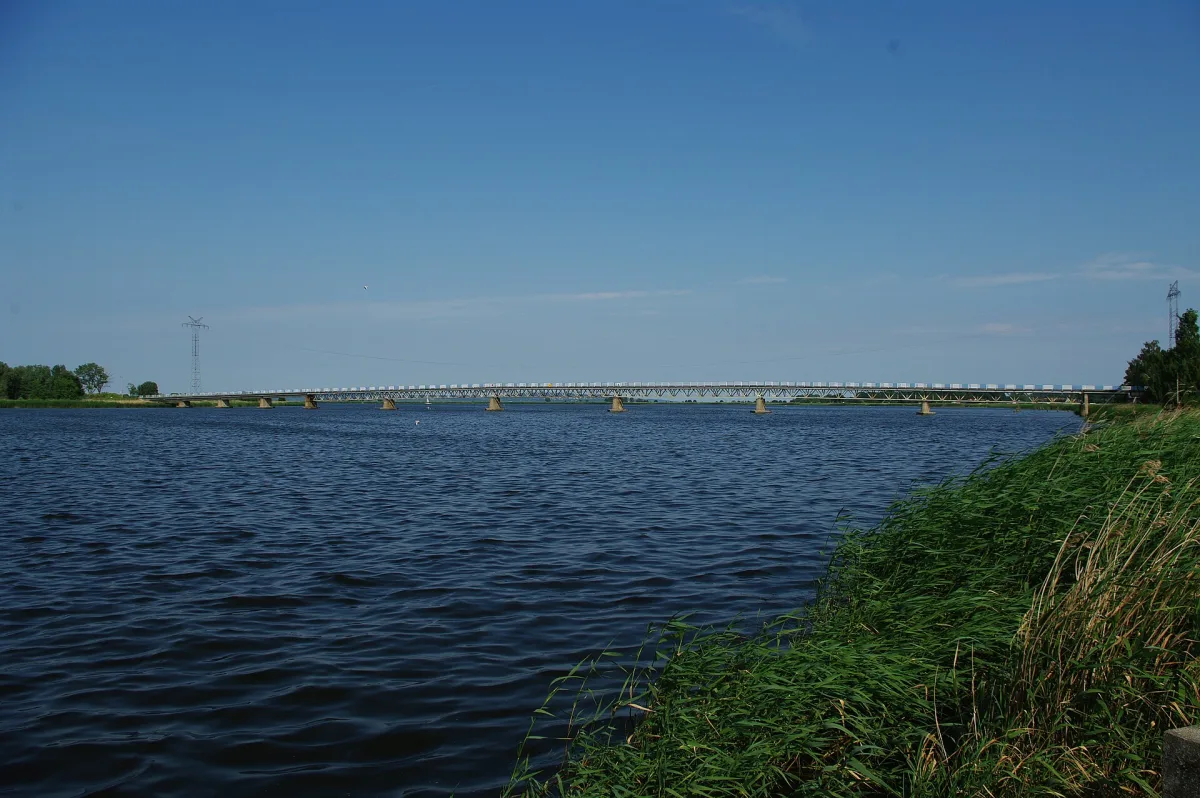
The new bridge was opened on 6 December 2012. Wikipedia gives its dimensions as 407 metres in length, 9.3 metres in width and 6.3 metres in height, with two traffic lanes and a pavement, and a load capacity of 50 tonnes instead of the 15 tonnes of the old bridge, which towards the end of its existence fell even to 10 tonnes. It is the only bridge spanning the Stara Świna and the only permanent link between Karsibór and Wolin island.


Be the first! Add a comment.
You need to log in to add a comment.
Log in