
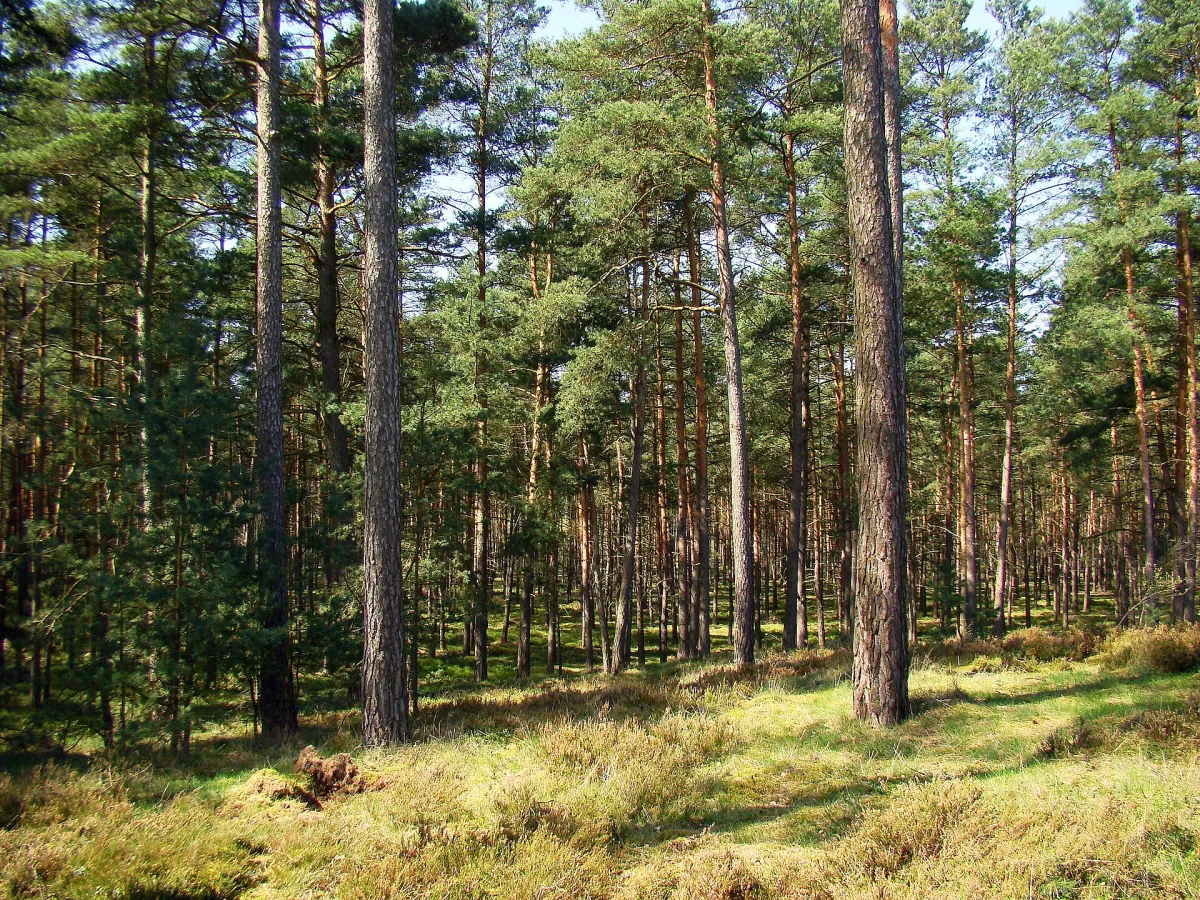
A forest on two sides of the border
The Wkrzańska Forest (in German Ueckermünder Heide) stretches along the Szczecin Lagoon on both sides of the state border. According to Wikipedia the whole covers about 1,550 square kilometres, of which 337 square kilometres, or 22 per cent, lie in Poland: in Police County and partly within the boundaries of Szczecin. It is bounded on the north by the Lagoon and on the east by the Oder. It owes its name to the Wkra River (German: Uecker), which flows on the German side.
In the Polish part, pine and pine-beech woods predominate. There are few lakes and rivers here, and among the lakes Wikipedia lists Piaski, Karpino, Głębokie, Piaszynko and Bartoszewo. Old-growth stands by bodies of water are, according to Wikipedia, a habitat of the white-tailed eagle. Within Szczecin the forest forms forest parks: Arkoński, Głębokie and Mścięcino. On the German side, part of it belongs to the Am Stettiner Haff nature park.
The forest can be seen on Lubinus's (Eilert Lübben's) Great Map of the Duchy of Pomerania from 1610-1618, and until 1945 or 1946 a railway line linking Gumieńce with Nowe Warpno ran through its middle. Wikipedia writes that only a short, disused section from Szczecin to Dołuje has survived, and the remains of the track are less and less visible. In 2004 the forest became part of the “Szczecin Forests” Promotional Forest Complex.
The Świdwie reserve, or marshes for birds
The most valuable place in the Polish part of the forest, in terms of nature, is the Świdwie reserve at its southern end. It is a faunal reserve with an area of 904.04 ha, established on 14 January 1963. It takes in the overgrowing Lake Świdwie and the wetlands around it: marshes, fens and reed beds. Wikipedia calls it a reserve of waterfowl and wading birds that is unique on a European scale. Since 3 January 1984 it has been on the list of the Ramsar Convention, and as a Natura 2000 bird site (code PLB320006, according to Wikipedia 7,196.241 ha) it borders the Szczecin Lagoon area on the north.
The lake itself is small: according to Wikipedia it covers about 45 ha and is on average 0.7 m deep, and the Gunica River flows through its waters. The rest of the reserve is taken up by wetlands. The Trzebież Forest District states that about 59 per cent of the reserve is marsh, 20 per cent farmland, 18 per cent forest and 8 per cent water. Of the 904.04 ha, 253.81 ha lies on forest district land, in the Zalesie forest division.
Protection covers, among others, cranes, golden orioles, marsh and Montagu's harriers, grasshopper warblers, corncrakes and geese: bean, greylag and white-fronted. The numbers of species depend on the source. Wikipedia gives over 160 bird species in the breeding season, the article on the lake itself about 150, and the Trzebież Forest District 218 species of avifauna in the reserve, including the water rail, the reed bunting and the black tern. Wikipedia adds that the reserve is a feeding ground and resting place for tens of thousands of birds flying between northern Scandinavia and the Mediterranean, and that within its boundaries lies the hunting territory of the white-tailed eagle. Among the plants growing here are the yellow water-lily, frogbit, water soldier and the rare white water-lily.
The ornithological station and the tower on the Gunica
According to Wikipedia, two ornithological stations operate around the reserve: in Bolkowo and on the Gunica River. The station of the Polish Zoological Society was founded in 1974 and, as Wikipedia writes, studies and rings about 5 thousand birds a year. In Bolkowo there is also an Educational and Museum Centre, and at the mouth of the Gunica into the lake stands a lookout tower. According to Wikipedia, relics of a hunter-gatherer society from the early Holocene and a presumed shamanic sanctuary from the Mesolithic were discovered by the lake in Bolkowo.
According to Wikipedia the reserve is visited by more than 20 thousand people a year, mainly from Poland, but also from Germany and Scandinavia. Because this is a bird protection area, it is wise to keep to the trails and to check the rules for moving around with the manager, that is the Trzebież Forest District.
Trails through the forest
Świdwie is a trail junction. Here meet the cycle Wkrzańska Forest Trail, the cycle Trail of Parks and Natural Monuments, and the walking Wkrzańska Forest Trail named after Stefan “Tata” Kaczmarek. This red trail is about 44 km long (the description in Wikipedia speaks of 45.5 km) and leads from Szczecin-Głębokie through Bartoszewo, Tanowo, Węgornik and the area of Lake Świdwie to Trzebież on the Lagoon.
Shorter routes are the yellow Police Trail from Police through Trzeszczyn and Stare Leśno to Bartoszewo, and the green trail through Arkonka Forest and the Warszewo Hills, which passes through the southern part of the forest and via Przęsocin reaches Skolwin. Wikipedia also lists cycle routes in the forest, including the international route around the Szczecin Lagoon R-66 and the Oder - Neisse route.
Wikipedia calls the forest an important place for weekend recreation for residents of the Szczecin agglomeration. On the way one can look in at the Baroque palace in Stolec, a village lying, according to Wikipedia, in the vicinity of the forest, or end the trip in Trzebież, at the Baroque Church of the Exaltation of the Holy Cross from 1745, standing on the foundations of an older church.


Be the first! Add a comment.
You need to log in to add a comment.
Log in