
East of Szczecin the town halls have very different life stories. The Kołobrzeg building was designed by Karl Friedrich Schinkel, in Darłowo the former market halls house the authorities, and Koszalin's seat of government was built only after the Second World War. Further on, in the Drawsko Lakeland and around Białogard, the town halls are more modest, but usually still serve their original role. Below is an overview of twelve buildings, from the coast inland.
The coast: Kołobrzeg, Koszalin, Darłowo, Trzebiatów
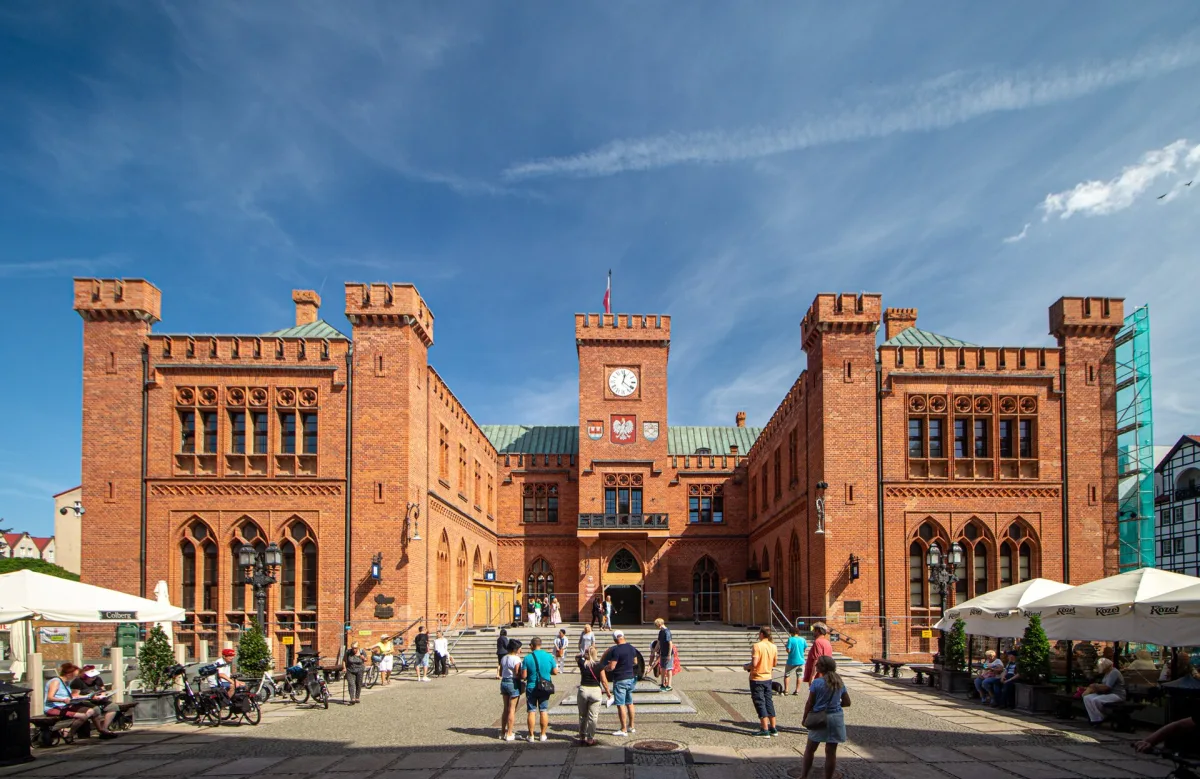
The town hall in Kołobrzeg is a Neo-Gothic building of light red brick, designed by Karl Friedrich Schinkel. Construction began in 1829 on the site of the medieval town hall, which suffered during the French siege of the town in 1807. The building has battlements, corner turrets and a clock tower, so from a distance it resembles a small castle. According to the National Heritage Board of Poland the work was completed in 1831, while the heritage register and Wikipedia give the range 1829-1832. One corner and the cellars of the old town hall were preserved, and a café is housed in them today. In April 1945 the building was among the few in the town that survived the fighting undamaged. Today it houses, among other things, a contemporary art gallery and a tourist information office.
The town hall in Koszalin is a completely different case. According to Wikipedia it is the sixth town hall in the town's history. The first was probably built around 1308 and burned down in 1504, later ones were destroyed by fires, and the last of the old buildings was demolished by artillery fire in March 1945. The present modernist brick building was built in 1958-1962 to a design by Władysław and Maria Michałowski. Since 2017 it has been entered in the heritage register.
The town hall in Darłowo is housed in former market halls, which were raised by one storey in 1725. The previous town hall burned down in 1722, and the stone Renaissance portal above the main entrance comes from it. The heritage register describes the style of the building as Neoclassical, Wikipedia as Baroque. In front of the town hall stands a fountain from 1919 with a figure of a fisherman.
The town hall in Trzebiatów dates from 1701 and stands in the middle of the market square. It was built after the fire of 1696, which destroyed the Gothic council house. The Gothic arcades of the older building were exposed in the façade of the west wing, and in the east wing stands a tower with a Baroque cupola and a clock. The building has a quadrangular plan with a courtyard. Wikipedia calls it Neoclassical, the heritage register speaks of a brick building from 1701.
Around Sławno and Białogard
The town hall in Sławno was originally the seat of the county administration. It was built in 1905-1907 to a design by Eduard Koch of Słupsk. The Neo-Baroque building on an L-shaped plan has a mansard roof and an octagonal tower with an onion dome. According to Wikipedia it survived the Second World War with its original interior fittings: doors, ironwork and tiles. In the council chamber, stained-glass windows show the coats of arms of Sławno, Darłowo, Polanów and Sianów. Since 2003 a gallery has operated here, mainly showing graphic art.
Białogard has two town halls side by side. The Old Town Hall is a Neoclassical merchant's house from 1827 with a timber clock tower added in 1847. Until 1924 the town authorities sat in it, and after renovation it has housed, since 2004, a museum and the Wedding Palace. The New Town Hall is a brick building in the style known as German Renaissance. According to the register of monuments the work began in 1923 and the building was handed over in May 1924, but a local grammar school headmaster gave the year 1926. From the start it aroused controversy: the architect Hans Reichow and the politician Karl Passarge held that it disturbed the layout of the market square and hid the medieval church.
The town hall in Maszewo was built in 1821-1827 as an in-block building in the middle of the market square, next to the church. It received its present form in 1920, when an attic storey was added. In the cellars, a memorial room with exhibits on the town's past has operated since 2017, and there are also rooms of the former treasury with heavy steel doors. The rules for visiting are set by the municipality. The town hall in Resko is a Neoclassical brick building from 1830-1841, with a small turret with a clock and a carillon. It is one of the few monuments of the small town that survived considerable wartime destruction.
The Lakeland: Wałcz, Czaplinek, Drawsko Pomorskie
The town hall in Wałcz from 1890 stands in a corner of the market square, that is Freedom Square (plac Wolności). It is a brick building with a rusticated ground floor and a corner oriel on the first floor, above which rises a Neo-Baroque turret with a gloriette. The heritage register classes the style as Neo-Renaissance, Wikipedia as eclectic. The building is the seat of the town authorities.
The town hall in Czaplinek was built in 1845. It is a two-storey brick building with high cellars, roofed with red tiles, with the town's coat of arms above the entrance. It houses the town and municipal office, so it is viewed mainly from the outside, from the market square, and a short walk separates it from the lake.
The town hall in Drawsko Pomorskie was built in 1907-1909. The brick building under a mansard roof has a three-bay projection with a triangular pediment on which a griffin is placed. The style is described in different ways: Wikipedia writes of eclecticism, the heritage register of a Neo-Baroque style. Today the building is occupied by the county administration.
Such a route shows well how the town halls of West Pomerania have changed: from 18th-century buildings rebuilt after fires, through the neo-styles of the 19th and early 20th centuries, to the modernism of the 1960s. The vast majority of them still serve the town authorities, so one looks inside mainly during office hours or in the parts made available as galleries or museums. Details are given by the institutions housed in the individual buildings.


Be the first! Add a comment.
You need to log in to add a comment.
Log in