
In the western part of West Pomerania stand town halls from several periods: Gothic brick ones, half-timbered, Neoclassical and Neo-Gothic. Many of them have survived to this day as seats of the town authorities, others have been turned into museums, libraries and culture centres. The dates they were built are not always clear-cut, because the sources can give different centuries, as we note for specific buildings. The interiors of working offices serve residents, so they are easiest to view from the market square.
Szczecin: three buildings, three periods
The oldest is the Old Town Hall on Hay Market (Rynek Sienny). According to Wikipedia it was built in the 15th century on the site of a timber building from the mid-13th century. In 1570 it hosted the peace congress that ended the war between Sweden and Denmark. It served as the town hall until 1879, and then again in 1937-1938, until wartime destruction. It was rebuilt in 1972-1975 and today houses the Museum of the History of Szczecin, a branch of the National Museum. In the cellars and two rooms upstairs the Gothic star vaults have survived.
When the city grew in the 19th century, the authorities built a new building. The Red Town Hall on Batory Square was built, according to Wikipedia, in 1875-1879: the foundation stone was laid on 2 November 1875, and the work was completed on 10 January 1879. The Neo-Gothic design was by Konrad Kruhl. Towards the end of the Second World War the building burned down, and it was rebuilt in the 1960s. Today it is home to, among others, the Maritime Office and the Inland Navigation Office.
The third building is easily confused with the previous one. The former New Town Hall on Rybacka Street was built, according to the heritage register, in 1900-1902 as the seat of the city administration. The Neo-Renaissance design was by Wilhelm Meyer-Schwartau. Since 1948 the building has belonged to the medical university and today houses the rector's office of the Pomeranian Medical University.
Brick Gothic: Stargard, Chojna, Kamień Pomorski
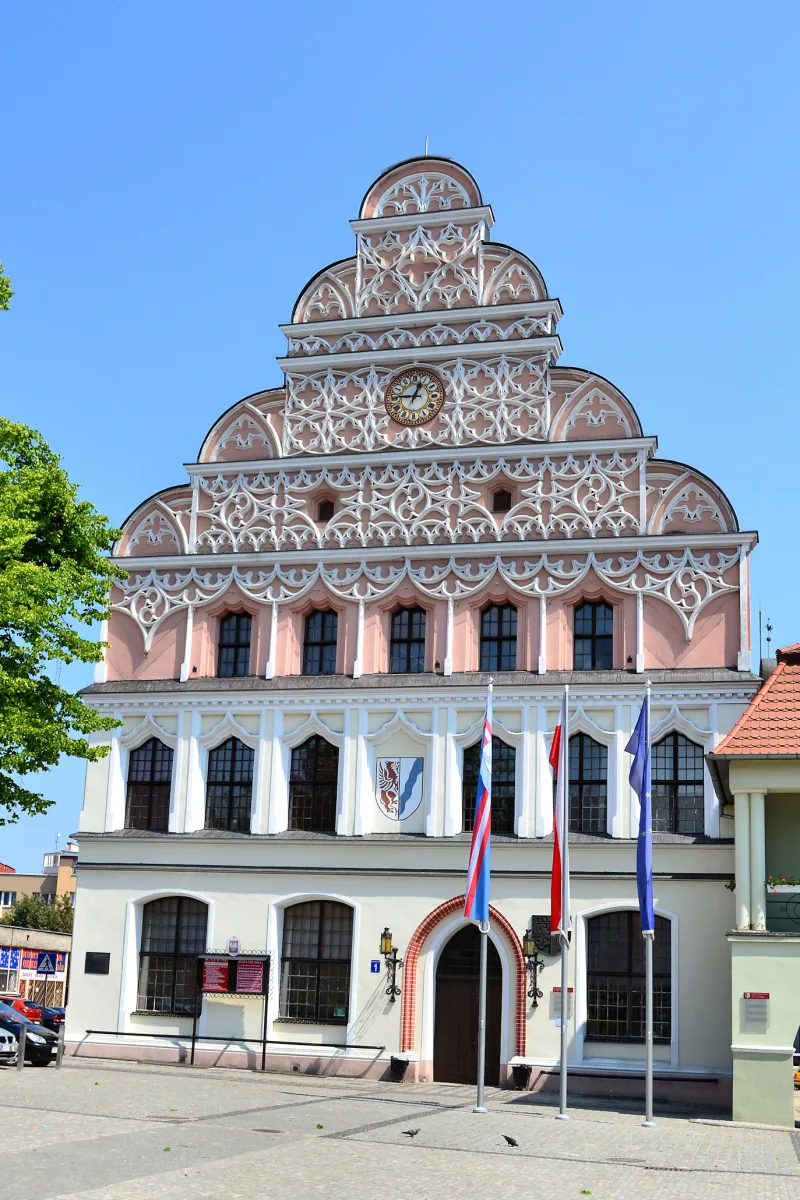
The town hall in Stargard stands on the Old Town Market Square (Rynek Staromiejski) and to this day is the seat of the City Council. According to Wikipedia the first building on this site was a masonry hall known as the Merchants' House, from 1250-1280, and at the end of the 14th century it was rebuilt as a town hall. After the fire of 1540 the reconstruction lasted 29 years, and after 1945 the building was rebuilt on the basis of drawings and photographs. On the front gable hangs a clock installed in June 2000.
In Chojna the dates when construction began are not the same in each account. The town hall, according to Wikipedia, was built in the second quarter of the 14th century, although in the same entry we read that construction began in the third quarter of the 13th century and that the first building burned down in 1316. The heritage register dates the building generally to the 15th century. Between 1433 and 1461 the town hall was extended and closed off with a new façade. In 1945 it was seriously damaged, and reconstruction lasted from 1977 to 1985. Since 1986 it has housed the municipal library and a culture centre.
A similar discrepancy concerns Kamień Pomorski. According to Wikipedia the town hall there was built in the 13th century, and in the mid-16th century it was given Renaissance features, although in the infobox of the same entry the 14th century appears. It is an arcaded town hall with a three-arch arcade on the east side, rebuilt after the destruction of 1945. Today it houses the offices of the town authority.
Half-timbered construction and Neoclassicism
Of quite a different character is the town hall in Nowe Warpno. According to Wikipedia it is a half-timbered building, built in 1697 after the great fire of the town in 1692, with a square clock tower on the west. It has been the seat of the town authorities from the start.
In Myślibórz the town hall is a Neoclassical building from 1771-1772, with a rusticated central projection and a triangular tympanum. The mayor and the town council sit in it. In Lipiany the town hall dates, according to Wikipedia, probably from the second half of the 18th century, but the entry there also allows for the early 19th century. It burned down in 1827, and the turret with a clock was added in 1844. In front of the building stand the Brewers' Fountain and the Peace Oak planted in 1816.
The youngest of the Neoclassical ones is the town hall in Cedynia: according to the heritage register a brick building from 1840 on Freedom Square (Plac Wolności). Nearby stand the Cistercian nuns' convent and the Church of the Nativity of the Blessed Virgin Mary.
Gothic roots and 20th-century town halls
The town hall in Trzcińsko-Zdrój has a Gothic portal, a tracery gable and a former courtroom with Renaissance polychromy from the 16th century. The heritage register gives the second half of the 13th century as the time of origin, while Wikipedia writes of a rebuilding of the Merchants' House in the 14th century and a joining of the two parts of the building at the turn of the 15th and 16th centuries.
At the end of the list stand buildings that became town halls later. The town hall in Pełczyce on Amber Square (Rynek Bursztynowy) was built in the 1920s, and the heritage register gives the year 1920. Its architecture alludes to the town's former half-timbered buildings. In Dębno the town authorities sit in a manufacturer's villa, built in 1905 by Kurt Neumann, the son of a printing-house owner. According to zabytek.pl, after 1945 the villa was taken over by the authorities of Chojna County, and after the county was abolished in 1975 the town and municipal authorities moved into it.


Be the first! Add a comment.
You need to log in to add a comment.
Log in