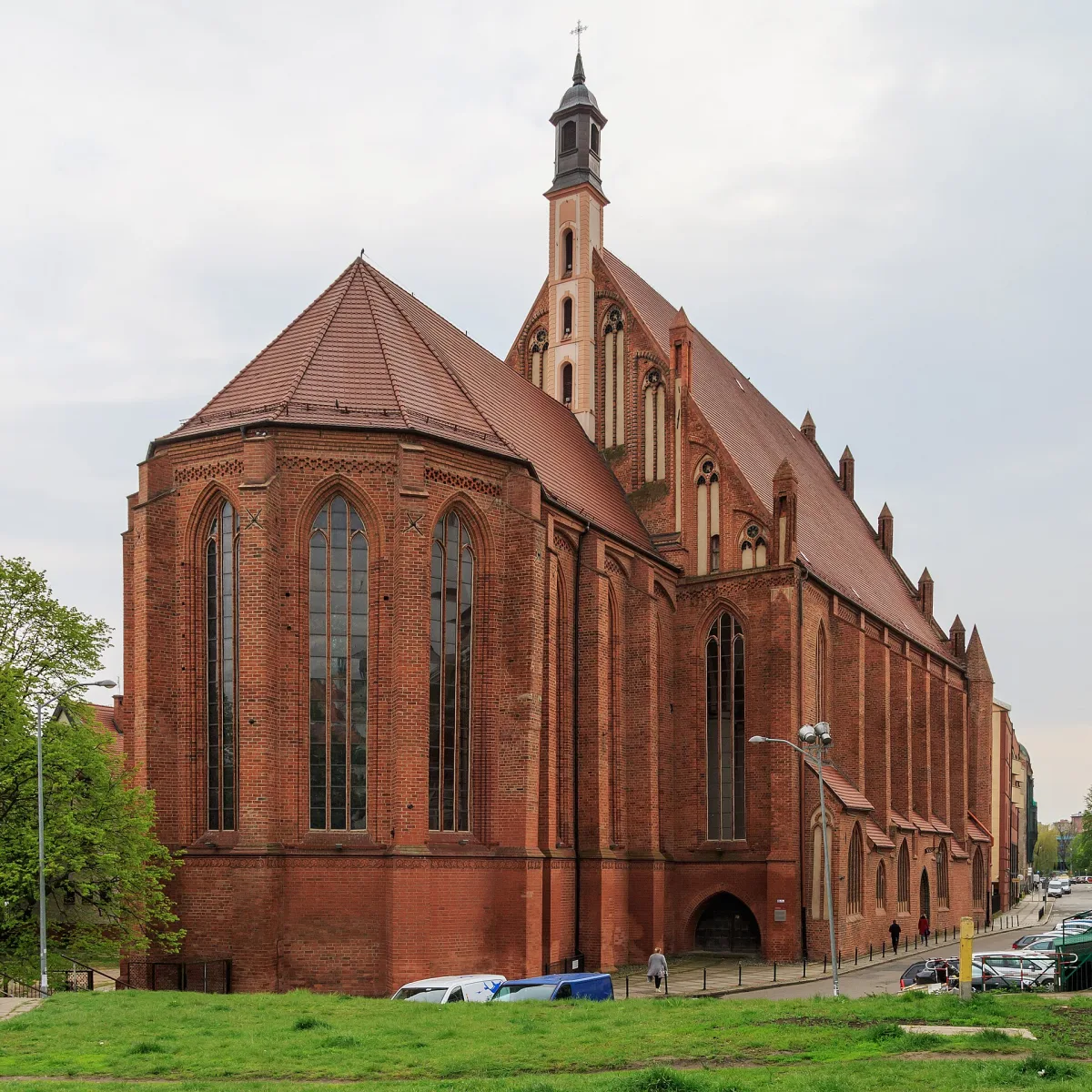
A Gothic brick former Franciscan church on Świętego Ducha Street, the only surviving part of the former monastery, with polychromes from the 15th and 16th centuries.
The Church of St John the Evangelist at Świętego Ducha 9 is a Gothic brick church, the only surviving building of the former Franciscan monastery complex in Szczecin. It stands on the European Route of Brick Gothic, a few minutes from the Old Town. The interior shows exposed brick structure, figural corbels and medieval polychromes.
The Franciscans came to Szczecin from Westphalia around 1240. Duke Barnim I founded for them wooden monastery buildings and a small brick church by the city walls. In the 14th century the church was extended into a three-aisled hall: the nave was built in 1350-1360, and tests on the timber of the roof truss showed that the beams were felled in the winter of 1368/69. In 1410 a chapel in honour of the Blessed Virgin Mary was added, and in the 15th century ten chapels between the buttresses.
In 1525 the Franciscans left the city, the monastery became a poorhouse, and after the Reformation the church served Protestants until 1945. Later it was used as an army store, a market hall and a store for theatre props. In the 19th century it was in danger of collapse, and some pillars still lean out of the vertical today. Conservation work in the 1920s and 1930s saved the building from destruction. After 1945 the city handed it to the Church in 1956, and in 1957 it was taken over by the Pallottines. The parish was established in 1974.
The church is a hall church, without an ambulatory and without a tower, and above the boundary of the chancel and the nave rises a characteristic ridge turret. The chancel has three bays and a seven-sided end. This layout is found in early Gothic French cathedrals, from where it was most probably borrowed. On the facade runs a frieze in the shape of a vine, and shallow chapels extend between the buttresses of the side aisles. Inside you can see decorative stonework details, chancel arch corbels in the shape of monks and gravestones.
The most valuable are the polychromes from the 15th and 16th centuries. They show a boy with the coat of arms of Szczecin, that is the griffin, Mary in a mandorla surrounded by saints, the mystic marriage of St Catherine and scenes with a bishop at an altar. Set into the wall is the medieval epitaph of Henricius and Gertrude Rabenstorp from 1378. The historic furnishings have not survived, the high altar dates from the 1960s, and the Baroque organ from the second half of the 18th century comes from Mazovia.
Barnim I also founded other churches in Szczecin, among them the former St Mary's Church, which did not survive. From the church described here it is about 300 metres to the Old Town Hall and the Loitz House, and a similar distance to St James' Cathedral. This makes a short walk around Gothic Szczecin.

Be the first! Add a comment.
You need to log in to add a comment.
Log in