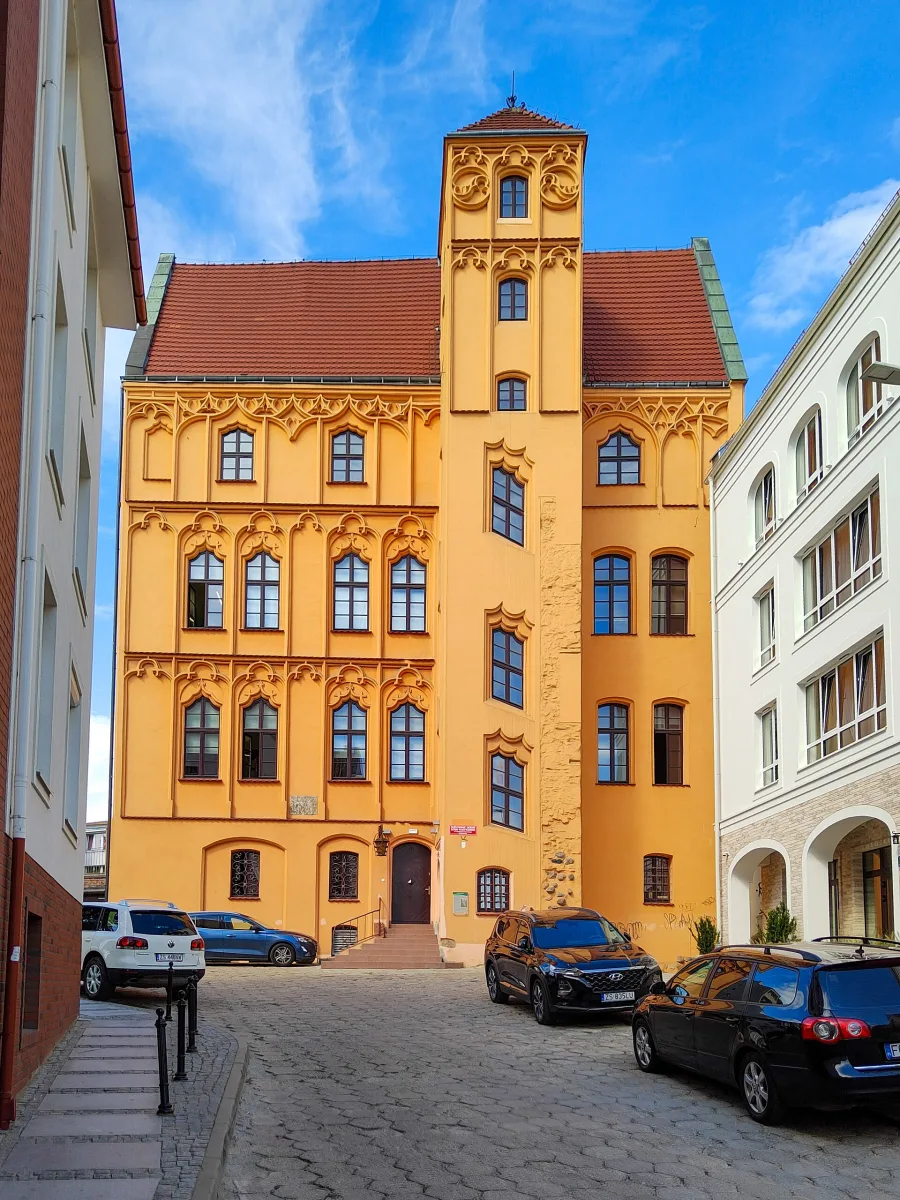
A late Gothic house of 1539-1547, the former home of the Loitz banking family, today a secondary school of fine arts.
Loitz House at Kurkowa 1 is one of the few surviving examples in Szczecin of the burgher architecture of the late Gothic period. Today it houses a secondary school of fine arts, so it is best viewed from the outside.
The house was built gradually in 1539-1547 on the commission of the banker and long-serving mayor of Szczecin Hans II Loitz and his wife Anna.
It was probably built on the walls of an older house of the 15th century. The Loitz family ran the largest bank in the city and traded across Europe. They lent large sums to Joachim II of Brandenburg, and when after his death in 1571 the debts were not repaid, the family went bankrupt and fled to Żuławy. The collapse of the bank affected the economy of Szczecin for decades, and in 1572 the house was taken over by the Pomeranian dukes.
After the fall of the duchy, in the middle of the 17th century the house became the seat of the Swedish councillor Rosenhandt.
In the 18th century the house was taken over by the Dubendorf brothers, who set up a confectioner's in it, called the Swiss Court. In 1944, after an air raid, the interior was completely burnt out. It was rebuilt in 1955, and since then the school of fine arts has operated here.
The elevation is orange, clearly divided and richly decorated with wavy and circular tracery, which echoes the decoration of the nearby Castle of the Pomeranian Dukes.
Characteristic are the slanting curtain-arch windows in the staircase in the tower. Built into the east elevation is a relief “Conversion of St Paul” of the middle of the 16th century from the workshop of Hans Schenck, court sculptor to Elector Joachim II. It is a copy, and the original is kept by the Szczecin museum. The building was entered in the heritage register in 1954.

Be the first! Add a comment.
You need to log in to add a comment.
Log in