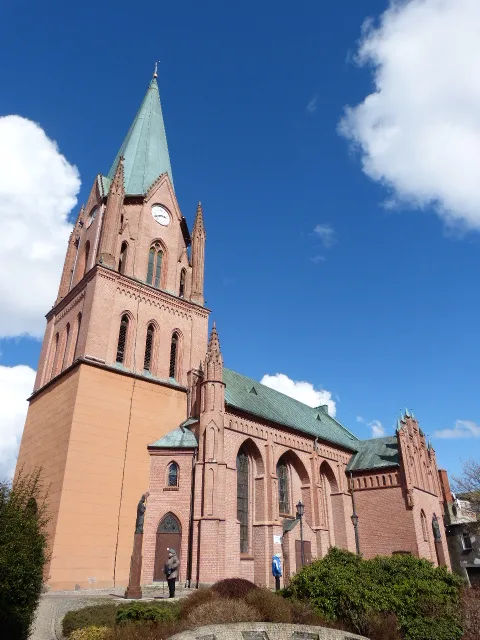
Neo-Gothic church in the centre of Połczyn-Zdrój, with a history going back to the 14th century, with the cast-iron tomb slab of Erasmus von Manteuffel of 1544.
The Church of the Immaculate Conception of the Blessed Virgin Mary stands in the centre of Połczyn-Zdrój, next to the main promenade. Today's neo-Gothic building was erected in 1860-1870, but the history of the church goes back to the 14th century. The building is entered in the heritage register.
The first mention of the church dates from 1389, although it may have existed from 1343. In 1418 the Knights Hospitaller took over its patronage. In 1505 the church burned down together with the town and was rebuilt in 1515. From 1545 it was used by Protestants for four hundred years, in 1547 a tower was added, and in 1628 a new altar was installed. After a fire in 1705 the church was rebuilt only in 1743. It received its present neo-Gothic form in 1860-1870.
The most valuable monument in the interior is the cast-iron tomb slab of Erasmus von Manteuffel of 1544, the last Catholic bishop of Kamień, who died in Połczyn. Other elements mentioned include a profiled portal, stained glass by Edward Schwartz and a 17th-century folk sculpture of the Last Supper. The Baroque high altar of 1626, the work of the Stargard sculptor Brock, has not survived.
Catholics regained the church on 28 October 1945. The tower, damaged several times by lightning strikes in 1943, 1950 and 1994, was rebuilt in 1981.
About two hundred metres from the church stands the palace in Połczyn-Zdrój.

Be the first! Add a comment.
You need to log in to add a comment.
Log in