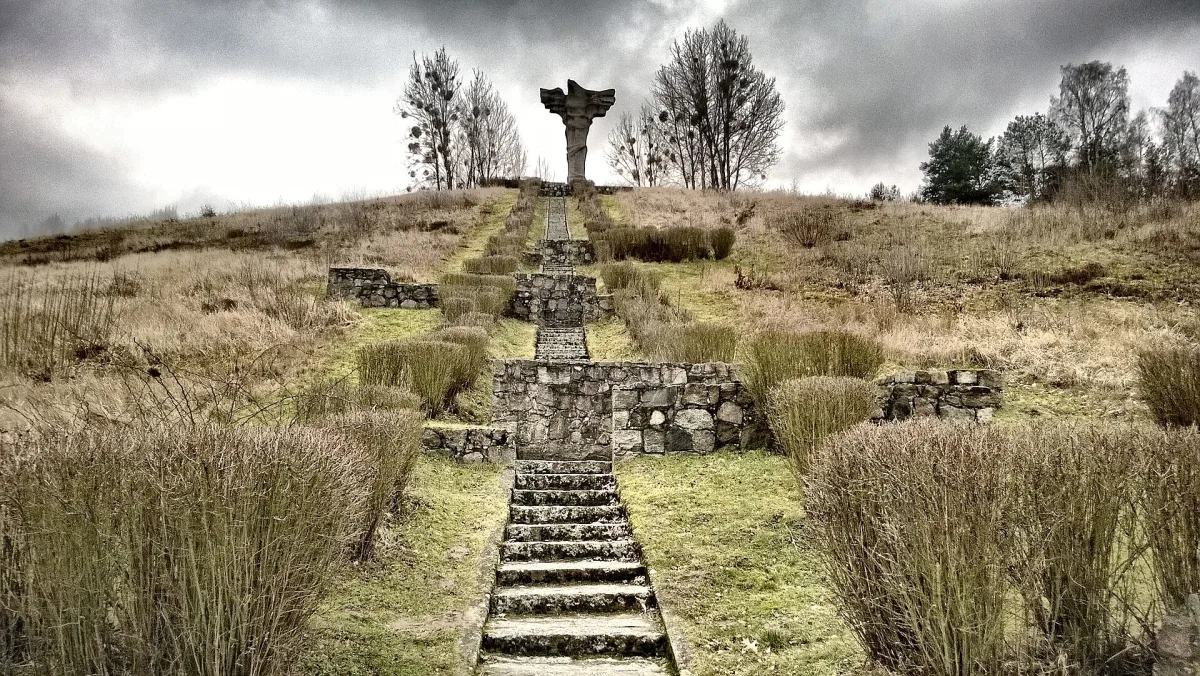
A moraine hill with a 15-metre eagle monument and 270 steps, commemorating the Battle of Cedynia of 972.
Czcibor Hill is a moraine elevation in the Cedynia Hills, on which stands a 15-metre monument of an eagle taking flight. The place commemorates the Battle of Cedynia of 972, and 270 stone steps lead to the top.
The hill is 54.5 metres above sea level and lies about 4 kilometres south-west of Cedynia, a few hundred metres east of Osinów Dolny. The top is reached by stone steps, in which 270 steps have been counted.
The name comes from Czcibor, brother of Mieszko I, who in the Battle of Cedynia commanded a third of the troops. According to Thietmar's Chronicle, he attacked from the hill near the stronghold of Cidini, identified with present-day Cedynia, the forces of Margrave Hodo, which decided the victory.
The battle was fought on 24 June 972 between the forces of Mieszko I and Hodo, Margrave of the Lusatian March, assisted by the magnate Siegfried von Walbeck. Information about it has survived in two accounts: the Chronicle of Thietmar of Merseburg and the life of St Adalbert written by Bruno of Querfurt.
At the top stands a monument of an eagle, unveiled in 1972, on the thousandth anniversary of the battle. Its authors are the Szczecin sculptors Czesław Wronka and Stanisław Biżek. The name of the monument is given in different ways: the Wikipedia entry speaks of the Monument to the Polish Victory on the Oder, and the website of Cedynia municipality of the monument to the Millennium of the Polish State. The ceremonies were planned for 25 June 1972, with nationwide rank, and the main part took place at the foot of the hill.
Earlier, in 1959, during the celebrations of the millennium of the Polish state in Szczecin Pomerania, a commemorative stone was unveiled on the hill. By the steps leading to the monument, plaques with inscriptions in Polish, Russian, English and German were placed. At the foot of the hill there is also a mosaic from the same year, showing an impression of the battle, the work of Jerzy Chmielewski and Kazimierz Błonka.
During preparations for the celebrations of the millennium of the battle, three archaeological points were located around the hill. During clearing work, bulldozers uncovered five hearths, which were investigated by archaeologists led by Dr Helena Malinowska. Radiocarbon (C14) dating of charcoal in 1983 gave a date of 920 AD with an error of plus or minus 70 years. This made it possible to date the hearths to the 10th century and, as the municipality states, perhaps to link them with the events at Cedynia in 972. Two more settlement sites, early medieval and multicultural, are known in the area, but the research was not systematic.

Be the first! Add a comment.
You need to log in to add a comment.
Log in