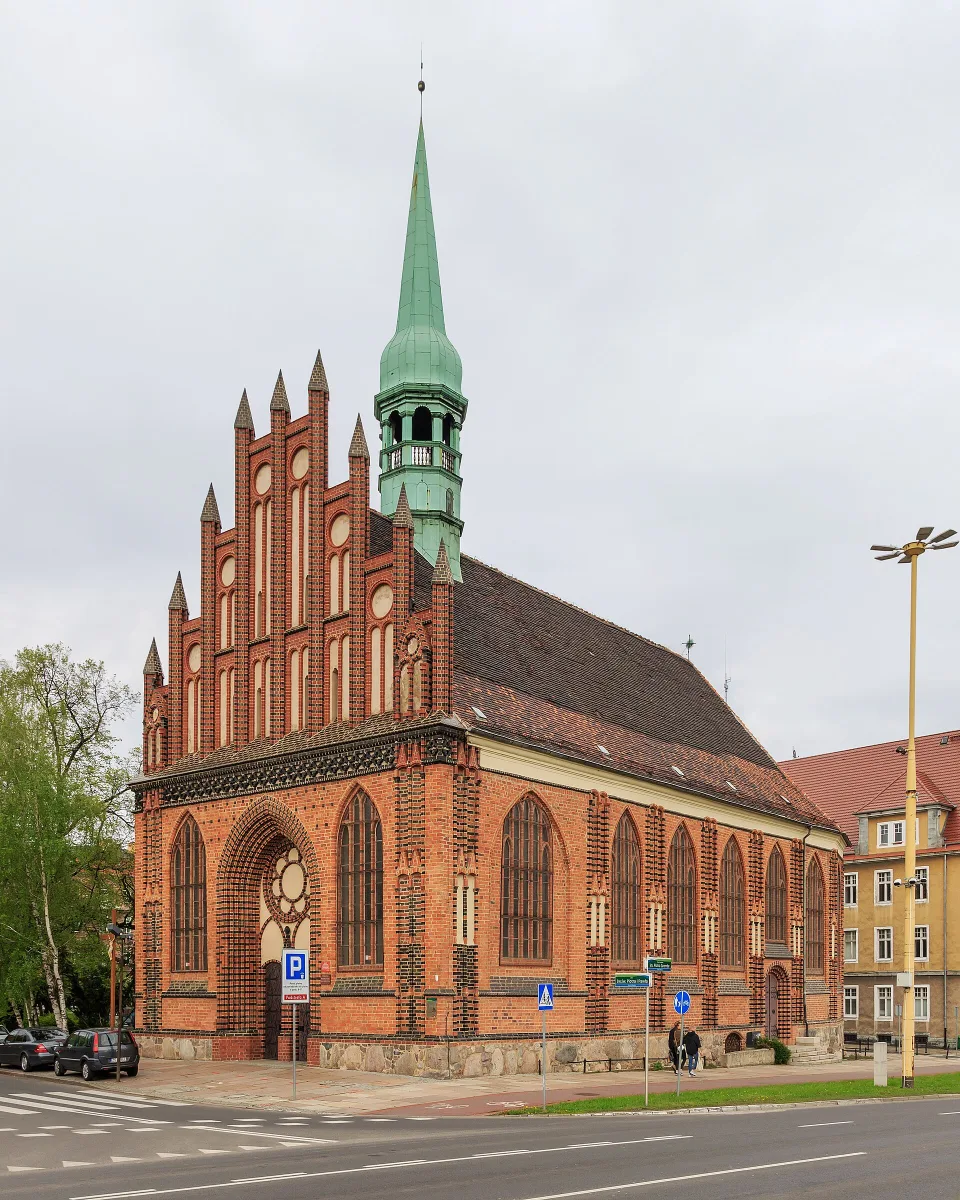
A Gothic brick church in the Old Town, a parish church of the Polish Catholic Church, with a ceiling painting of 1703.
The Church of St Peter and St Paul is a small Gothic brick church on Saints Peter and Paul Square in the Old Town of Szczecin. It belongs to the European Route of Brick Gothic, and since 1946 it has been a parish church of the Polish Catholic Church. The greatest ornament of the interior is a painted ceiling from the early 18th century.
The first, wooden church stood here in 1124, when Otto of Bamberg came to Szczecin on his mission, and it was probably the oldest religious building in the city.
It burnt down in 1189 during a Danish raid. In 1223-1237 a brick church was built on the site, and from 1425 a new body of the church was built in the spirit of Heinrich Brunsberg's Pomeranian school of Gothic. In 1460 the church was extended to the west by one bay topped with a tower. The tower was pulled down in 1556, and the present bell turret was added in 1602.
In 1534 the church was converted to a Protestant one, and after artillery fire in 1677 it was badly damaged and the rebuilding took 24 years.
It was rebuilt as a hall, without pillars dividing the interior into aisles. In 1901 the west façade was given a Gothic Revival makeover, with a Neo-Gothic gable with pinnacles added. The church was entered in the heritage register in 1955, and nearby stand Loitz House and the Hay Market.
The ceiling is a wooden false vault of 1702, made in imitation of brick vaults, covered with an oil painting by Eichner of 1703.
The ceiling panel has the shape of an elongated rectangle measuring 27 by 3 metres, and its edges are decorated with golden acanthus leaves. The painting consists of three scenes separated by the word “SANCTUS”. The first, by the entrance, is a vision of the end of the world, the middle one shows Christ enthroned with the four winged figures from Ezekiel's vision, and the third the crowds adoring the Lamb on Mount Sinai. Together they form a story of the end of the world, the Last Judgement and the happiness of the saved.
On the outer walls and in the sacristy there survive corbels in the shape of the heads of residents of medieval Szczecin.
Wikipedia says that these are the faces of real people of Szczecin, of different sexes and ages. The sculptures that once stood on them have not survived. On the north wall there is also an alms niche from the first half of the 15th century with a slot for donations. On its sides two limestone slabs from the end of the 14th century are set into the wall, with figures of the church's patrons, St Peter and St Paul.
In 2009 old burials were found in the crypt, most probably of the patriciate or of members of the House of Griffin (the Griffins).

Be the first! Add a comment.
You need to log in to add a comment.
Log in