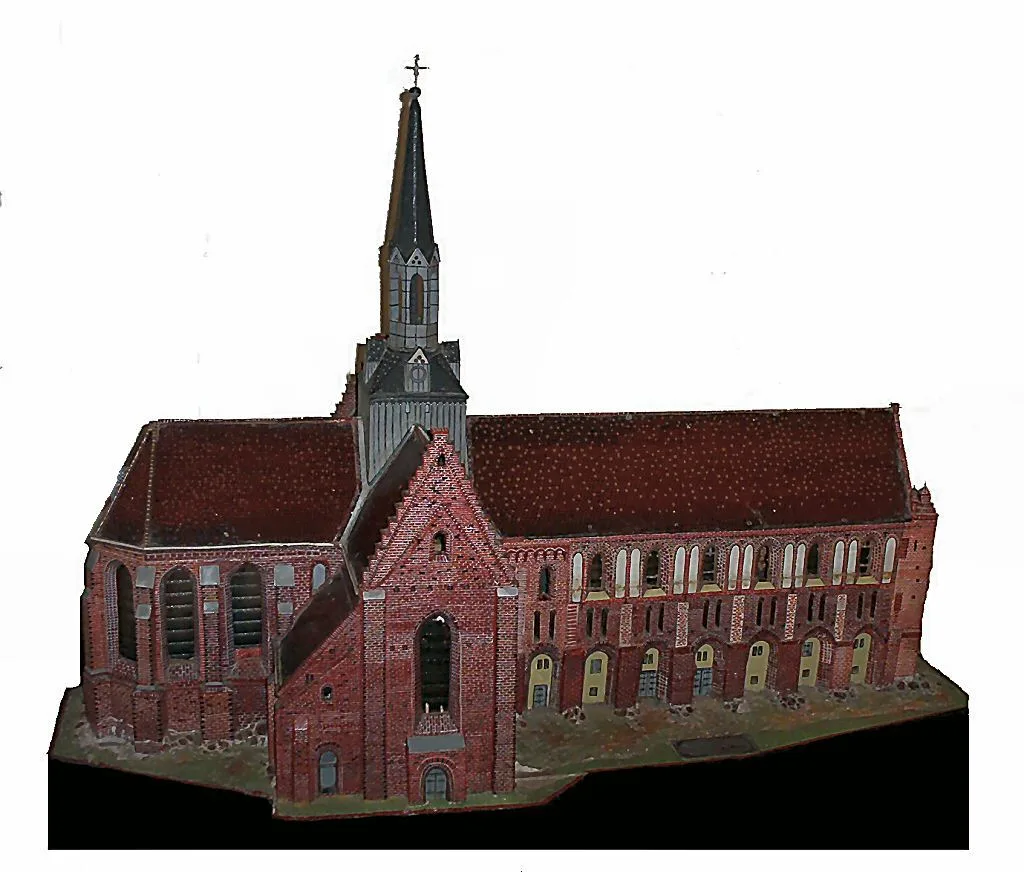
A former Cistercian monastic complex on the Płonia from the 13th-16th century, recognised in 2014 as a Historic Monument (pomnik historii).
The Cistercian Abbey in Kołbacz is a former Cistercian monastic complex from the 13th-16th century on the Płonia River in the municipality of Stare Czarnowo. The Wikipedia entry calls it one of the most valuable monuments of brick Gothic in West Pomerania. In July 2014, by a regulation of the President of Poland, the complex of the former monastery was recognised as a Historic Monument (pomnik historii).
The Cistercians came to Kołbacz from the Danish monastery of Esrum at the invitation of Warcisław II Świętoborzyc, according to the entry in 1173, and according to the chronology on 2 February 1174, led by Reinhold. The monastery established three daughter houses: in Oliwa in 1186, in Bierzwnik in 1280-1294 and in Mironice. The monks developed farming, and after 1237 they founded granges, that is, large farmsteads. In 1183 they changed the course of the lower Płonia, and the damming of the water raised the level of Lake Miedwie.
In 1413 Duke Swantibor I of Szczecin was buried in the abbey. From its foundation until the dissolution of the monastery in the 16th century the church was one of the burial churches of the dukes of Szczecin. The last abbot gave up his office in 1535, and in the 17th century the chancel with the transept was turned into a chapel, while the nave served as a granary and a ducal coach house. In 1721 the dismantling of the monastic buildings began.
Construction of the church began in 1210 still in the late Romanesque style, and was completed in 1347 in the Gothic style. On the west façade, flanked by two quadrangular projections, there is a large, bricked-up window and a gable with an intricate rose window. The main nave has five storeys, wooden ceilings and pointed arcades, and the star vaults partly date from 1500 and were reconstructed in 1851-1852. Inside there are traces of the division characteristic of Cistercian churches: the monks occupied the eastern part and the lay brothers the western part.
Today the parish church of the Sacred Heart of Jesus occupies the chancel and transept, while the main nave still serves as a storeroom. The high altar is a copy of a triptych from 1990, and the 15th-century original is in St James' Cathedral Basilica in Szczecin. On the north wall there is a 16th-century pulpit. In front of the entrance a plaque has survived in the floor dedicated to the missionaries murdered during the baptism of the Pomeranians in 1124. The Romanesque columns with richly carved capitals, which survived the fire of 1662, are in the National Museum in Szczecin.
The Lay Brothers' House, that is, the house of lay monastic brothers, is according to the Wikipedia entry a building from around the middle of the 13th century, rebuilt in the 17th-19th century, with the representative Triglav Hall on the upper floor. In the 1970s it was restored and adapted as a house of culture. The Abbot's House from the first half of the 14th century, according to the latest research from around 1350, has two storeys and a cellar. After the latest conservation it was designated as a library.
About 3.3 km from the abbey stands the church in Stare Czarnowo.
About 6 km further on is the Arboretum in Glinna.

Be the first! Add a comment.
You need to log in to add a comment.
Log in