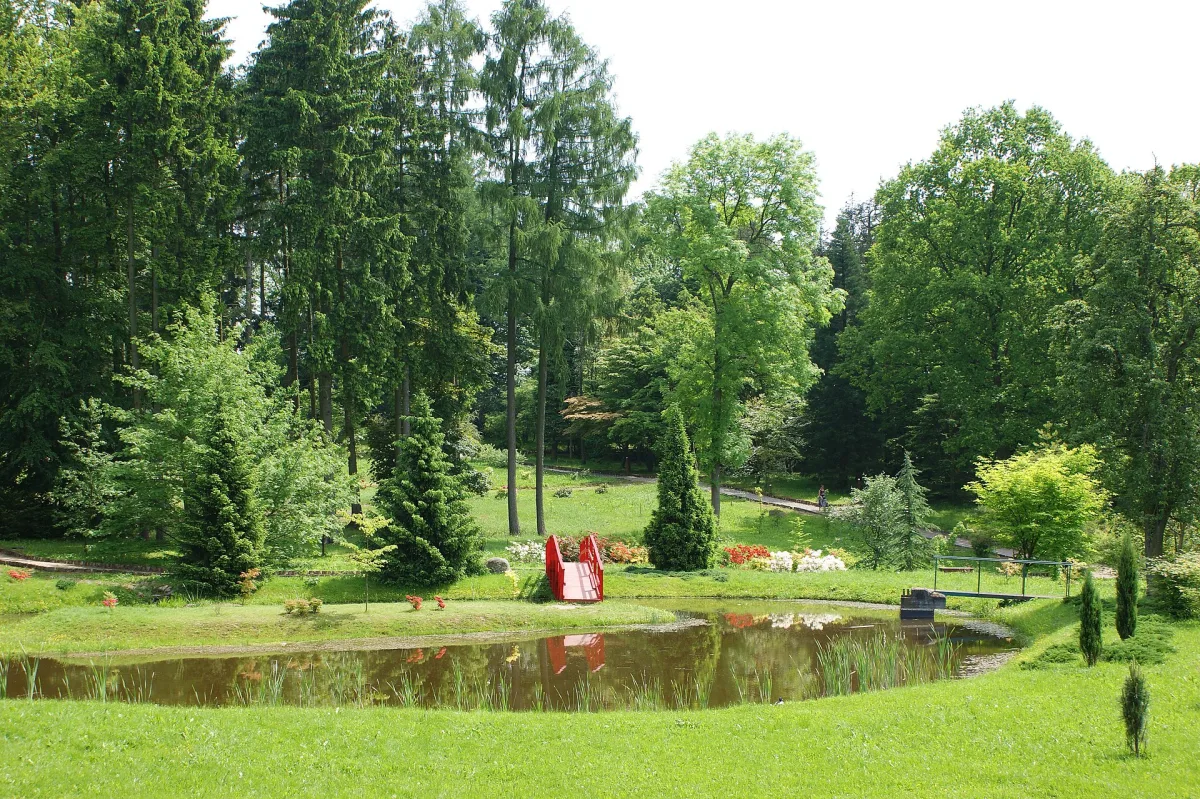
Dendrological garden of the Gryfino Forest District on the edge of the Beech Forest, with more than 800 species and varieties of trees and shrubs, most of them exotic.
The Prof. Jerzy Tumiłowicz Dendrological Garden in Glinna lies on the edge of the Beech Forest, in Stare Czarnowo municipality, and is managed by the Gryfino Forest District. More than 800 species and varieties of trees and shrubs grow in it, most of them exotic, and several specimens are among the largest trees of foreign origin in Poland. Entry to the garden is free.
The history of the garden goes back to 1823, when private tree nurseries were established here; in 1870 they were taken over by the state forest district in Śmierdnica. Most of the oldest exotic trees, now protected as natural monuments, date from that period. A special contribution was made by the Śmierdnica forester Carl Ludwig Gené, who worked here in the late 19th century. The first mention of the garden dates from 1911, and an inventory of 1938 recorded 51 species of exotic trees and shrubs.
After the war care was limited to the fencing, benches and keeping order, and frosts, gales and the spread of native vegetation meant that by 1970 only 23 species from that inventory had survived. Then the State Forests began cooperating with the Rogów Arboretum of the Warsaw University of Life Sciences (SGGW) in order to manage the garden properly. The area was then just under 2 hectares; today the Wikipedia entry gives 6 hectares.
The garden lies on the south-eastern edge of the Beech Hills, sheltered from the east, north and west winds by moraine hills covered with beech forest. According to the Gryfino Forest District, the favourable microclimate and the Atlantic climate of West Pomerania make it possible to grow here plants sensitive to frost which would not survive in central and eastern Poland. A small, seasonally disappearing stream, the Gliniec, flows through the northern part. The oldest tree is a shagbark hickory, which according to the Wikipedia entry is about 180 years old.
Despite its small area the collection is universal in character: in one walk you can get to know different groups of woody plants. Among the species mentioned by Wikipedia are the Japanese angelica tree and the Chinese angelica tree, the buttonbush, the Franklin tree, the seven-son flower and the Japanese beautyberry. Selected specimens are described under QR codes in the garden, and a guide is available on the forest district's website.
Nearby are the nature reserves of the Beech Forest, among them Źródliskowa Buczyna about one and a half kilometres away and Kołowskie Parowy. A few kilometres further stands the Cistercian abbey in Kołbacz.

Be the first! Add a comment.
You need to log in to add a comment.
Log in