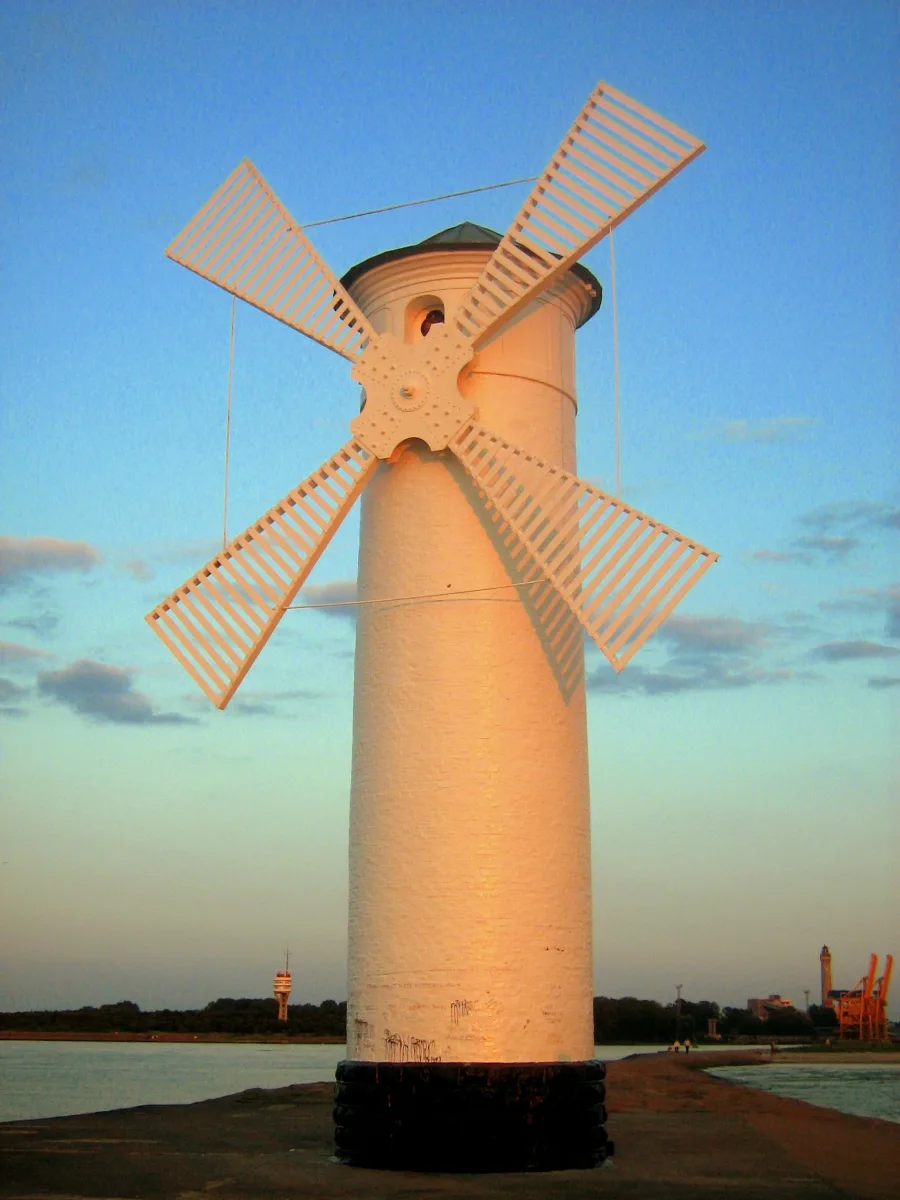
A white windmill-shaped stawa at the end of the West Breakwater in Świnoujście, a navigation mark from 1873-1874 and a symbol of the city.
Stawa Młyny is a white, 10-metre navigation mark in the shape of a windmill with a black roof, standing at the end of the West Breakwater in Świnoujście, at the mouth of the Świna into the Baltic. It is one of the symbols of the city and part of its official logo, and its photographs appear on postcards and the covers of guidebooks.
Together with the Galeriowa stawa, located 522 m south of it, Stawa Młyny marks the 170°12′ leading line that guides ships along the fairway into the port of Świnoujście. At its top is the front light of the leading line: white, flashing, with a period of 10 seconds, at a height of 11 m above the water and with a range of 17 nautical miles. The structure was built in 1873-1874 during the modernisation of the fairway.
The windmill is linked with a legend, not a documented fact. According to it, Alicja, in despair at the state of her sailor husband, heard a voice at night on the shore telling her to seek rescue in the windmill. The old miller told her to bring her husband, cover him in mud, bathe him in the sea and take him for walks. The husband came out of the windmill rejuvenated, but after the miller's death nobody knew his secrets. In the legend this is why people still come to Świnoujście today for mud treatments, sea bathing and walks.
In 1976 the stawa appeared in the film “Latarnik” (The Lighthouse Keeper), directed by Zygmunt Skonieczny, and for the shooting a building and a balcony were added next to it, then taken down when the work was finished. Nearby stands the Świnoujście Lighthouse, and about 800 metres further on is the Western Fort.

Be the first! Add a comment.
You need to log in to add a comment.
Log in