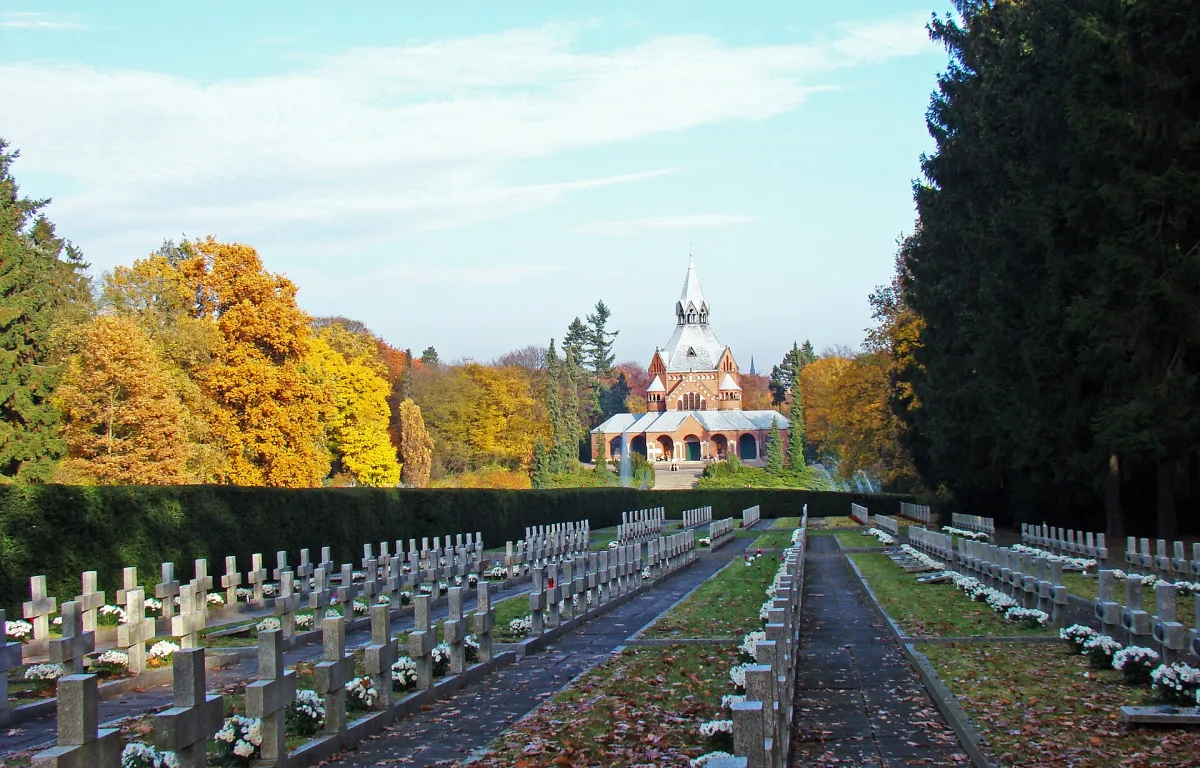
An active park cemetery from 1901 in Gumieńce, covering 172.33 ha, with a historical trail and a botanical trail.
Szczecin Central Cemetery is an active necropolis with the character of a park, founded at the beginning of the 20th century in Gumieńce. It covers 172.33 ha and, according to Wikipedia, is the largest cemetery in Poland. More than 300 thousand people have been buried here since it opened. By a regulation of the President of Poland the cemetery has been declared a Historic Monument, the first site in Szczecin with this status. It is visited with respect for a place where funerals take place and the dead rest.
The design was prepared by Wilhelm Meyer-Schwartau, and the final form was given to the cemetery by Georg Hannig in 1918. The necropolis was opened on 6 December 1901. The model was the Ohlsdorf cemetery in Hamburg, so a large part of the grounds is taken up by lawns, water bodies, hedges and avenues lined with rows of trees. In the older, eastern part the main avenues run in curves and make use of the natural shape of the land. There are also small steps, wooden footbridges and viewpoints.
The neo-Romanesque main gate, 77 metres wide, was built in 1901-1903. The chapel, on a Greek cross plan, was designed by the same architect. After the war the buildings were rebuilt, but the dome of the gate was not recreated. In 1981 a fire broke out in the chapel, which destroyed, among other things, the dome, and the rebuilding took 13 years.
On the main axis of the cemetery lies the war section. It holds 3379 soldiers: 367 Polish, including 203 unknown, and 3012 Soviet, including 2586 unknown. After 1945 the former garrison cemetery and a military area were added to the cemetery. By Lipowa Avenue there is a Jewish section, the only active Jewish cemetery in the West Pomeranian Voivodeship. The cemetery also has monuments, among them the Katyn Cross, the monument to the Siberian deportees and the monument “To Those Who Did Not Return from the Sea”. Near the second gate the victims of December 1970 were buried in secret.
In 2010 a historical trail with 21 stations, with bilingual information boards, was laid out in the eastern part. The route starts and ends at the main gate, and walking it takes about 1.5-2 hours. The stations lead, among other things, to the gravestones of old Szczecin families, a lapidarium with several dozen historic gravestones, the gravestone of Lord Mayor Hermann Haken and the section for distinguished people. More than 120 historic gravestones have survived, most of them gathered in the lapidarium of 2007.
About 415 species and varieties of trees and shrubs grow in the cemetery, including North American, Far Eastern and European ones. In October 2010 a botanical trail with 32 boards describing interesting trees and shrubs was laid out in the eastern part. It starts and ends at the main gate. In the western part two streams flow, the Cicha and the Jasna Woda.
The cemetery lies in Gumieńce, about 2.5 km in a straight line from the Old Town with the Castle of the Pomeranian Dukes. On Mieszka I Street, near the cemetery, stands a 19th-century Dutch windmill.

Be the first! Add a comment.
You need to log in to add a comment.
Log in