
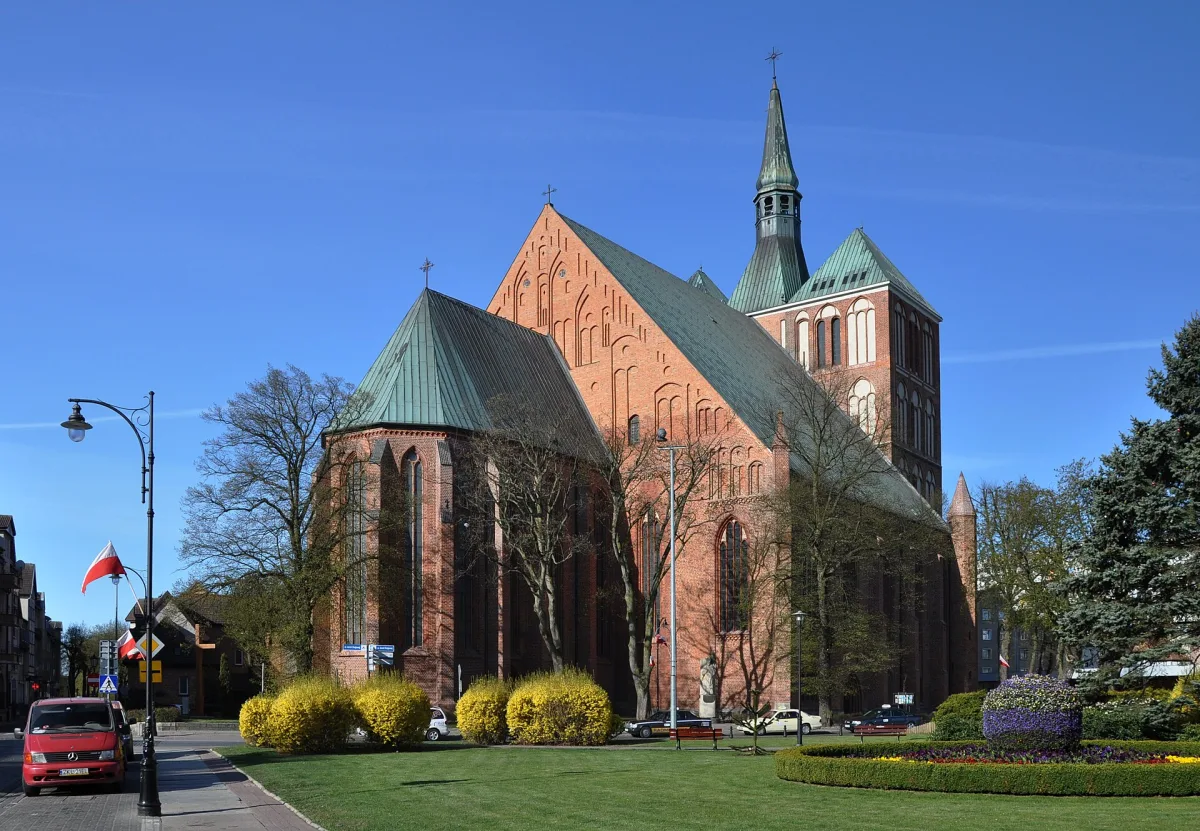
The Co-Cathedral Basilica of the Assumption of the Blessed Virgin Mary stands in the Old Town centre of Kołobrzeg, next to the town hall. According to the Encyclopedia of West Pomerania, it is the only five-aisled church in Poland, a Gothic hall church built in stages from around 1300. Below are the history of the building, the reason for the leaning pillars, the consequences of 1945 and the historic furnishings that still stand in it despite the destruction.
Construction and the five aisles
The exact date when construction began is not known. Wikipedia assumes that the main town church began to be built at the start of the 14th century on the site of the former St Nicholas' Church, and that the first mass at the building site was celebrated in 1321. The Encyclopedia of West Pomerania, citing a study by Robert Gauer, says that the church was built in stages after the chartering of the New Town, from around 1300, as the seat of the chapter and a parish church. Initially it was a three-aisled hall with one tower; the presbytery was added in 1323-1331, and the two outer aisles in 1386-1400. The Wikipedia entry gives the start of construction in its infobox as the 13th century, and the heritage register also indicates the 13th century, so the dates are given differently.
According to the Encyclopedia, the building is brick on a stone foundation. The main nave and the adjoining side aisles are of the same height, while the outermost ones are lower and divided by galleries. The side aisles have star vaulting and the main nave has rib vaulting. On the west side rises a massive tower, which the Encyclopedia describes as forty metres high. The Museum of Polish Arms, in turn, says that at a height of 50 m the tower ends in a viewing terrace, so the two figures probably refer to different points of measurement, but the sources do not explain this. At the end of the 15th century, according to Wikipedia, the northern and southern towers were joined into one massive block by walling up the gap between them, and a central spire was added, which gave the church its present silhouette.
Pillars out of true
The Encyclopedia of West Pomerania notes that the interior pillars lean out of the vertical. Both it and Wikipedia state that, as a result of the ground settling, the church was rebuilt several times. The sources do not describe exactly which rebuildings concerned the pillars, but the two facts form a single picture: a heavy brick hall stood on ground that kept moving, and the builders corrected it many times. For visitors it is one of the easiest details of the interior to notice.
Lutherans, the shelling of 1945 and reconstruction
From the 16th century the church was Lutheran: according to Wikipedia initially belonging to the Pomeranian Evangelical Church, and from 1817 to the Prussian Union Church. The Encyclopedia gives the years 1531-1945 as the Protestant period. The Wikipedia entry says that from the 17th to the 20th century the church was repeatedly damaged by military action, and during the siege of 1807 a shell fired by General Loison fell on the presbytery and destroyed the furnishings, including an altar from the end of the 17th century, of which only the predella with the Last Supper remained.
In 1945, during the fighting for the town, the church was an important point of defence and was destroyed by Soviet artillery fire. After the war it was initially intended to demolish the ruins. In 1957 they were handed over to the Catholic Church and reconstruction began, and in 1958 the presbytery was consecrated and the first mass was celebrated in it. In the 1960s the Museum of Polish Arms was set up in the unrestored part of the church, and heavy military equipment was displayed in the main nave. According to the museum's website, from 1966 its exhibition was held in the tower of the collegiate church, rebuilt with funds from the voivodeship conservator of monuments. The Kołobrzeg Town Museum, a branch of the Museum of Polish Arms, is today housed in the Brunswick Palace. In 1974 the whole church returned to worship.
The status of the building changed several times. In 1972 the church was made the co-cathedral of the Koszalin-Kołobrzeg diocese, in 1979 its function as a collegiate church was restored, and on 10 June 1986, according to Wikipedia, Pope John Paul II raised it to the dignity of a minor basilica.
What survived: the candelabrum, font, stalls and triptychs
The interior has not preserved many historic elements, but according to the Encyclopedia the collection of movable monuments was saved from destruction during the war by Pastor Hinz. The most famous is the Gothic seven-branched candelabrum. According to Wikipedia, it was cast in bronze in 1327 by Jan Apengeter, under the terms of a bequest by the dean of the chapter, Gotfryd de Wida. It is 4 m high, its arms span 380 cm and it weighs more than 900 kg, and Wikipedia calls it the only one of its kind in Poland and one of five surviving Gothic candelabra in the world. During the Second World War the candelabrum was dismantled and hidden in a utility room of the church. In the 1950s Polish workers found it and, not knowing its value, sold it for scrap, but Jan Frankowski saved it. The museum's website adds that after the war the candelabrum ended up in the museum in Słupsk, and according to Wikipedia in 1981 it returned to the Kołobrzeg cathedral.
The bronze font was cast, according to its inscription, in 1355 by a local craftsman, Jan Alart. The bowl is supported by four lions, and on its side surface are 26 relief scenes from the life of Christ. According to Wikipedia it is the oldest metal font in West Pomerania. In the presbytery the oak chapter stalls from around 1340 have survived, from the workshop of Herman Walther of Kołobrzeg, which Wikipedia calls the oldest objects of this kind in Poland. In the south aisle stand the smaller stalls of the town councillors, according to Wikipedia from the first quarter of the 15th century.
Of at least 22 Gothic altars, four triptychs from around 1500 have survived. Three still stand in the basilica: the Last Supper in the presbytery, the Adoration of the Magi to the left of the high altar, and an altar with St Anne with the Virgin and Child and St Nicholas to the right. The fourth, with scenes from the life of St James, is in the National Museum in Szczecin. In addition, Wikipedia lists a crucifix on the rood beam, which according to it came to the basilica from the church in Rymań in 1976, a brass hanging candelabrum from 1420 and the wooden Schlieffen Crown from 1523. The parish asks that no photographs be taken inside.
Nearby
From the basilica it is a short way to the town hall on Town Hall Square, designed, according to Wikipedia, by Karl Friedrich Schinkel. In its cellars is the Kołobrzeg Museum Patria Colbergiensis. On Katedralna Street stands the neo-Gothic Church of the Immaculate Conception, a former monastery and garrison church, and not far away, about 100 metres from the museum, is the Match Tower (Baszta Lontowa).
Be the first! Add a comment.
You need to log in to add a comment.
Log in