
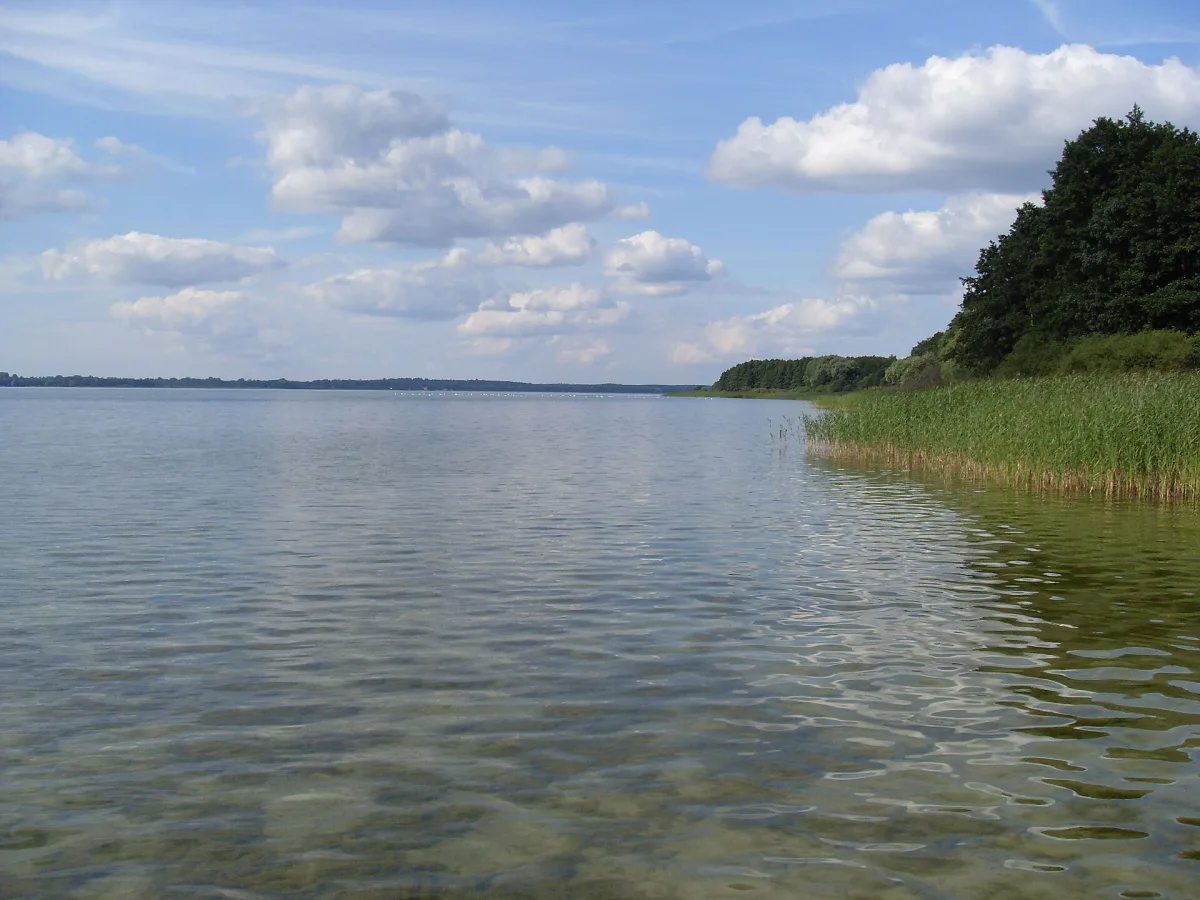
The devil and the prior at Lake Miedwie
Miedwie is, according to Wikipedia, the fifth largest lake in Poland by area (35.27 km2) and the country's largest cryptodepression: its depth reaches 43.8 m, and the bottom lies 29.8 m below sea level. The name has been recorded since the 12th century. The lake is linked with a tale about the devil, written down in the 20th century.
The version quoted by Wikipedia in its article on Miedwie was told by Franciszek Pałasz, born in Stężyca near Kartuzy, and a resident of Żelewo in Gryfino County from 1946. The record appeared in the bimonthly "Literatura Ludowa. Pomorze Zachodnie" (Polish Ethnological Society, 1960, no. 4-5), and the transcription was prepared by Jan Sadownik and Zofia Przyłuska-Jaworska. The narrator speaks in dialect, and came from the Kartuzy area.
The tale says that Miedwie had no fishing nets and few fish. The prior of the monastery in Kołbacz made a bet with the devil: if the devil brought a net into the lake, he could take the prior's soul. The devil travelled for a net as far as Latvia, to Lake Peipus. On his way back midnight was approaching, and the frightened prior ordered the monks to surround the lake and crow like roosters. The devil, hearing the crowing, decided that dawn was breaking, let the net into Miedwie and fled. The prior saved his soul, and the lake got its net.
The story combines two motifs found in tales from various parts of Europe: a bet with the devil and tricking him with a rooster's crow. Its source is the record of a single narrator, so versions from other villages around Miedwie are not given here.
Skarbek from Szmaragdowe Lake
The best-known Szczecin legend about water concerns Szmaragdowe Lake (the Emerald Lake) in Zdroje, which is an artificial lake. According to Wikipedia it formed in the pit of a chalk and marl mine, and the mine was flooded on 16 July 1925, when a layer of water-bearing sands was struck in the southern wall. All the workers present at the time managed to escape. The story of the ghost Skarbek who flooded the mine is a legend: according to the same article, the flooding of the mine is explained by a tale of a greedy ghost who had gathered treasure underground. According to the legend, the ghost gathered treasure underground, and when a miner's pick exposed the hiding place at the foot of the southern escarpment, he flooded everything with water.
The Julki of Lake Jamno
Jamno near Koszalin is, according to Wikipedia, 9th in Poland by lake area and 3rd in West Pomeranian Voivodeship. It is connected to the sea by a canal called the Jamieński Nurt. On a map from 1789 the lake is named Jamundsche See.
A local legend, described in a leaflet on the Jamno culture published by the Koszalin City Office, tells of the Julki: modest and friendly goblins who lived on a burial mound on the lakeshore, between Jamno and Łabusz. In times of crop failure they were said to share their supplies with people. The farmers repaid them by leaving unharvested crops in the fields so that the Julki would lack nothing. At the end of Promowa Street in Koszalin, next to the Jamno Marina, stands a monument to a goblin holding a loaf of bread, the work of the Koszalin sculptor Zygmunt Wujek. The leaflet adds that the legend is still alive in Jamno and is part of local culture.
The source here is promotional material from the city, not a collection of folk tales, so it is not known how old the tale is or how its earlier versions went.
Zielenica and the church in Trzęsacz
The cliff in Trzęsacz is linked with a tale of the sea taking back what belongs to it. In its article on the church of St Nicholas, Wikipedia notes that there are several legends about the sea taking successive parts of the church. One concerns Zielenica, a sea goddess, caught by chance by fishermen and held by the local parish priest. Zielenica died of longing and was buried in the churchyard. From then on her father, the Baltic, was said to send wave after wave to take back his daughter's body and carry it to the seabed. The article cites a piece by Krystyna Słomka on the Focus.pl website from 2008.
The facts are simpler than the legend. According to Wikipedia the church originally stood about 1.8-2 km from the shore, in the middle of the village. The sea began to expose the churchyard in the second half of the 18th century, and the cemetery was closed in 1809. The new church, today the Church of Divine Mercy, was completed in 1880. What survives of the old church is the south wall, 12 m long and 6 m high, standing at the top of the cliff: these are the ruins of the church in Trzęsacz.
Be the first! Add a comment.
You need to log in to add a comment.
Log in