
Three stories from the region share a common thread: a hidden or lost valuable object. The first concerns the golden figurine of Triglav, the second the golden dove of King Eric of Pomerania, the third an aeroplane sunk in Lake Resko Przymorskie. In each case it is possible to separate what the written sources say from what the legends have added.
The golden figurine of Triglav: what the lives of Otto say, and what the legends say
According to Wikipedia, information about Triglav comes from three sources: the anonymous Life from Prüfening (written before 1146), the Life of St Otto, Bishop of Bamberg by the monk Ebbo from 1151, and the Dialogue on the Life of St Otto by the monk Herbord from about 1158-1159. All of them describe the missions of Bishop Otto of Bamberg among the Slavs. He reached Wolin in 1124, in August (according to the Anonymous on 4 August, according to Ebbo on 13 August). The people of Wolin refused to accept the new faith and forced him to leave the town.
Ebbo describes how, when Otto was destroying the temple and the images of the gods, pagan priests stole the golden figurine of Triglav, took it out of the country and entrusted it to the care of a widow in a small village. She was said to have hidden the figurine in a hollowed-out tree trunk, wrapped in cloth, with a small opening for offerings. The bishop sent a certain Herman to fetch it, and he entered the hut under the pretext of making an offering. The figurine was lodged in the tree so firmly that it could not be removed, so Herman took only Triglav's old saddle, nailed to the wall, and returned with it to the bishop. In the passage quoted by Wikipedia, Ebbo does not give the name of the village.
Places appear only in the legends. Folklorists, as Wikipedia reports after the work of Kajkowski and Szczepanik from 2013, have collected several local legends in western and northern Poland: the figurine was said to be hidden in Gryfice, in Świętouść on the island of Wolin, in Tychowo under the erratic boulder Trygław, or in Lake Trzygłowskie. These are several different places for one figurine, so the legends contradict one another from the start, and none of them is confirmed by a 12th-century source.
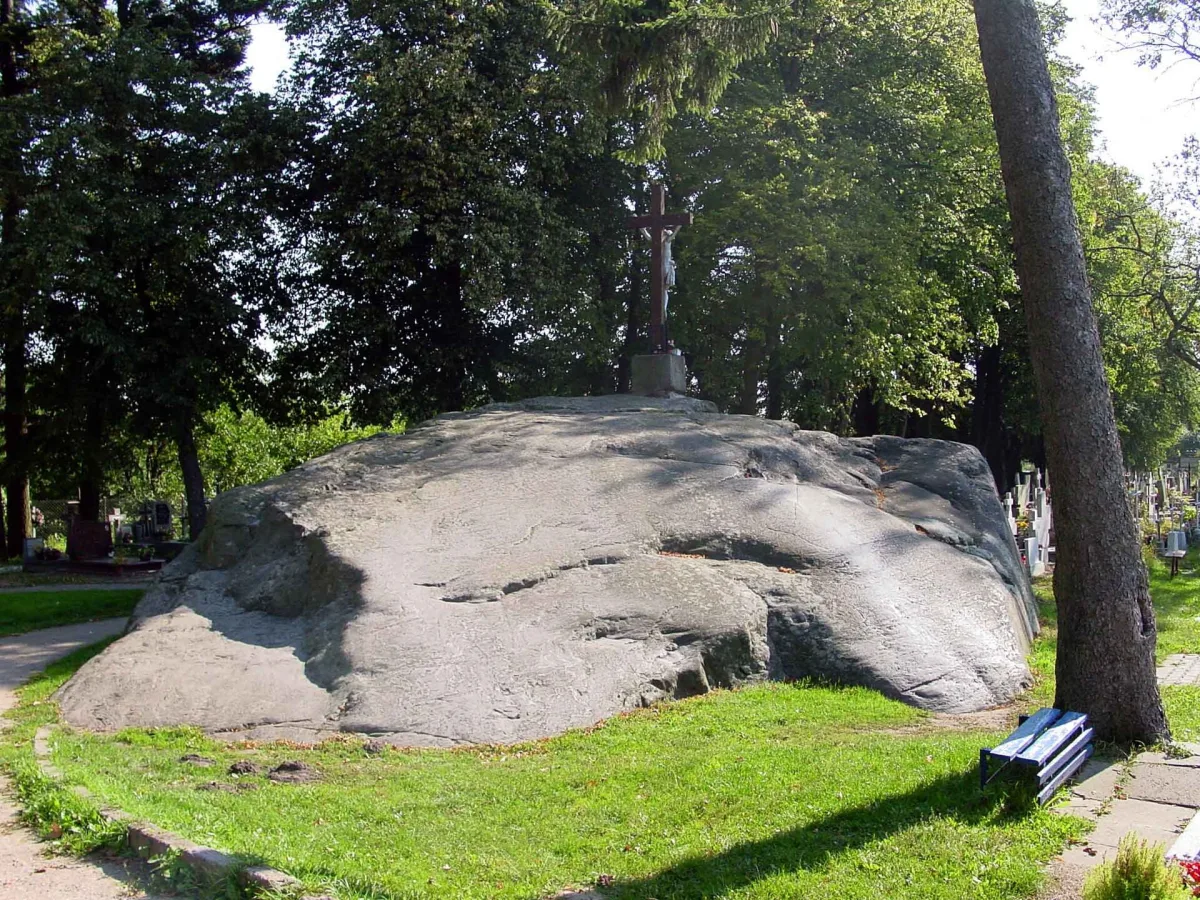
In Tychowo lies Trygław, an erratic boulder that appears in the town's coat of arms, by which the story is told of a buried golden statue. The explanation of its origin is geological: it is dark grey gneiss that travelled from Scandinavia with the ice sheet. The legend of the statue remains a legend.
The golden dove of Eric of Pomerania
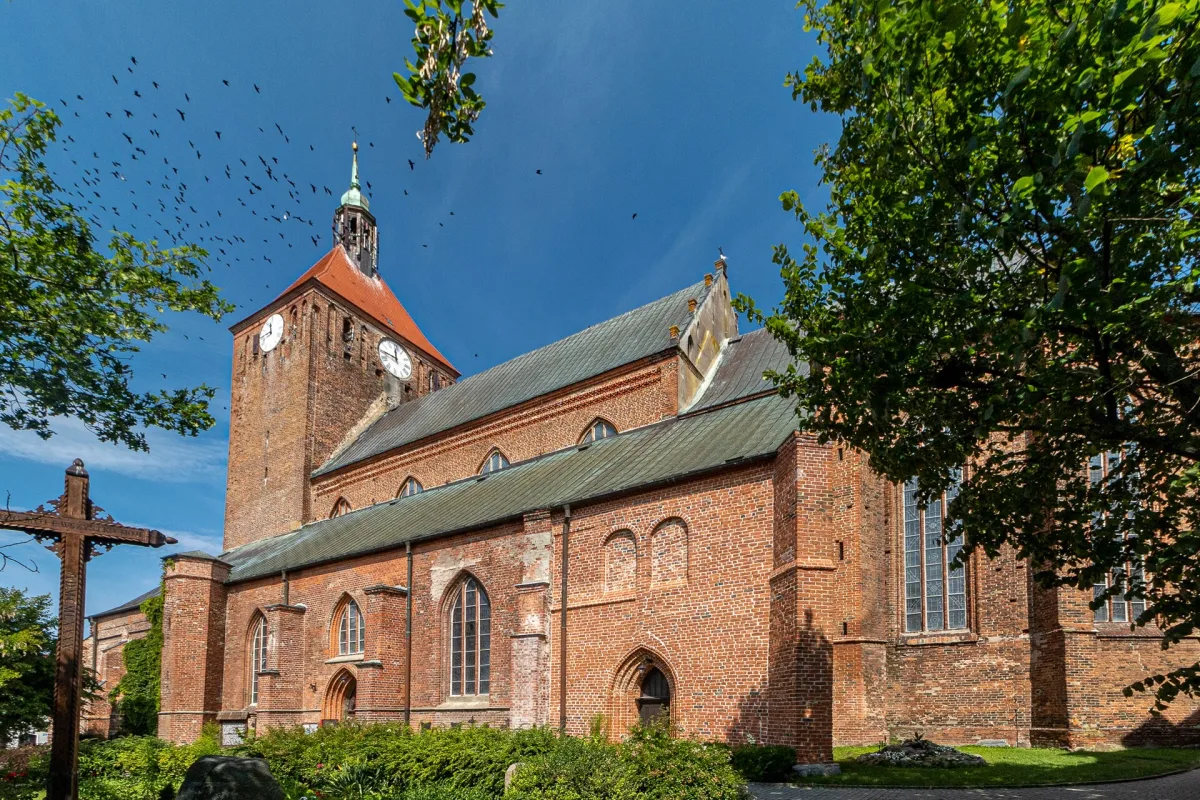
Eric of Pomerania was born in Darłowo, was King of Norway, Denmark and Sweden, and after losing his thrones returned to his native duchy and died in Darłowo before 16 June 1459, probably on 3 May. According to Wikipedia, before his death he handed over to Princess Sophia and to Eric II a treasure made up of valuables brought from Denmark and obtained during privateering expeditions. Later Danish kings tried to recover it, and what became of it, as the entry states, is not known.
The dove appears in two accounts, which are not identical. According to National Geographic Polska, citing Leszek Walkiewicz, president of the Society of Friends of the Darłowo Land, the talisman of the golden dove was a keepsake of a knightly brotherhood founded by the king in the Holy Land, and he wore it around his neck. It was said to have been found in his coffin in 1724 and sent to Berlin, to the Prussian king Frederick William I. The dzieje.pl website writes more briefly: that Eric was buried in Darłowo in 1459 with a golden dove, and adds that this bird was a symbol of his reign. The first account therefore speaks of an object that was found and taken away, while the second mentions only a burial with a dove, with no word on its fate after 1459.
What is missing here is a primary source: a description of the opening of the coffin in 1724, from which it would be clear what exactly was found. The story of the dove should therefore be treated as an account passed on by a regional historian, not as a documented fact. Similar caution applies to the sarcophagus: Wikipedia writes of a tomb erected in 1882, National Geographic Polska of a sarcophagus from 1888. Today it can be seen in St Mary's Church in Darłowo, and the king's birthplace is the Castle of the Pomeranian Dukes in Darłowo.
The aeroplane in Lake Resko Przymorskie
Resko Przymorskie is a coastal lake behind a spit on the Trzebiatów Coast. According to Wikipedia, in 1945 it served as a landing site for Luftwaffe seaplanes. The entry describes the event that became the basis of later searches: at the beginning of spring, most probably in the last days of March, when Soviet troops reached the shore of the lake, a German Junkers Ju 52 transport aircraft was said to have landed. Hit by a Soviet artillery shell, it struck the surface of the lake several dozen metres from the shore and sank. German prisoners were said to have testified that the machine had taken off from Königsberg and was carrying a valuable cargo. In August 1946 Soviet soldiers tried to raise the wreck, during which it broke in half, and the body of a soldier in a uniform with a general's insignia floated out of the cabin.
The thread of the crates comes from a letter which, according to Wikipedia, was written years later by the former commander of a Red Army unit, Colonel Novikov, to the head of the Königsberg group searching for looted works of art. In it he described the sinking of the aircraft and suggested that the Junkers might have been carrying crates with the Amber Room. It is therefore a supposition from a single letter, not an established fact. In 1987, after Novikov's death, the lake was examined by a Polish-Soviet expedition of divers, Polish Army soldiers and scouts. According to the account of the group's leader Borys Waszkiewicz of the ZHP, it was hampered by poor visibility and a three-metre layer of silt. A few small fragments of the front of the aircraft were recovered, some silver tableware, a pendant and a wedding ring, as well as documents and food coupons from the pilot's cabin, which confirmed that the machine had been flying from Königsberg. The second, broken part with the cargo hatch was not reached.
The entry also cites another version. During further searches in 1989 a Dornier Do 24 flying boat was mentioned, and in May 2009 divers found fragments of a German aircraft which, according to the president of the Rogowo Fort Museum Foundation, most probably came from a seaplane of exactly that type. According to this account, it carried 72 German children and carers, being evacuated on 5 March 1945 from the nearby airfield into the interior of Germany. The aircraft was hit by a shell in the engine and fell into the lake, no one survived, and the victims are commemorated by a monument put up in the early 21st century. The date, the type of aircraft and the passengers therefore differ between the two descriptions, although both appear in the same entry.
This much follows from the sources: a crashed wartime aeroplane lies in the lake, and the searches carried out have not confirmed the presence of the Amber Room. According to the second account it is also the place where children and their carers died, and that is how it should be spoken of.
Be the first! Add a comment.
You need to log in to add a comment.
Log in