
Place names rarely have a single, certain explanation. For Choszczno there is a legend about a warrior founder and, separately, a hypothesis of linguists. For Woświn and Świdwin there are only hypotheses, and for Połczyn-Zdrój there is an explanation from a personal name and a tale about the discovery of the springs. Below, each explanation is labelled with the name of its source and kept separate from what has been documented.
Choszczno: the warrior Choszcz and choszcze, that is, thickets
According to Wikipedia the legendary founder of the town was Choszcz, and the town was said to have taken its name from him. A reminder of this tale is a wooden sculpture from 1984 by Zbigniew Tracz. It shows a warrior with a sword and a shield bearing the town's coat of arms, and stands on the twin-town roundabout, at the junction of Wolności and Bohaterów Warszawy streets. This is a tale, not a finding of historians: the article cites no documents that would confirm the existence of such a founder.
The linguistic hypothesis is different. Wikipedia, citing the etymological dictionary of Stanisław Rospond, states that the topographic name “choszczno” meant a settlement full of chosts, that is, thickets and bushes (today's chaszcze). A place called Chocznia, recorded as Choszcznia, once bore a similar name. According to this version the name describes a place, not a person.
The documentary records run as follows. In 1233 Duke Władysław Odonic granted the Cistercians of Kołbacz the lands on which the town lies, and the name Hoscno was mentioned then. In 1269 the German name Arnswalde appears for the first time, which Wikipedia translates as “eagle forest”. Jan Długosz in 1433 recorded it as Harnsswald alias Choschczno. So the German name was linked with a forest, and the Polish one, according to Rospond, with thickets. After 1945 the forms Choczno and Choczen were temporarily in use, and the name Choszczno was formally introduced on 7 May 1946.
Mementoes of the Choszczno land are collected by the Choszczno Land Museum.
Woświn: a name older than the Slavs, or an aspen grove
According to Wikipedia, Woświn is the largest lake in the Rega river basin. The surface area of the water, depending on the catalogue cited in the article (Choiński, the Inland Fisheries Institute), is from 767.5 to 809.7 ha, the length is about 9.5 km and the width about 2 km. None of the sources checked mentions a legend of the name, but researchers dispute its origin.
The oldest record is Woswin from 1284, from the Pommersches Urkundenbuch (Pomeranian Document Book). Later the German form Wotschwin-See appears on a map from 1780 and Wotschwin in 1789 and 1895. Wikipedia cites two hypotheses. According to the first, the name is of Baltic origin and is linked with the Lithuanian word ašvà, meaning mare. According to this hypothesis the name belongs to a pre-Slavic layer. The second, Slavic, assumes an unattested word meaning wasp or aspen, or a derivative of osъvina, that is, an aspen grove. In this view the name of the area could have been transferred to the lake. Wikipedia does not settle which of these versions is correct.
Połczyn-Zdrój: the name Połk and a tale about a clothmaker
The explanation of the name is best documented here. According to Wikipedia, citing Edward Breza, the record Poltsin from 1304 comes from the name Połk, a short form of the name Świętopełk, with the ending -in added. In a document of 1337 the place was written Bolczin. The element “Zdrój” is linked with the spa: in 1926 the element Bad was added to the German name Polzin, and the name Połczyn-Zdrój was officially introduced on 19 May 1946.
A tale also leads to the spa. According to Wikipedia, the properties of the local mineral waters and peat were discovered by a clothmaker suffering from rheumatism, who washed in a spring, put his leg into the mud and was said to have recovered the next day. The spa's website tells the same story but with a different occupation for the hero: it speaks of a weaver and gives 1688 as the moment the springs were discovered. The discrepancy therefore concerns the profession of the discoverer, not the substance of the tale. According to the spa's website, the local pastor confirmed the existence of the springs and their healing character in a report to the church authorities.
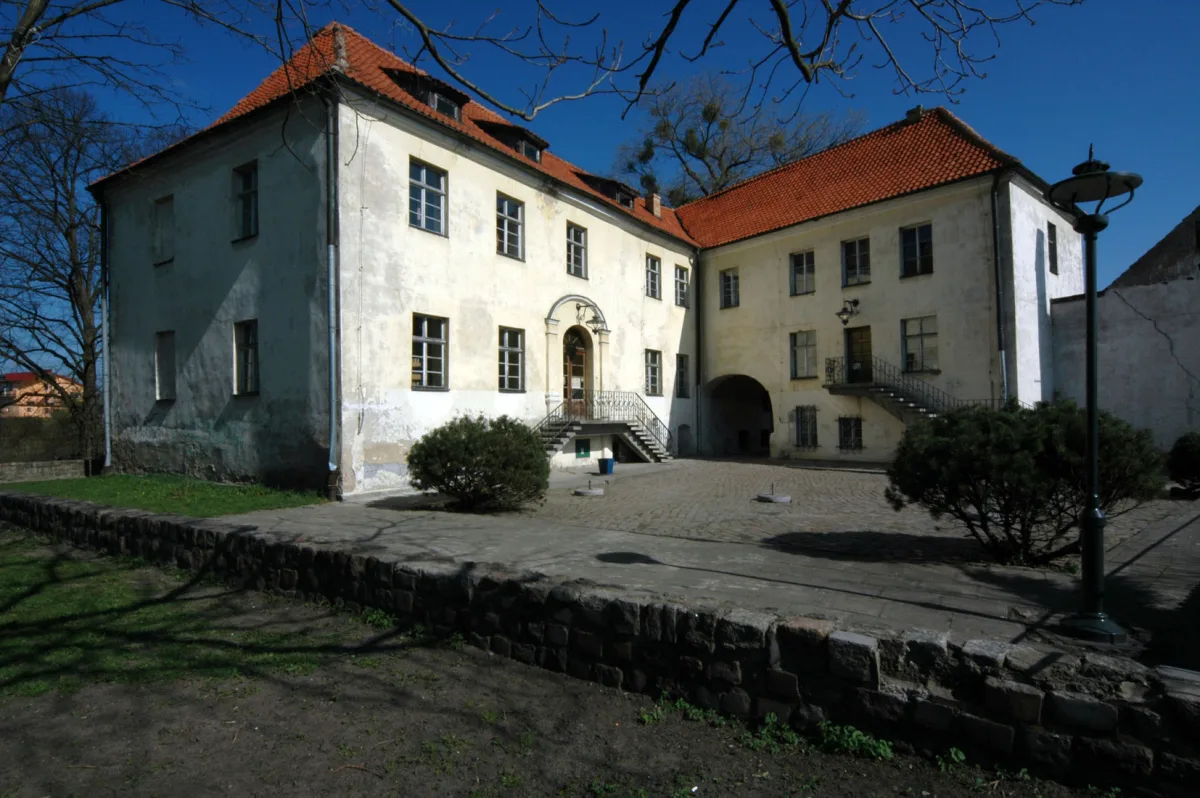
Wikipedia adds that in the 17th and 18th centuries Połczyn was the largest spa in Pomerania, and that the resort flourished at the beginning of the 20th century. A reminder of that era is the Palace in Połczyn-Zdrój.
Świdwin: a name without documents
According to Wikipedia the name Świdwin is not historically documented. German researchers, among them Rudolf Virchow and J. Spers, ascribe to it a Slavic-German origin. The Polish linguist Mikołaj Rudnicki derives it from the Pomeranian words Skwilbin or Skwielbin, meaning a disc in a marsh. Świdwin would then be a town situated on a dry disc amid the marshy valley of the Rega. Wikipedia cites this version from the town's development strategy of 1999.
After the war the town was first called Świbowina, and only after consultations with scholars was the present name fixed by a ministers' regulation. The first mention of the settlement dates, according to Wikipedia, from 1280, and on the Rega stands Świdwin Castle, built in the 13th century. Wikipedia states that the name of the castle comes from the Knights Hospitaller, who had a commandery in it from the 16th to the 19th century.
How to read such explanations
The tale of Choszcz speaks of a founder, whereas the document of 1233 speaks of lands granted to the Cistercians, that is, of a place, not of a man. The hypotheses of linguists also differ: for Woświn two conflicting etymologies are set side by side, and for Świdwin researchers have no records on which to rely. The best documented is the name of Połczyn, and that is because we have records from 1304 and 1337.
Be the first! Add a comment.
You need to log in to add a comment.
Log in