
The Pomeranian Wall, in German Pommernstellung, is a belt of fortifications that the Germans built in the 1930s several dozen kilometres from the then border with Poland. It ran through today's Wałcz and Drawsko Lakelands, from the vicinity of Gorzów Wielkopolski through Tuczno, Wałcz and Nadarzyce to Szczecinek. Today its remains stand in forests and on the necks of land between lakes, and several sites are run as museums.
Construction in 1930-1937
According to Wikipedia, preparatory work began in 1930, and in spring 1931 survey teams appeared on the border of West Pomerania to mark out the course of the future defence lines. A year later construction began on about 20 reinforced concrete bunkers at crossings near Strączno, Prusinowo and Strzalin. A new stage, along the whole border with Poland, began in summer 1934.
The dates and the size of the whole differ between studies. The Pomeranian Wall 1945 Association writes that the main part was built in 1932-1937, that modifications were added in 1938-1939, and that by 1937 about 235 km of fortifications had been built from Gorzów Wielkopolski to Biały Bór. According to the same portal, the Wall comprised about 1,000 reinforced concrete structures, as well as rifle trenches, anti-tank obstacles, minefields and trenches. The Wikipedia entry on the breaking of the Wall gives other figures: the line from 1932-1945 was to be about 275 km long, with about 900 reinforced concrete bunkers and firing positions. The section from Biały Bór to the vicinity of Darłówko was, according to both sources, to be reinforced only in the event of a direct threat.
Wikipedia states that in 1935 the expansion of the main position, based on lakes, forests, marshes, rivers and water barriers, was completed, and that in 1936 construction of bunkers began along the northern slopes of the Noteć ice-marginal valley. The Pomeranian Wall 1945 Association points out that the fortifications were not built during the war against the Red Army: according to it, their main purpose was to shield West Pomerania from an attack by the Polish army. Wikipedia describes the position similarly, as an extended field position covering the troop concentration areas in the event of a strike by Polish forces.
Types of bunkers
Most of the structures had low resistance. According to the Pomeranian Wall 1945 Association, mainly category C bunkers were built, with reinforced concrete 0.6 m thick and armour up to 6 cm, and category B1, with reinforced concrete 1.0 m thick and armour up to 12 cm. These were as a rule row bunkers with basic weapons, the MG08 machine gun, without extensive living facilities. The line was supplemented with a few heavier type B bunkers, with reinforced concrete 1.5 m thick, armour up to 30 cm and reinforced armoured cupolas, with extensive facilities.
The Regional Museum in Szczecinek writes that the B-Werk bunkers were the largest structures in the whole belt of fortifications and that the Germans built 11 of them in total, two of which stand in Szczecinek. Wikipedia states that the Szczecinek B-Werk is the best preserved of the 11 structures of this type on the Pomeranian Wall. According to Wikipedia, the bunkers in the area of Nadarzyce, Wałcz and Strzalin had several underground levels reaching 15 m, walls more than 200 cm thick and ceilings of about 190 cm, and their armament included two rotating small-calibre guns, three machine guns, grenade launchers and a periscope. The largest number of bunkers stood in the Nadarzyce area and in the narrow necks of land between lakes.
In 1944, according to Wikipedia and the Pomeranian Wall 1945 Association, earthworks and machine-gun positions known as Tobruks were added in front of the main position, together with a screening belt along the Gwda and Noteć and a switch position from Nadarzyce through Iłowiec and Wierzchowo to Kalisz Pomorski. The association assesses that the shallow depth of the line hampered defence and made it easier to break through.
January and February 1945
The fighting for the Pomeranian Wall was conducted by the 1st Polish Army as part of the Vistula-Oder Offensive, alongside Soviet forces. Wikipedia gives in its infobox the period from 29 January to 10 or 20 February 1945, and in its description of the fighting dates the 1st Army's losses to 30 January - 11 February. According to this entry, on 31 January both columns of the army fought on the Gwda against forces defending the field position on the Podgaje, Jastrowie, Ptusza line, and by 4 February the 4th and 6th Infantry Divisions had reached the main position behind lakes Dobre, Zdbiczno, Smolno and Lubianka. According to Wikipedia, there were 35 reinforced concrete bunkers in the army's sector there.
Wikipedia describes how by dawn on 6 February the 4th Infantry Division had made a breach 3 km wide and 4 km deep. On 9 February the assault group broke through the defence in the direction of Piecnik, and on 10 February it took Mirosławiec. According to this entry, the army broke through the German defence to a depth of 30 km and cut off the retreat route of the Wałcz group. By 12 February its units had halted at the switch position, where the Germans organised a defence.
The losses of the 1st Polish Army from 30 January to 11 February were, according to Wikipedia, 1,780 killed, 2,767 wounded and 1,055 missing. The entry does not give Soviet losses, and in the infobox the casualty fields are left empty. The inscription WAŁ POMORSKI 1 - 10 II 1945 is, according to Wikipedia, on a plaque of the Tomb of the Unknown Soldier in Warsaw.
After the war
According to the Pomeranian Wall 1945 Association, the fortifications survived the war almost intact, and their present condition results from decisions of the post-war authorities: structures that could fire eastwards were designated for demolition, some were blown up, and scrap hunters completed the destruction. The Regional Museum in Szczecinek states that in the bunker there the main armour plates were shot off by Soviet sappers in March 1945.
Museums and traces along the line
In Wałcz, on national road no. 22, the Pomeranian Wall Museum operates on the grounds of a former barracks. Its exhibition has four parts: on the start of construction of the Wall and the German army in 1934-1945, on the Red Army in 1945, on the 1st Polish Army, and on the prisoner-of-war camps in the Wałcz Land. In Wałcz there is also the Cegielnia Fortified Group open-air fortification museum, a branch of the Wałcz Land Museum.
In Szczecinek the Museum of the Pomeranian Wall and the Second World War is housed in a B-Werk bunker from 1934-1935. According to Wikipedia, there are 25 bunkers in total in Szczecinek, which closed the neck of land between lakes Trzesiecko and Wielimie. The rules for visiting are given by the museum.
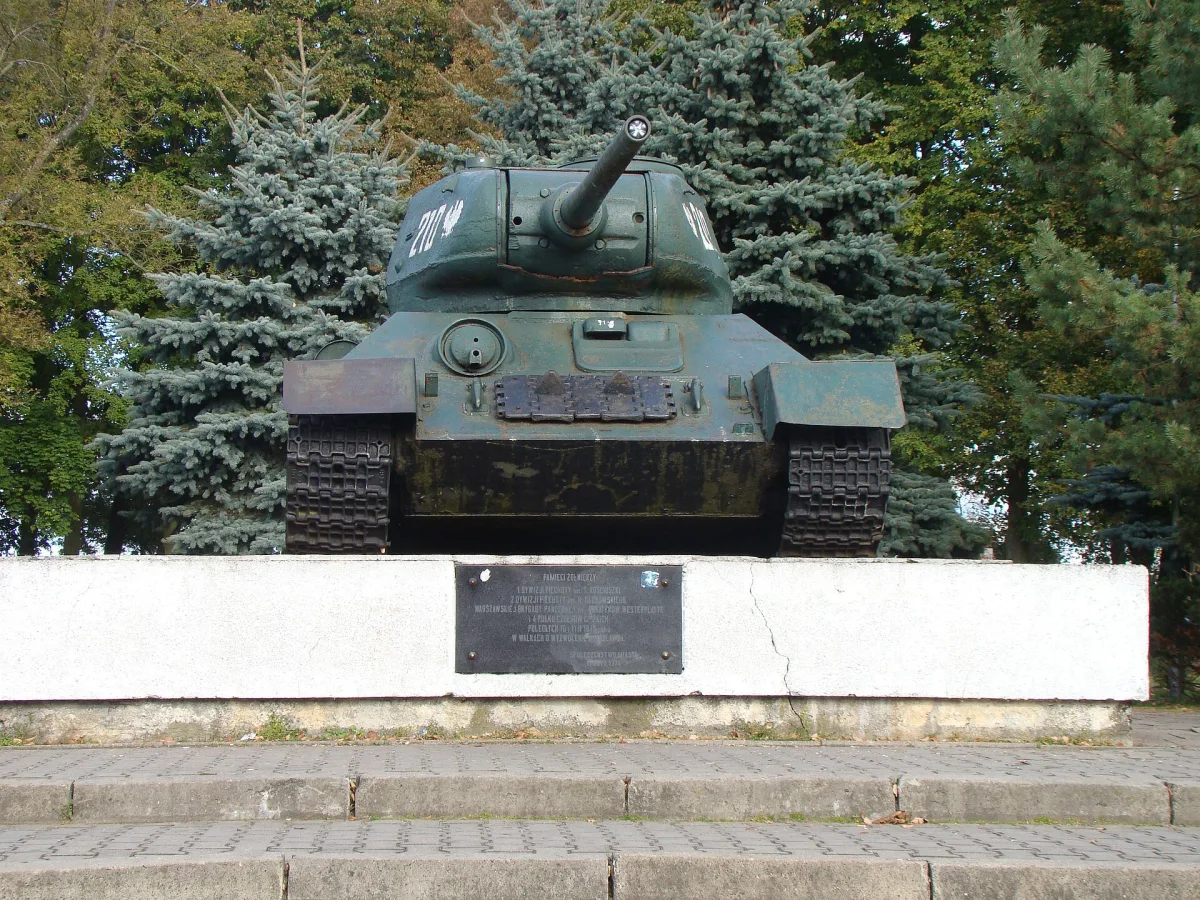
In Mirosławiec the Museum of the Battles for the Pomeranian Wall was opened on 16 March 1985 in the building of the Cultural Centre. Its central point is a diorama measuring 9 x 3.3 m, showing the fighting to break the Wall in the Mirosławiec area, and the outdoor display includes cannons, a howitzer and a T-34-85 tank.
The combat open-air museum in Zdbice is linked, according to Wikipedia, with a decision of 1980 to create the Central Memorial Area of the 1st Polish Army. Wikipedia notes that some of the exhibits did not take part in the fighting in this area.
Among the structures connected with the fortifications is also the fortress weir on the Piława near Czochryń, a reinforced concrete structure from 1932-1937 entered in the heritage register. Information on the other sites and routes is gathered by the Pomeranian Wall 1945 Association of Wałcz.
Be the first! Add a comment.
You need to log in to add a comment.
Log in