
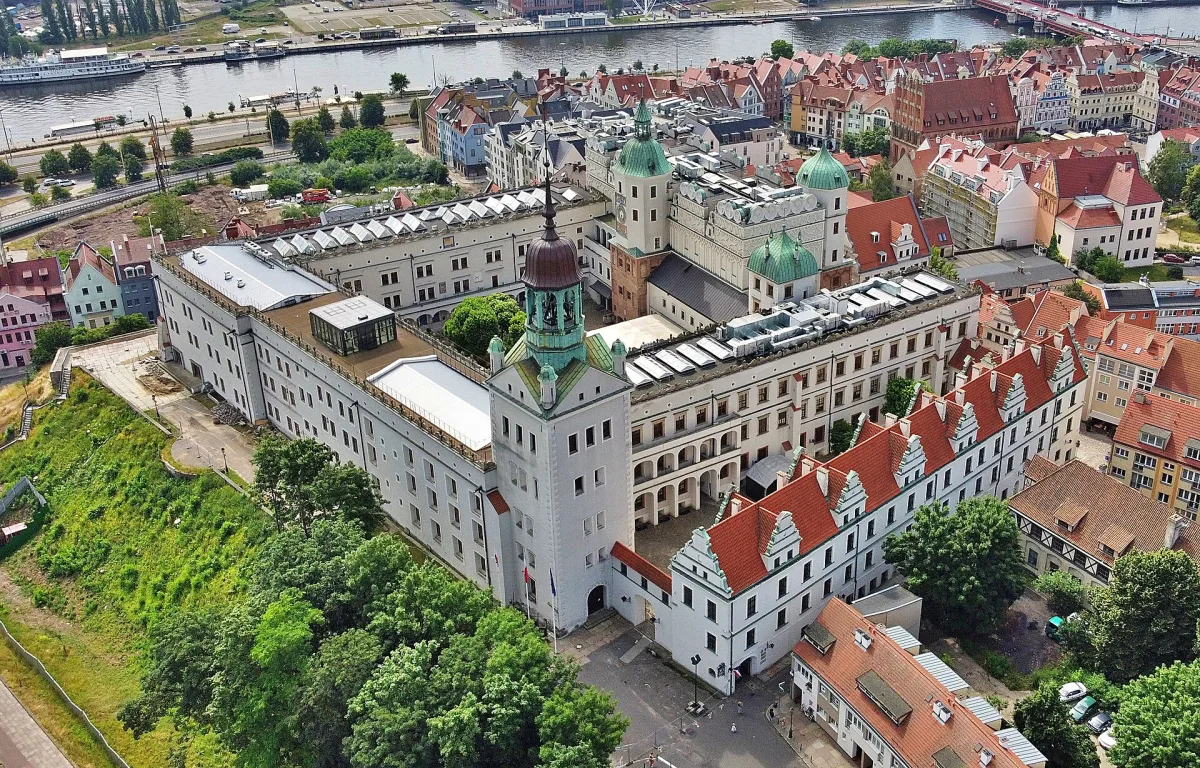
Under the north wing of the Ducal Castle in Szczecin (the Castle of the Pomeranian Dukes) there is a crypt in which the Szczecin Griffins rested for centuries. Its history shows well how, over two hundred years, attitudes to ducal graves changed: from a closed necropolis, through plunder and wartime losses, to a second burial in the 20th century. Below are dates and figures as Wikipedia gives them in the entry on the Griffins and the entry on the castle. Wikipedia is the main source here, so where it relies on a single publication, we say so plainly.
Where the Griffins were buried in Szczecin
According to Wikipedia, the Szczecin Griffins were buried in the churches of St James, of the Blessed Virgin Mary and of St Otto, and in the castle crypt. St James's Church was the earliest necropolis of the dukes in the town, and from the 16th century most burials took place at the castle. One example of the wanderings of remains is Bogislaw X. According to the Encyclopaedia of West Pomerania, he was buried in 1523 in the former collegiate church of St Otto, in 1557 he was moved to the collegiate church of the Blessed Virgin Mary, and in 1575 to the new castle church of St Otto.
1731 and 1803: the crypt opened, then the sarcophagi smashed
In 1731, on the order of the commandant of the Szczecin Fortress, the castle crypt was opened. According to Wikipedia, fourteen sarcophagi and two damaged coffins were counted at that time, but their interiors were not looked into. The opening itself did not yet mean plundering.
The destruction came several decades later. Wikipedia states that in 1803 or 1804, on the personal order of King Frederick William III of Prussia, some of the sarcophagi were smashed and valuable objects found in them were taken. The entry does not settle which year it was, so both have to be treated as possible. As the source of this information it points to a website about Polish monuments rather than a scholarly study, so the settling of the dates is left to historians.
In 1810, when Szczecin was occupied by Napoleonic troops, the crypts were visited by the Marshal of France Claude Victor-Perrin. According to Wikipedia, he was tempted by the legends of the Griffins' hidden treasures, but seeing the signs of plundering, he limited himself to looking at the interior.
From 1830 to the world wars
In 1830 two coffins from the demolished parish church of the Blessed Virgin Mary were moved to the crypt. In 1840 Princess Elisabeth Christine of Brunswick, the former wife of Frederick William II, died in Szczecin and was solemnly buried in the crypt. According to Wikipedia, on this occasion the interior was put in order and the ducal sarcophagi were emptied of historic objects, which were sent to Berlin.
Further losses came with the wars. During the First World War German soldiers, gathering stocks of non-ferrous metals, removed the copper and tin sheathing from the coffins. The coffins were protected by two or three layers of sheet metal, and the bottom layer was often left. Damage of an unspecified kind also occurred during the fighting for the city in 1945 and in the period when the state allegiance of Szczecin had not yet been settled.
After 1945: the discovery, Wawel and the missing sarcophagus
According to the entry on the castle, in 1946 the ruins were being secured and under the direction of Helena Kurcyusz a crypt with the sarcophagi of the Pomeranian dukes was discovered. The Polish administration found in it, as Wikipedia states, fourteen sarcophagi in various states of preservation and four wooden coffins lying on them. The scattered bones were collected and burnt, and the ashes were buried in the castle courtyard. The better preserved coffins and sarcophagi were moved at the end of 1946, to protect them from damp, to the first floor of the north wing.
Between 1946 and 1948 one sarcophagus went missing, in circumstances which according to Wikipedia remain unexplained to this day. A footnote to the entry, however, suggests that the trace of a theft may have arisen from counting two parts of one burial as two separate ones. In 1948 ten sarcophagi were sent to Wawel for assessment and conservation. Seven of them were judged to lack individual historic features. The stripped sheet metal was melted down into 938 kilograms of tin, then scarce and needed to repair roofs and gutters destroyed during the war.
The skeletons and the remaining sarcophagi returned to Szczecin and in 1949-1954 were displayed in the museum. Afterwards the bones in cardboard boxes ended up on the shelves of a storeroom, and some of the worse preserved, according to Wikipedia, were buried in the 1970s in the castle courtyard.
A theatre in the crypt
In the emptied crypt a small Krypta Theatre was founded in 1965, and since 1990 the cabaret Piwnica Przy Krypcie has also operated there. The name of the theatre thus comes from the place where the dukes were originally buried.
The 1990s: research and the funeral in the cathedral
In the 1990s the history of the dukes' burials became, according to Wikipedia, widely known thanks to the local press, and an initiative appeared to rebury the surviving remains. The bones were handed over for examination to the Institute of Forensic Medicine of the Pomeranian Medical Academy. The examination made it possible to identify seven skeletons as female and the bones of Bogislaw XIV, on the basis of deformations from degenerative joint disease from which he suffered in life. The entry notes that the question of establishing the identity of the remaining remains has not been concluded.
The funeral took place on 25 March 1995. It was held not in the castle crypt but in the specially prepared Chapel of the Pomeranian Dukes in St James' Cathedral. It was an ecumenical funeral, celebrated by Marian Przykucki, Archbishop of Szczecin-Kamień, and the pastor Piotr Gaś.
What remains at the castle
According to the entry on the castle, under the north wing there survive the remains of the Gothic church of St Otto and the crypt with the sarcophagi of the dukes, discovered after the war and made accessible at the castle. The ducal bones were laid in St James' Cathedral. The ducal garments and jewels were passed to the National Museum in Szczecin, where according to Wikipedia they are shown in the exhibition “The Golden Age of Pomerania”. Wikipedia adds that objects and clothing taken from the coffins are on display.
Be the first! Add a comment.
You need to log in to add a comment.
Log in