
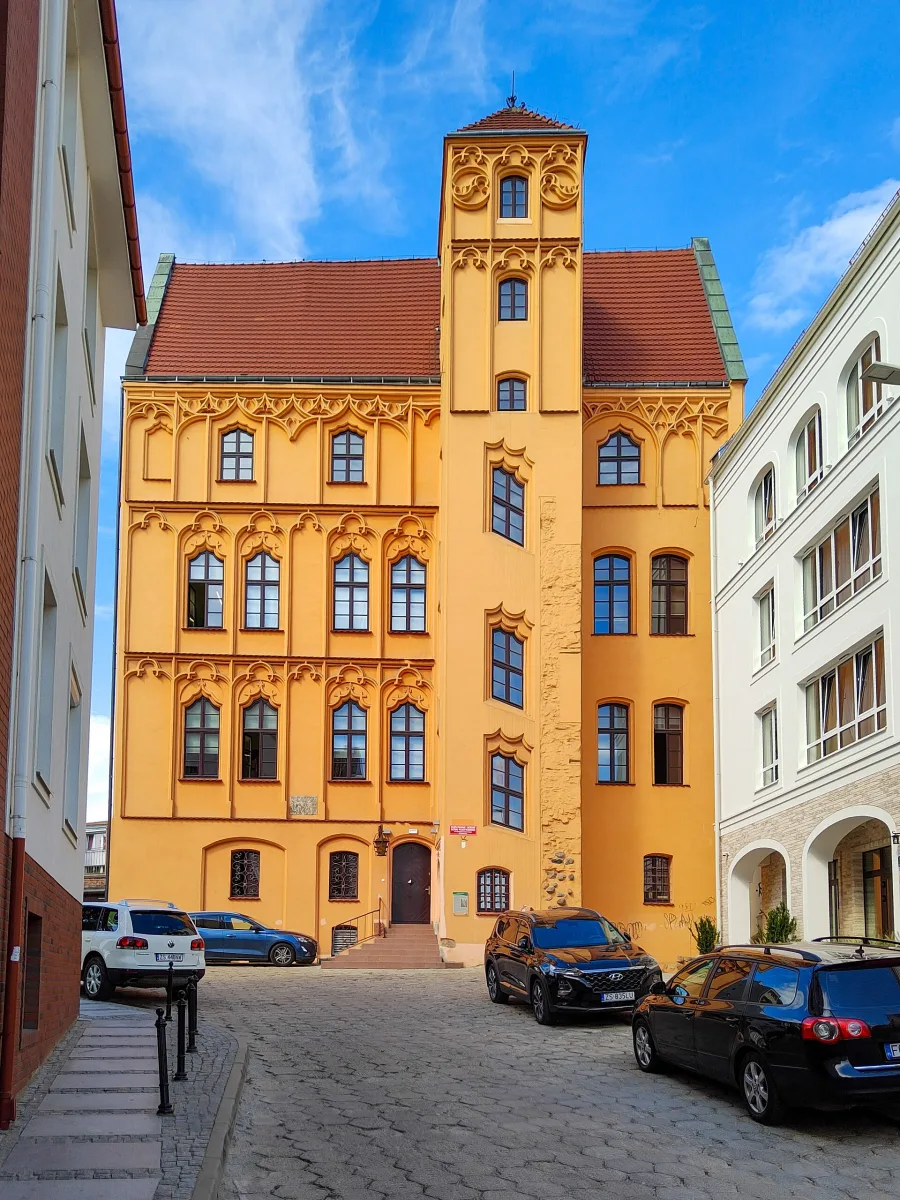
Szczecin belonged to the Hanseatic League, and the city's merchants, organised in guilds, had for centuries their own seat called the Sailors' House (Dom Żeglarza, in German Seglerhaus). We can no longer see the building itself: it stood near today's Rynek Sienny (Hay Market), and what remains are entries in encyclopaedias and a few neighbouring historic buildings. We can, however, trace how this corporation worked and what happened to it over the following centuries.
Szczecin in the Hanseatic League: what the sources say
According to Wikipedia, Szczecin became a Hanseatic city in the 13th century. The table of cities in the entry on the Hanseatic League gives 1278 as the year Szczecin joined, and adds that in 1283 the city entered the Rostocker Landfrieden group, regarded as the predecessor of the federation of Wendish cities (from 1293). From the 14th century, according to the same entry, Szczecin gradually took over the role of the main city in the Pomeranian zone.
The Encyclopaedia of West Pomerania (Pomeranica) links the year 1283 to something else: the privilege of free trade in Scania, which was obtained by the burghers of Szczecin. In the 1280s, according to Pomeranica, the first guild was founded in Szczecin, bringing together merchants and sailors.
The guilds: who belonged to them and why they existed
Pomeranica describes the guilds as organisations of merchants and financiers engaged in maritime trade and in large-scale wholesale and retail trade. Their main purpose was to defend the privileges they had obtained, for example staple rights and free trade with the Scandinavian countries, and also to organise the protection of convoys and trade routes. Members also jointly arranged social and religious life, exchanged information and undertook larger commercial and financial ventures. Representatives of the guilds represented the interests of merchants before the city and ducal authorities and in the Hanseatic League.
According to the same source, some ten years after the first guild was founded, shipping and trading fraternities were formed within it, bringing together merchants and sailors operating in particular areas. Members of the first guild were called grosites, that is financiers, because of their large financial means and large-scale operations.
- In 1444 the guild of grocers was founded, bringing together dealers in spices, metals and silk; according to Pomeranica, they soon gained a monopoly on trade in basic necessities.
- Around 1466 the guild of cloth cutters was founded, dealing in the wholesale and retail sale of fabrics.
The Sailors' House: the guilds' seat on Szewska Street
Pomeranica states that all these guilds, following the example of Hanseatic cities, had a shared seat, a so-called court, in the Sailors' House. Meetings were held there, professional matters were handled and people met socially. Supervision of the corporation and the settling of disputes between members were entrusted to an eight-person Council of Elders.
The Pomeranica entry on the Guido Reck Square describes where it was. The main building (recorded as zeghlerhus, 1405) belonged to the guild of merchants and sailors, that is, as the entry puts it, the so-called great merchants, wholesalers. It stood on the Szewska Street side, on the plot, which no longer exists, at Szewska 18. Along the upper part of Kurkowa Street, running towards the Loitz House, stood small houses belonging to the Sailors' House, and between the house and the sailors' stalls by the tenement house there operated, according to the same entry, the oldest comedy theatre in Szczecin. Wikipedia writes of the Municipal Theatre that before its opening in 1848, mostly amateur and travelling companies performed in the city, among others on the stage at the Sailors' House.
The merchants of the Sailors' House were also a party in the city's affairs. According to Pomeranica, in 1762 they proposed to the city council moving the stalls of retail merchants from the Bollwerk quay to the Vegetable Market (Rynek Warzywny); the council granted the request seven years later, in 1769, at the cost of removing the medieval pillory from that spot.
From resistance to Prussia to liquidation
According to Pomeranica, the importance of the guilds began to decline at the end of the 16th century, and the merchants of Szczecin, attached to tradition, did not want to change the old social and financial relations, which deepened the economic collapse of that period. After taking over Szczecin from the Swedes, the Prussians considered the corporation of the Sailors' House obsolete and inefficient in 1721. They tried to replace it with specialised trading companies: for trade with Russia, the grain trade and the Levant trade. In the face of resistance from the members of the Sailors' House, all three failed.
In 1821 the corporation was liquidated, and in its place, according to Pomeranica, a modern, state-supported Merchants' Corporation was established. Its creation was linked, among other things, to the Industrial Freedom Act of 1810. The corporation nevertheless inherited many features of the old guilds, including the ability to control the private lives of its members and so-called merchant morality.
What remains of the Sailors' House
According to Wikipedia, in the years 1833-1835 a stock exchange building referring to the architecture of Karl Friedrich Schinkel was erected on the site of the former Sailors' House and nearby buildings, on the corner of Panieńska and Szewska streets. It stood next to the former guardhouse. In 1938, after the interior was rebuilt, its name was changed to Haus der Wirtschaft. In the night air raid on Szczecin of 16 to 17 August 1944 the building was partly destroyed. After the war its reconstruction was planned, but in 1951 the building was demolished. Today, as the photograph in the Wikipedia entry shows, a block of flats stands in its place.
The best place for a walk is Rynek Sienny, by which the stock exchange building stood, and beside it the Old Town Hall with the Museum of the History of Szczecin. The Loitz House on Kurkowa Street, late Gothic, from 1547, in turn recalls the wealthy burghers of old Szczecin; the small houses of the Sailors' House stood right next to it. The Sailors' House has long ceased to exist, but for centuries this small fragment of the Old Town was a place where merchants decided their affairs together.

Be the first! Add a comment.
You need to log in to add a comment.
Log in