
A fortress instead of medieval walls
According to Wikipedia, Szczecin was taken by the Swedes in 1630, and on 21 January 1720 Queen Ulrika Eleonora sold the town together with the eastern part of Swedish Pomerania to the King of Prussia for 2 million thalers. Prussia had in fact taken control of the town as early as 1713 and began planning a new fortress then. The entry on the Szczecin Fortress says that in 1724-1740, under the direction of the Dutch engineer Gerhard Cornelius van Wallrawe, a system of bastions, ravelins and lunettes was built, and with it the town gates were rebuilt.
This construction swallowed up the remains of the medieval fortifications. Of the old walls, which according to Wikipedia were first mentioned in 1283, there remains, among others, the Maiden Tower (Baszta Panieńska), also known as the Tower of Seven Cloaks. Stones from demolished structures were reused: the Encyclopedia of West Pomerania records that some of the stones from the foundations of the New Gate, demolished in 1732, went into the water supply bringing water to the well on today's White Eagle Square. According to Wikipedia's entry on that square, the fountain was put into operation on 15 August 1732, as the completion of the new water supply.
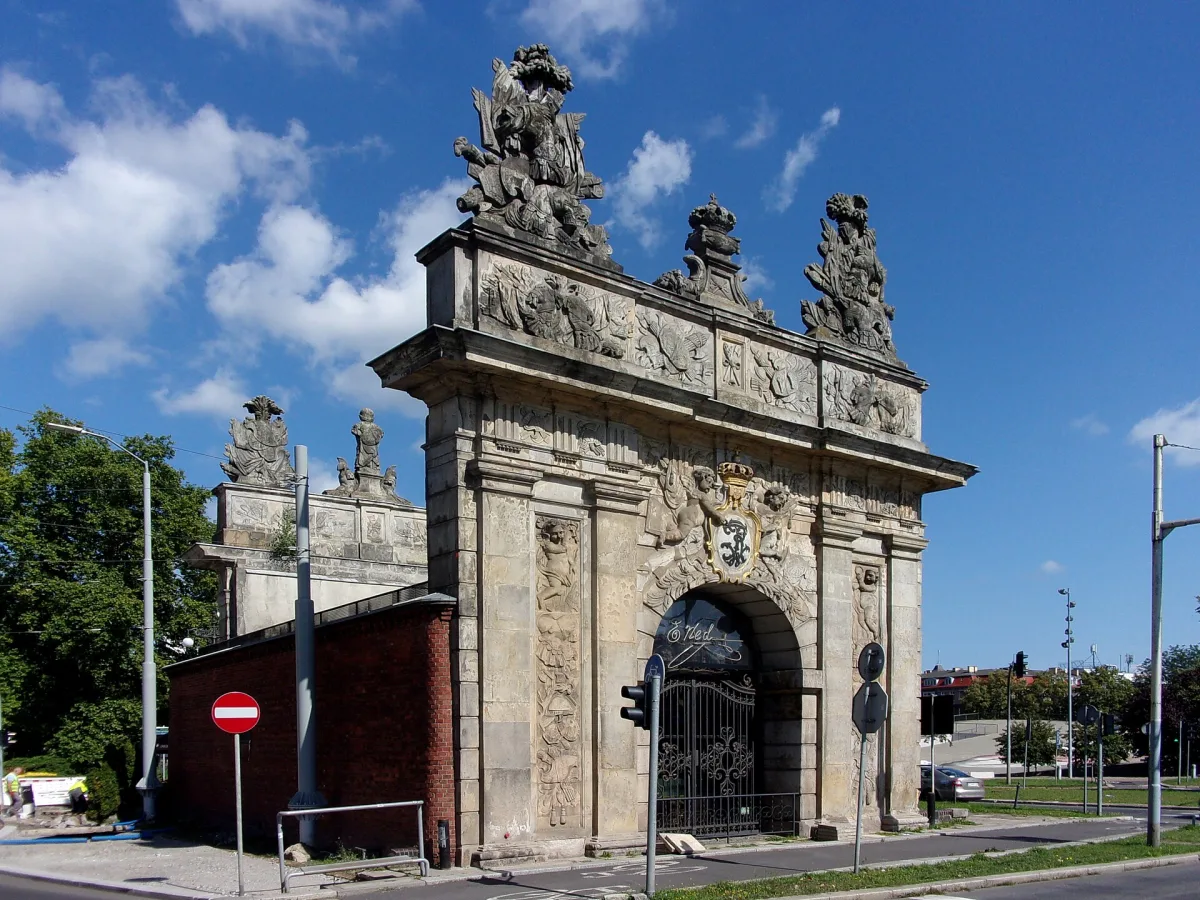
Port Gate: the former Berlin and Brandenburg Gate
The Port Gate has had several names. Before the war it was called the Berlin Gate, because the road to Berlin led through it. The Encyclopedia of West Pomerania states that from 1721, on the order of King Frederick William I, this name was given to the earlier New Gate, which was demolished in 1732. The imposing outer gate on the other side of the moat, built according to the same source in 1724, bears the name Brandenburg Gate in its inscription.
The years of construction differ depending on the source. Wikipedia gives 1725-1727, and the Encyclopedia of West Pomerania in the entry 1724-1725; in the box of the same entry there is also the record 1725-1740. They agree, however, on the designer: according to both sources it was van Wallrawe. The gate is in the heritage register under number A-790 of 1954.
The facade is decorated with a shield bearing the monogram of Frederick William I, and in the attic there is a plaque with a gilded inscription in Latin. According to Wikipedia, the outer wall was decorated by the French sculptor Bartholomé Damart. Above the inscription one can see a panorama of the town with Viadrus, the god of the Oder, and above it a shield with the coat of arms of Prussia under a royal crown.
What does the inscription say? According to the translation by Maciej Słomiński, quoted in the Encyclopedia of West Pomerania, Frederick William I, King of Prussia, purchased the Duchy of Szczecin, ceded to the electors of Brandenburg and granted as a fief to the dukes of Pomerania, which then passed to the Swedes. For a fair price he acquired it as far as the Peene, and to commemorate this he ordered the Brandenburg Gate to be built in the year 1719. The year on the plaque is therefore the year of purchase recorded in the inscription, not the date of construction: Wikipedia, in the entries on Szczecin and on the fortress, gives the year 1720 for the takeover of the town, so the years from the inscription and from the entries do not coincide.
Royal Gate: from the Mill Gate to the Anklam Gate
The Royal Gate stands on the former Prussian Homage Square, at the junction of Matejki Street and Polish Soldier Square. According to Wikipedia, it was built in 1725-1728 as a gate on the site of the town walls, to a design by van Wallrawe, and the Encyclopedia of West Pomerania gives the same years. It replaced the Mill Gate, demolished in 1726-1727. For this reason, in September 1725 the king ordered that the new gate should be called the Anklam Gate, after the town of Anklam, which in older Polish publications is also called Nakło nad Pianą.
The name Royal Gate appears later, and the sources do not agree on the year. Wikipedia speaks of 1806, while the Encyclopedia of West Pomerania claims that the name Anklam persisted until 1840, and in 1841 the gate was given the name Royal, in honour of King Frederick William I. After 1945 the names Anklam Gate, Nakło Gate and Prussian Homage Gate were in use.
The most striking features are the gables carved by the court sculptor of Frederick William I, Bartholomé Damart, according to Wikipedia: Mars with a sword and shield and Hercules with a club and a lion skin. Above the passage is a panoply with a shield bearing the Prussian eagle, surrounded by the chain of the Order of the Black Eagle. The carved weapons, armour and banners refer, as Wikipedia writes, to the Roman tradition of triumphal processions and of hanging captured weapons on town gates. On the western elevation a plaque was unveiled in 1999 in memory of Gen. Dezydery Chłapowski, a prisoner of the Szczecin fortress in 1833.
Parade ground, demolition and the fate of the gates
Behind the Royal Gate stretched a square that, according to Wikipedia, began to be laid out in 1725. Officially it was called Königs Platz, and the residents called it the White Parade Square. Today it is Polish Soldier Square. On it, on 10 October 1793, the marble Monument to Frederick II the Great was unveiled, which can now be seen in the courtyard of the National Museum.
The fortress began to limit the town's development. According to Wikipedia, in 1873 it was decided to dismantle it, and demolition began in June of that year. Fort Leopold, which stood in the area of today's Chrobry Embankment, gave way to the terrace. Two gates were saved, entered in the heritage register on the same day, 11 June 1954. During the Second World War the carved gables of both gates were taken down and hidden in the Arkoński Forest, and the gates themselves were covered with ivy. According to Wikipedia, the gables were found in 1957 and set back in place.
After the war the Port Gate housed for many years a shop selling artistic products, and the Royal Gate, after renovation in 1994, an art gallery and a catering venue. Until 1932 in front of the Port Gate stood a fountain with a statue of Amphitrite by Reinhold Felderhoff. The square in front of it links with Victory Square.
The Royal Gate stands, according to Wikipedia, about 300 metres from the Ducal Castle (the Castle of the Pomeranian Dukes), on the edge of the Old Town. Like the Port Gate, it was built on the site of the old town walls.

Be the first! Add a comment.
You need to log in to add a comment.
Log in