
A city in ruins and the first day of Polish administration
According to Wikipedia, citing data from the Szczecin history portal, Allied air raids from 1943 destroyed 60-70% of Szczecin's buildings, 70-80% of the port with its associated facilities and almost 90% of industrial sites. The last Gauleiter of Szczecin and Pomerania, Franz Schwede-Coburg, left the city on 25 April 1945. The next day it was occupied by the Soviet 65th Army under Gen. Pavel Batov.
Two days later, on 28 April, Piotr Zaremba, an urban planner from Poznań, and Captain Jaśkiewicz reached the city. Zaremba had set out from Piła, the first seat of the Polish authorities of the region, as the future mayor of the city. According to Wikipedia, citing his account, of more than 300 thousand former residents about 6 thousand remained in the ruins. The entry on the history of Szczecin adds that at that time there were about 200 Poles and about 6 thousand Germans in the city, gathered in the Niebuszewo district.
Zaremba found the building of the former Regierung by the terraces that were then called Hakenterrasse and are today the Chrobry Embankment. On 28 April at 14.15 he declared to the Soviet commandant of the city, Col. Aleksandr Fedotov, that from that moment civil authority in the city was being taken over by the Polish authorities. It was jointly agreed that they would take three buildings on the embankment: the later Voivodeship Office, the building that today houses the National Museum (then the Museum of West Pomerania), and the building of the later Maritime University.
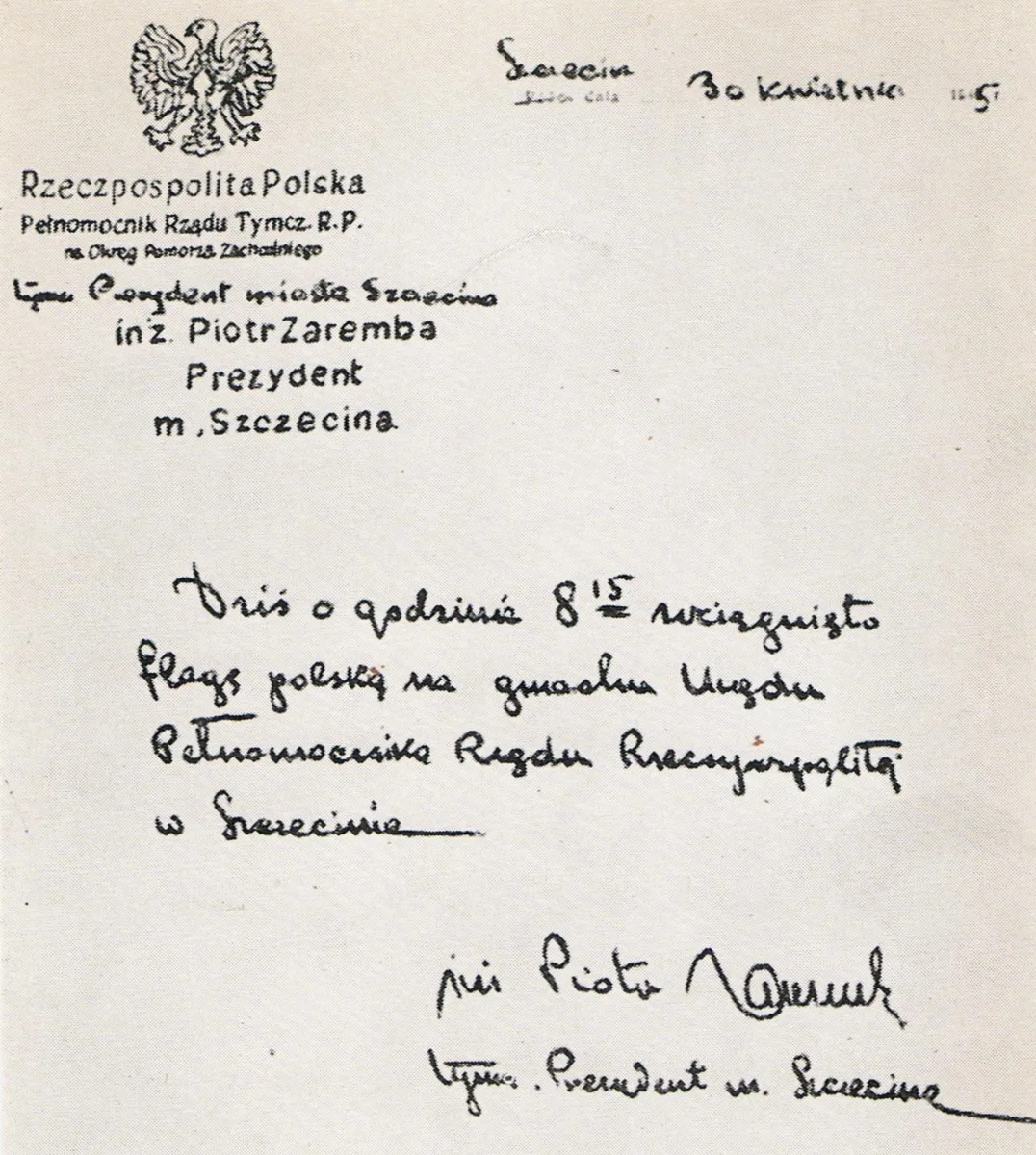
The first official document of the Polish administration in the city dates from 30 April 1945. It is a handwritten report on the raising of the Polish flag on the building of the Office of the Government Plenipotentiary. On a form headed “Piła”, that word was crossed out and “Szczecin” written in.
May and June: withdrawal and return
The office of the government plenipotentiary for West Pomerania moved to Szczecin on 8 May 1945, with the arrival of Lt. Col. Leonard Borkowicz. The status of the city nevertheless remained uncertain. According to Wikipedia, the original arrangements spoke of a border on the Oder, so on 5 May the Soviet commandant agreed to the creation of a German civil administration. It began work in Niebuszewo and in time took in the whole city.
Wikipedia states that on 12 May Borkowicz sent the government a note in which he complained of obstacles to Polish settlement created by the Soviet side and of violence by soldiers against civilians. The government gave no support and ordered the evacuation of the Polish administration, which was carried out on 17-19 May. The office then operated in Stargard (17-23 May) and afterwards in Koszalin. In the entry on Zaremba this decision is described differently: the office was moved under pressure from the Western members of the anti-German coalition. The two entries agree on the dates and differ in the reason given.
From 19 May the city was again administered by the Soviet military authorities together with the German city administration. According to Wikipedia, the number of German residents then rose from about 6 to about 24 thousand (the calculation is by Agata Łysakowska, Histmag, 2015).
In the first days of June the commander of the 2nd Belorussian Front, Konstantin Rokossovsky, conveyed to Borkowicz Stalin's position that the Polish administration could return. Zaremba returned to Szczecin on 9 June, but at that time there were two administrations in the city, Polish and German. Ten days later, on 19 June, the Polish administration had to leave the city for the second time. After this second withdrawal the city was handed over to the Polish side in July.
5 July 1945: the formal handover
According to Wikipedia, on 1 July the command of the Soviet occupation forces in Berlin announced the handover of Szczecin to the Polish side, and on 3 July this was confirmed by the administration of Marshal Georgy Zhukov. On the same day Borkowicz and Zaremba were in Berlin for talks on removing the city from the Soviet occupation zone. According to Zaremba, on 4 July they were informed that the city had been awarded to Poland.
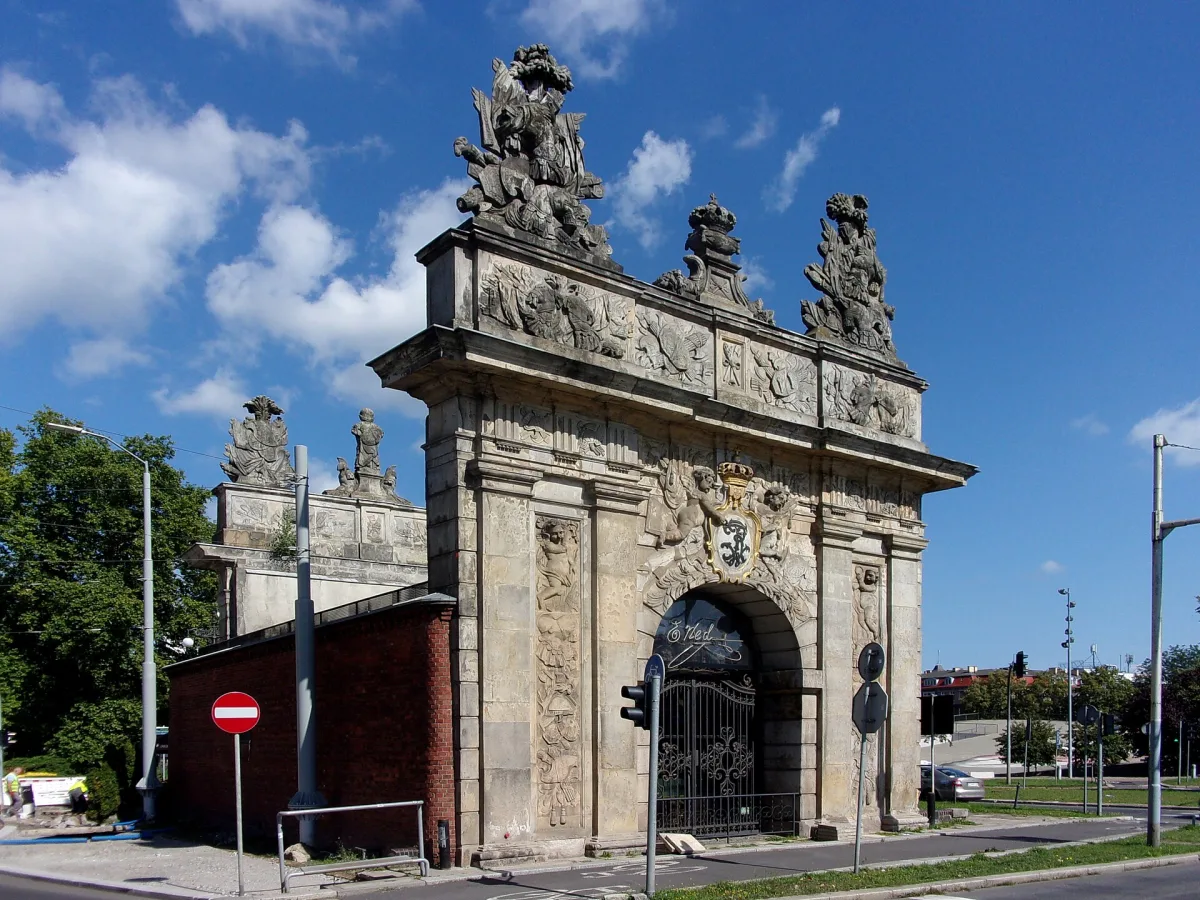
The handover took place on 5 July at 18.00. The German mayor Erich Wiesner then handed power to Zaremba in the seat of the military commandant, in the building that today houses the City Hall. The Encyclopedia of West Pomerania also gives 5 July as the date of the takeover of Szczecin by the Polish authorities. Four days later, on 9 July, the first issue of “Wiadomości Szczecińskie” appeared, a bulletin of the Office of Information and Propaganda, which Wikipedia calls the first Polish newspaper in the city. In a photograph from 1945 that Wikipedia captions as a view of the Port Gate, an inscription can be seen reading “Welcome to the government of national unity”.
The takeover of the city did not include the port. According to Wikipedia it remained in Soviet hands until 1947, and partly until 1955. The office of the plenipotentiary returned to the Chrobry Embankment only in February 1946.
The border: Potsdam and Schwerin
The Potsdam Conference, which lasted from 17 July to 2 August 1945, did not finally settle the border. According to Wikipedia, no decisions were taken there on the lands placed under Polish administration, including Szczecin, because they were to be taken by a peace conference, which never took place. The course of the border west of Szczecin and Świnoujście was decided, as the same encyclopedia states, by Stalin. The document on delimitation was signed on 21 September 1945 in Schwerin. It was signed by Gen. Ivan Khabarov on behalf of Marshal Zhukov, Lt. Col. Leonard Borkowicz on behalf of the Provisional Government of National Unity, and Piotr Zaremba. Wikipedia notes that the document referred to the decisions of the Potsdam Conference contrary to the facts.
In 1945 there was not yet a Polish-German border in the conventional sense. Wikipedia recalls that the border agreement between Poland and the German Democratic Republic was concluded in July 1950, and that earlier it was a changeable line between the lands under Polish administration and the Soviet occupation zone.
How the museum tells it
Zaremba led the city until 1950. The events of 1945 are described by the exhibition in the Przełomy Dialogue Centre, the underground pavilion of the National Museum in Szczecin, opened on 25 January 2016. According to Wikipedia, the exhibition begins with the incorporation of Szczecin within the borders of Poland in 1945.
Be the first! Add a comment.
You need to log in to add a comment.
Log in