
A grave from the cliff and a cemetery in the forest
The area around Bagicz has been a site of archaeological discoveries since the late 19th century. According to Wikipedia, in early 1899 a local fisherman found a log coffin in a low cliff from which abrasion was washing out the soil: a hollowed oak trunk 3 m long and 0.5 m in diameter, containing, in peaty soil, an almost complete skeleton of a woman with pieces of jewellery. In the literature she is known as the “princess” or the “woman from Bagicz”. It is not a barrow and not a Bronze Age grave: Wikipedia attributes the burial to the Goths of the Wielbark culture.
In spring 1899 the find was examined at the museum in Szczecin by Hugo Schumann together with Almgren, who dated it to the 2nd or 3rd century AD. According to Wikipedia, the grave was examined again in the 1970s and 1980s by a team led by Ryszard Wołągiewicz, and in 2018 by researchers from the Department of Archaeology at the University of Szczecin. In the second half of the 1930s, during construction of the airfield, cremation graves with urns were found: three of the Wielbark culture and one of the earlier Oksywie culture. Rescue excavations were led by Otto Dibbelt, founder of the first museum in Kołobrzeg.
In 2017, thanks to laser scanning of the terrain, a barrow cemetery of the Wielbark culture was discovered about 1 km from the earlier finds. According to Wikipedia, 57 burials were identified over an area of about 5 ha, in a forest about 2.5 km from the seashore. Field research has been carried out since 2017 by Dr Marta Chmiel-Chrzanowska of the Department of Archaeology at the University of Szczecin. In February 2018 Robert Maziarz, owner of the Patria Colbergiensis Museum in Kołobrzeg, discovered another cremation burial of this culture in the cliff face, close to the spot where the 1899 grave was found.
A village expelled in 1935 and the airfield
Bagicz, German Bodenhagen, was founded in 1753, according to Wikipedia, on marshy ground at the edge of the Kołobrzeg Forest, on the site of the medieval settlement of Boltenhagen. In 1935 the authorities of the Third Reich expelled the inhabitants and began building a military complex on the site, code-named Kolberg Flugplatz. Of the former village only the railway station with adjoining buildings survives.
According to Wikipedia, the airfield was built between 1935 and 1939. It was initially home to Junkers Ju 87 Stuka bombers, later Junkers Ju 86. In September 1939 aircraft that carried out raids on Poland operated from Bagicz. In 1941 outdoor scenes for the German propaganda film “Kampfgeschwader Lützow” were shot here. The Germans left the airfield in March 1945, when the front approached Kołobrzeg.
From March 1945 the base and the neighbouring garrison estate of Podczele were occupied by the Red Army. According to Wikipedia, a self-contained, extraterritorial zone covering 162.48 ha was created there, with its own hospital, school and shops, and about 2,000 soldiers stationed in it. After 1956 the airfield was extended with a longer runway, parallel to the seashore and adapted for jet aircraft. From 1965 MiG-21 fighters were stationed here, and from 1973 MiG-23s as well. After 1966 construction began on hangar shelters and facilities in which, according to Wikipedia, Scud or SS-20 missile launchers may have been stored.
After a MiG-23 crash in 1989 the fighter-bomber regiment was moved to Brzeg and a helicopter regiment was relocated in its place. The last military helicopters left Bagicz in 1991, and the last Russian soldiers left in spring 1992. The base grounds were divided between the town of Kołobrzeg and the municipality of Ustronie Morskie, and Podczele became a residential district of Kołobrzeg. Wikipedia states that the civilian airfield was built in July 2012 and opened on 9 September 2012. It describes it as a seasonal airfield handling tourist and charter traffic of small aircraft. The airfield's current status is given by its operator.
Ustronie Morskie: a seaside resort and fortifications in the forests
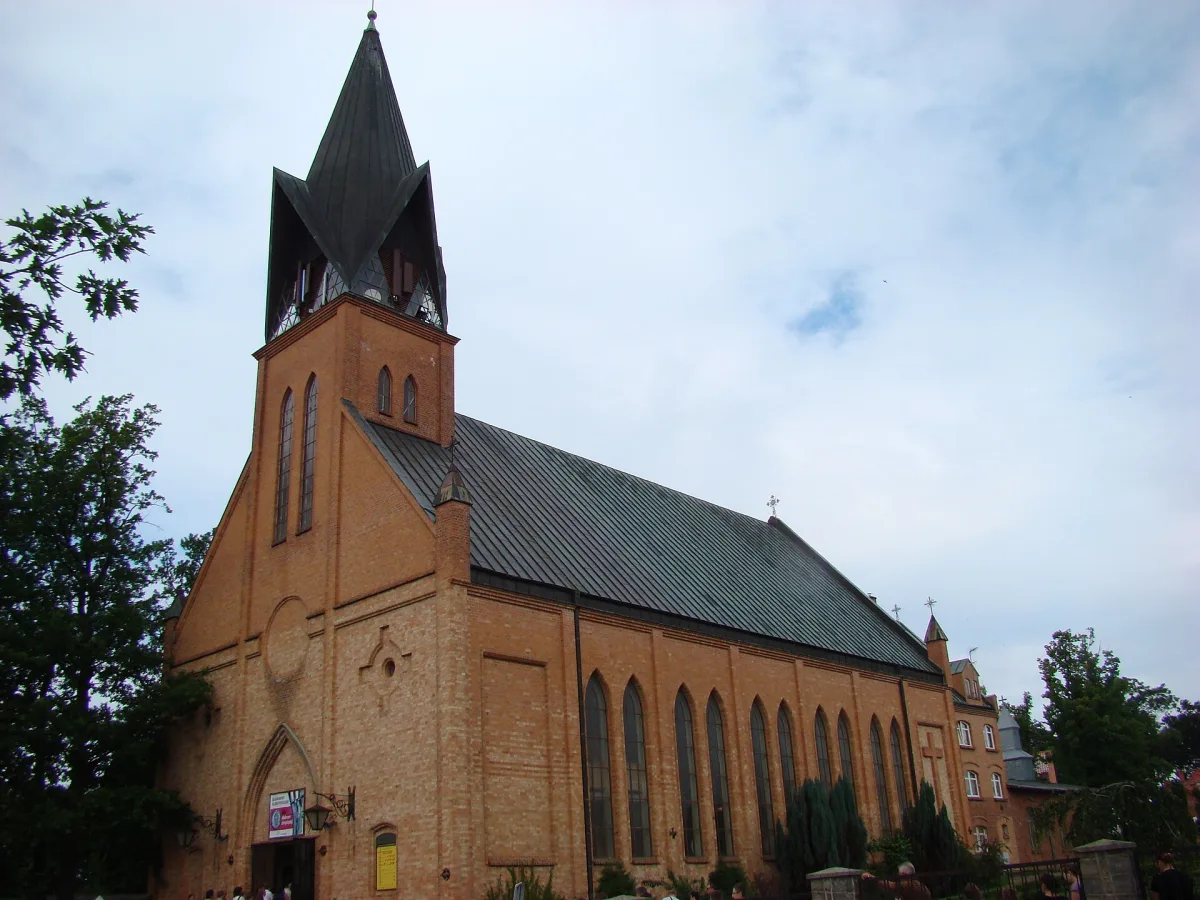
According to Wikipedia, Ustronie Morskie was a fishing village until the end of the 19th century. The development of tourism began after the Koszalin-Kołobrzeg railway line opened in 1899. In 1899 there were 360 guests, in 1905 about 1,200, and shortly before the First World War about 3,000. In the 1920s the village was among the better-known seaside resorts of Germany at the time. After 1945 it was called Ustronie Nadmorskie, and in the late 1960s there were five centres of the Workers' Holiday Fund with about 775 beds. According to Wikipedia, the summer bathing area covers 2,100 m of coastline and held the Blue Flag in the seasons of 2006, 2007 and 2010 to 2013. In the village stands the neo-Gothic Church of the Exaltation of the Holy Cross, built in 1885 according to its description.
In the coastal forests east of the village, fortifications from the Polish People's Republic period survive. According to Wikipedia, four coastal artillery battery positions were built there in the 1950s as part of the coastal defence system. The 31st Fixed Artillery Battery had four Soviet 130 mm guns on reinforced concrete bases, which defended the approach to the port of Kołobrzeg. The unit was reduced to a cadre in 1961 to 1965 and withdrawn from service in the early 1970s, leaving the guns in place. Beyond the Czerwona River, on the remains of German buildings of a Luftwaffe facility, firing positions of the 42nd Missile Battalion were built; it was disbanded in 1995. Wikipedia describes these fortifications as decaying, and bunkers and gun emplacements are said to be hidden in the forests.
Outside Ustronie, near Bagicz, grew the Bolesław oak, named in 2000 in honour of Bolesław the Brave (Bolesław Chrobry). The State Forests gave its age as about 800 years, but according to Wikipedia the authors of “Drzewa Polski” (Trees of Poland) from 2016 estimate it at about 400 years, because the age was not measured by dendrochronology. The oak was toppled by a gale in the night of 31 May to 1 June 2016, and its remains were left in place as a natural monument.
Be the first! Add a comment.
You need to log in to add a comment.
Log in