
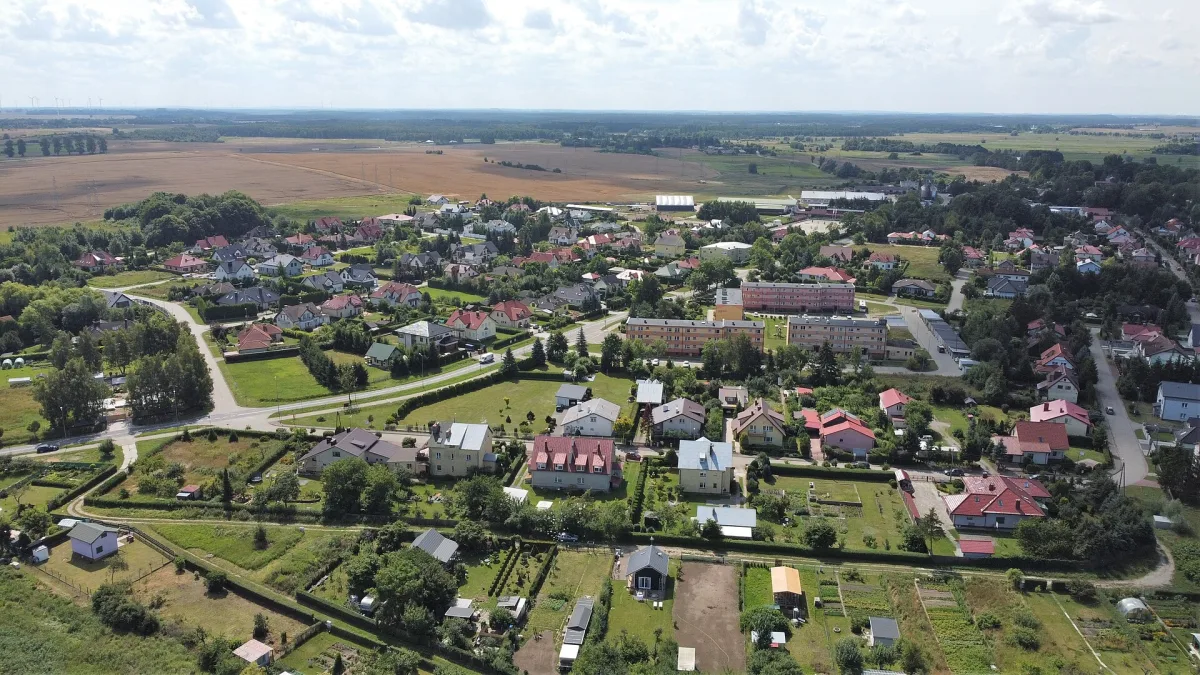
Budzistowo is a village on the Parsęta River, four kilometres from where the river meets the sea. Until 1948 it bore the German name Altstadt, meaning Old Town, and that name itself reveals what this is about: according to Wikipedia, the pre-charter Kołobrzeg lay here. The town that now stands directly on the sea was founded only in 1255, and the earlier centre, with its stronghold, salt and first bishopric, has to be sought inland.
The stronghold on the Parsęta and the salt it stood on
The dates of the beginning are not uniform in the sources. The Wikipedia entry on the village says that its history goes back to the 8th century and that a fortified stronghold arose in the middle of the 9th century. The entry on the history of Kołobrzeg gives around 880. The entry on the hillfort itself distinguishes two stages: an open settlement from the 8th/9th century and the first half of the 9th century, and the stronghold itself from the second half of the 9th century to the 13th century, according to the dating of finds, which included coins and timber elements that braced the rampart.
The basis of the wealth was salt. According to Wikipedia, as early as the 7th century a settlement extracting salt from brine springs operated on Salt Island by the coast, and the salt was transported to Greater Poland and Silesia. Craftsmen worked iron, antler and amber, which were also traded with the Vikings. The name itself is tied to salt: the Encyclopedia of West Pomerania notes that the Latin salsae Cholbergiensis, meaning the Kołobrzeg brine, appears in sources as early as the 10th century, which is rare in Pomerania, and most of the roughly twelve hypotheses about the origin of the name link it to salt.
Wikipedia describes the hillfort as an upland, two-part site with an area of about 4 hectares: the stronghold proper measures 150 by 250 metres, and the fortified southern suburb about 110 by 30 metres. The timber-and-earth rampart is partly visible to this day, and traces of a moat have survived in the north. The complex also included an unfortified northern suburb, a settlement beside the stronghold, a presumed harbour and a bridge. The hillfort was entered in the heritage register in 1960. According to Wikipedia, which cites a 2005 study by Robert Śmigielski, Kołobrzeg at that time may have had between two and four thousand inhabitants.
In the middle of the 10th century, as Wikipedia writes, the stronghold came within the Piast state. The entry on the history of Kołobrzeg speaks of an expansion after 979, which is said to be confirmed by the timber crib structures (izbice) characteristic of the Piasts, that is, wooden boxes in the construction of the ramparts.
The year 1000: Bishop Reinbern and the Congress of Gniezno
The oldest certain written trace comes from the Chronicle of Thietmar of Merseburg. According to it, at the Congress of Gniezno in 1000, when the Archbishopric of Gniezno was created, Reinbern, bishop of the church of Kołobrzeg Salt (Salsae Cholbergiensis aeclesiae episcopus), Poppo of Kraków and John of Wrocław were to be subordinate to its archbishop, Radzim. Unger of Poznań remained outside this arrangement. Wikipedia points out that in this way Kołobrzeg was placed on a par with Kraków and Wrocław.
Little is known about Reinbern. Wikipedia stresses that we know him solely from Thietmar's information. He came from Thuringia. According to the chronicler he fought paganism, destroying and burning temples with statues of idols, and he cleansed the sea, in which evil spirits dwelt, by throwing into it four stones anointed with holy oils and sprinkled with holy water. In 1004 his chaplain was at the side of Bolesław the Brave in Bohemia, and before 1013 Reinbern set out for Rus as chaplain to the daughter of Bolesław the Brave. There he was imprisoned and, as Wikipedia reports, died in prison; the date of his death is not known.
The bishopric did not last long. The entry on the Diocese of Kołobrzeg says that it collapsed between 1007 and 1015 as a result of a return to the native faith, the entry on Reinbern himself dates the collapse to around 1007, and the entry on Kołobrzeg to 1007-1013. Wikipedia assumes that the first cathedral stood in the suburb. The archaeologist Lech Leciejewicz put forward a hypothesis that after 1000 Reinbern began to build a stone cathedral here, but he based it on two minor finds: a fragment of a ceramic tile with a relief and a stone slab, perhaps the remains of a floor. The entry on the hillfort adds a caveat that the idea is a subject of discussion and remains an unconfirmed hypothesis.
After the collapse of the bishopric Kołobrzeg, as Wikipedia describes, regained its independence. In 1103 Bolesław the Wrymouth failed to take the stronghold because its fortifications proved too strong, and success came in 1107 or 1108. Gallus Anonymus called Kołobrzeg a famous town.
The Church of St John the Baptist: 1222 or later
In Budzistowo today stands a small brick church, single-aisled, measuring 8 by 5 metres, with a wooden bell turret. It was entered in the heritage register in 1959. The Wikipedia entry on the village calls it the oldest church in Pomerania and dates it to 1222. It should be noted, however, that the description "oldest" appears only in this entry, and the separate entry on the church is more cautious: it speaks of a church from 1222 or the middle of the 13th century, or around 1281.
According to this separate entry, the first church, perhaps still wooden, was founded in 1222 by the Pomeranian duchess Mirosława, mother of Barnim I. The brick church was built presumably around 1250, no later than 1281, when it was mentioned. It was donated to the monastery in Mogilno, and according to a source from 1333 it was subordinate to the Bishop of Kamień. The entry on the history of Kołobrzeg, by contrast, says that the church was mentioned in chronicles as early as 1222. The heritage register speaks only generally of the 13th century.
The history of the building is a history of destruction and repairs. After the Reformation and the Thirty Years' War it was devastated and its demolition was considered, but in 1670 it was repaired. It was damaged by the Russian siege of Kołobrzeg in 1760 and by the siege of 1807. The rebuilding of 1824 changed its appearance: a new entrance was cut in from the west, a half-timbered turret covered with shingles was raised in the upper part, and the side portals were walled up. In 1945 the fighting destroyed the top of the tower and part of the glazing. The church was consecrated again in 1980. The presbytery has rib vaulting. Around the Church of St John the Baptist the former churchyard has survived, with old lime and maple trees, without gravestones.
The year 1255: a new town closer to the sea
Wikipedia states that on 23 May 1255 Duke Warcisław III and the Bishop of Kamień, Herman von Gleichen, chartered a new town under Lübeck law. The town received 100 lans (łany) of arable land, the Kołobrzeg forest and the right to fish in the sea between the mouths of the Rega and the Parsęta, and for five years it was exempt from all dues. It was founded closer to the coast, north of the old stronghold.
The old stronghold was abandoned and survived in memory as the Old Town. According to Wikipedia, the remains of several churches are located there: the cathedral of Bishop Reinbern, St Otto's Church, St Peter's Chapel and a Benedictine nunnery. At the turn of the 13th and 14th centuries the new Kołobrzeg was already a strong Hanseatic town, surrounded by walls and a moat. Budzistowo remained a village, where a stretch of the rampart of the old stronghold is still visible to this day and a small brick church stands.
Be the first! Add a comment.
You need to log in to add a comment.
Log in