
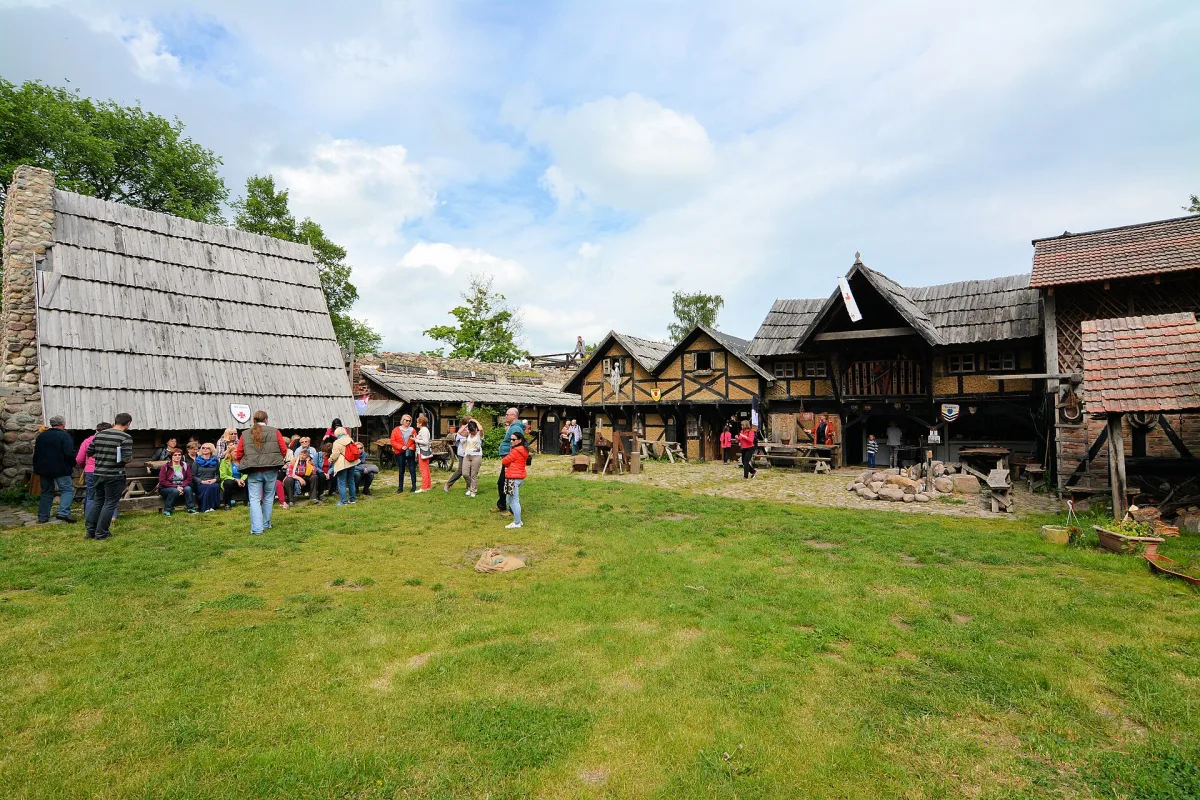
An isthmus between two lakes
Drahim Castle stands in the village of Stare Drawsko, about 5.5 km north of Czaplinek. According to Wikipedia, the defensive complex was located on a narrow isthmus 60 metres wide between lakes Drawsko and Żerdno, on the Drawa River, which links them. Wikipedia adds that in the 7th century this place was probably a peninsula of the lakes, which were not yet joined. It was these natural defensive qualities that had earlier been used by the Drawians, who built a stronghold here that developed from the 7th century to the mid-12th century, until it was taken by the warriors of Bolesław Wrymouth.
Today lakes and forests lie all around. The larger of them, Lake Drawsko, is the largest lake of the Drawsko Lakeland, and the area belongs to the Drawsko Landscape Park. The castle stands by voivodeship road no. 163, which leads from Czaplinek to Połczyn-Zdrój.
Construction and size of the stronghold
According to Wikipedia, a wooden castle was first built here in 1350, and the Hospitallers built the masonry one in 1360-1366. The entry on the village speaks of construction around 1360, so both versions fall within the same decade. The Order of St John, that is, the Hospitallers, had the seat of its commandery in Czaplinek, and Drahim was built about 5-6 km from the town as a border stronghold.
The building site was artificially raised by 6 m and shaped into a mound measuring 50 x 50 m. The castle was built of granite boulders and brick on a quadrangular plan measuring 41 x 46.5 m. According to Wikipedia it had no tower. It was surrounded instead by defensive walls 2.5 m thick and from 7.6 to 12.8 m high, with hoardings, that is, wooden galleries with stairs, and numerous loopholes. The entrance was set in the north curtain wall and reinforced with a gate tower.
From the north and the south the castle was protected by a moat 3.5 to 5 m deep, and from the east and west by the waters of the lakes. The slopes of the rise were lined with stones to protect the fortifications from erosion. A wooden bridge on thick, hewn posts linked it with the outer ward. The south wing had two or three storeys: the ground floor held service and prison rooms, and above were living quarters.
The courtyard and the starosts
The stone courtyard had a watering trough for horses, a well with a 180-centimetre curb and a brick oven, which has now been reconstructed. Over time the buildings in the courtyard grew denser. According to Wikipedia, two Fachwerk houses were built in it: a larger, two-storey one for the starost, and a smaller one for his assistant. In a corner a shed was set up in which about 20 hectolitres of beer could be stored, and on the opposite side there was a building that eventually became an armoury.
The starosts came after the Hospitallers. Wikipedia, in the entry on Stare Drawsko, states that in 1366 Casimir the Great incorporated these lands into Poland and extended the castle, and that from 1407 to 1668 the castle housed the seat of the Drahim starosts. According to the website of the town of Czaplinek, in 1407 Władysław Jagiełło marched on Drahim and took it after the Hospitallers refused to yield. For more than two centuries the castle was therefore the seat of Polish authority on the border.
The fortifications were extended in the 16th century. The ramparts around the rise were reinforced at the corners with semicircular bastions with four wooden watchtowers. In the mid-17th century plans were drawn up to surround the stronghold with bastion fortifications, but they were not carried out.
The legend of the fisherman
A legend is attached to the castle. According to the website of the town of Czaplinek, in 1422 townspeople from nearby Drawsko, at the urging of the Teutonic Knights, attacked the castle and briefly took it. The legend tells of a fisherman, Paweł Waszniak, who had a chamber in Drahim and let down a net from the window, along which a Polish relief force entered the stronghold. The town's website cites chronicles but does not name them, which is why this is a legend, not a confirmed fact.
Fire and ruin
According to Wikipedia, in 1758, during the Seven Years' War, a fire broke out, caused by the defence mounted by Colonel Cosel against an attack by the Cossacks of General Denikoff. This began the rapid decline of the former seat of the Order. The discrepancy concerns the year: the entry on the castle gives 1758, while the entry on the village speaks of a ruin from 1759. As late as the end of the 18th century the castle housed the offices of the Prussian tax authority. In 1784 part of the damaged walls was demolished for material for a church, today dedicated to All Saints.
In 1818 the Kingdom of Prussia sold the castle grounds together with the farm to a private Junker. In 1927 breaches were patched and the walls reinforced, and more serious work combined with archaeological research was carried out in 1963-1968, when the monument was secured in a permanent form. The ruins were entered in the heritage register in 1959 under number 190.
The castle today and its Hospitaller sister sites
According to Wikipedia, in the 1990s the land together with the castle was bought by a private entrepreneur who planned a full reconstruction, and the monument belongs to the private Museum of Motorisation and Technology in Otrębusy. The entry on the village states that the castle is open to visitors and that shows and knightly tournaments are held there. It is a ruin, so move about carefully.
Traces of the Hospitallers remain in West Pomerania in several places. In Swobnica the Hospitaller castle of 1377-1382 still stands on Lake Grodziskie, and in Pęzino the Hospitallers built a castle at the turn of the 14th and 15th centuries. In Świdwin they used the castle from 1540, and above the gate the coats of arms of the commanders of the local commandery can still be seen. In Czaplinek itself, the seat of the commandery, stand the Church of the Holy Trinity from the turn of the 14th and 15th centuries and the Church of the Exaltation of the Holy Cross from the 1820s, and by the market square a brick town hall from 1845.
Be the first! Add a comment.
You need to log in to add a comment.
Log in