
A town on the Ina that wanted its own money
Goleniów lies on the Ina River, about 35 km from Szczecin. According to Wikipedia, Duke Barnim I chartered the town under Magdeburg law in 1268, and in 1314 the town received Lübeck law. The further growth of trade led to its joining the Hanseatic League in 1368. The entry on Goleniów describes how the town was then in disputes with Szczecin, which wanted to monopolise shipping on the Oder, and cooperated with Stargard. The first major dispute was settled in favour of Goleniów and Stargard in 1397.
Traces of that wealth are still visible in the centre today. Wikipedia notes that the religious and defensive monuments were built here mainly in the 14th and 15th centuries, when the town grew rich on trade and crafts. The former river port is recalled by the granary on Nadrzeczna Street. According to Wikipedia it is the only survivor of several grain stores, and the present half-timbered building was erected in the 18th century on the foundations of an older granary demolished in 1749.
Four gates and a wall with towers
According to the entry on the town walls, construction of the fortifications began immediately after the town's chartering. By the middle of the 14th century the town was surrounded by a stone and stone-and-brick wall with watchtowers, towers and four gates: the Wolin, Szczecin, Stargard and Mill gates. In the second half of the 14th century and in the 15th century the walls were raised, the gates enlarged, three water gates were made on the port side and further towers were added. Wikipedia states that the Mill Gate was destroyed in 1761 during the Seven Years' War and the siege by the Russians, the Szczecin Gate was demolished in 1836 and the Stargard Gate in 1864.
Sections of the walls survive, best visible on the bank of the Ina. The town authorities decided to preserve them in 1889, and the date of that decision is placed on one of the turrets by the Wolin Gate. The entry also stresses that the present state of the fortifications is the result of rebuilding after the destruction of the Second World War.
The Wolin Gate
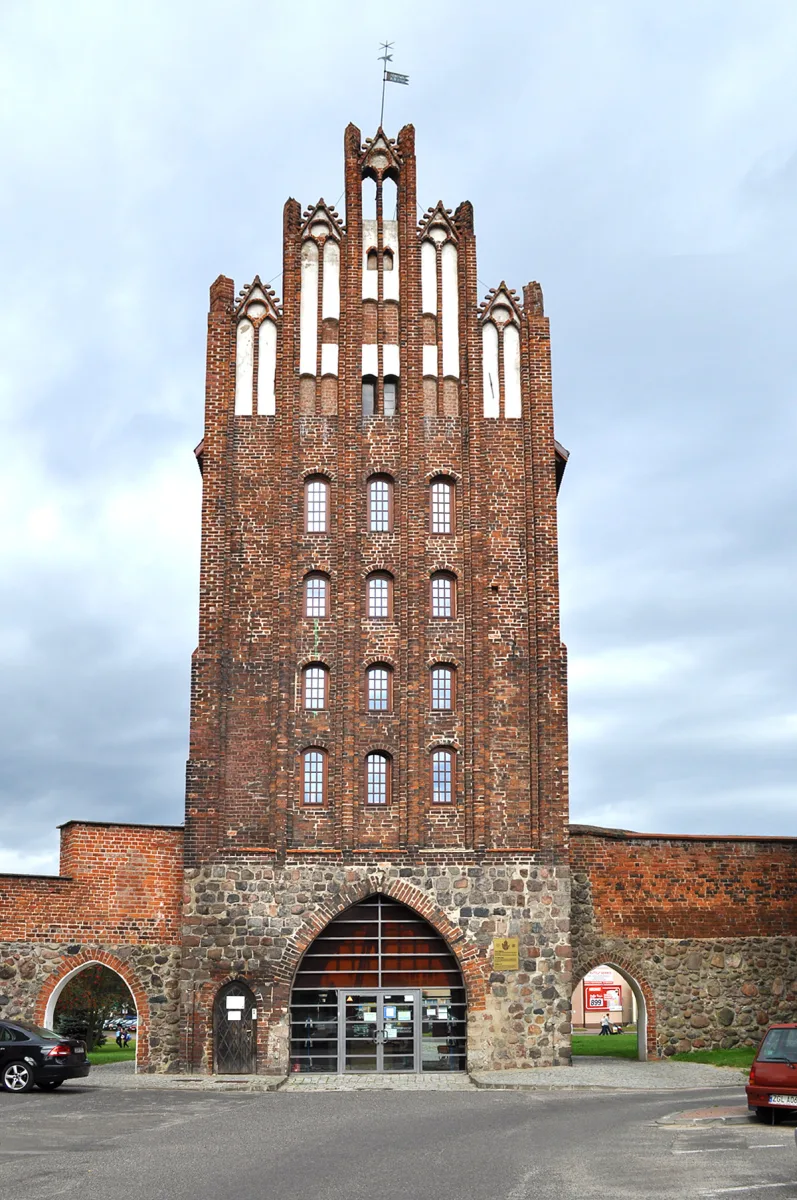
The Wolin Gate is, according to Wikipedia, the town's most valuable monument and the only one of the four gates to survive. Originally a guardhouse built of erratic boulders from the second half of the 13th century stood here, and in the 14th and 15th centuries a brick tower was added on top. The building has five storeys and is 26 metres high (29.85 m with the finial), and it served a defensive function until the 18th century. The heritage register dates it to the 14th century, while Wikipedia gives the 15th century as the time the gate took its present form.
On the turret by the gate are two coats of arms of Goleniów: the historical one, with a river, a boat, a tree and a griffin, and the present one, with two crescents and four stars. The gate was restored in 1971-1972 to house the Museum of the Goleniów Land, and after renovation it is a branch seat of the Goleniów House of Culture. The passage under the gate was built over in 2002-2003 and a Tourist Information Centre was set up there.
The Mint Tower and the Gunpowder Tower
Two towers stand on the Ina, along the promenade. The Mint Tower is octagonal and, as Wikipedia states, once housed the town mint. Next to it a water gate survives, that is, the former passage from the town to the river. The heritage register does not give an exact date for the tower. The Gunpowder Tower is cylindrical, built of red brick, with a conical top, and the register dates it to the 14th century. It served as a gunpowder store and a prison, hence its second name: the Prison Tower. Both towers are viewed from the outside.
The coin with a griffin
According to the Wikipedia entry on Goleniów, in 1386 the town obtained the privilege of minting its own coin. The entry on the coin itself also gives the year 1386, but in that entry the sentence has no footnote citing a document. The coin is popularly called the white groschen of Goleniów, and Wikipedia explains that in reality it was a quartnik (a quarter-groschen), minted in Goleniów in the 14th and 15th centuries.
The same encyclopaedia points out that regional historians use the term "white groschen", but groschen were coins of a different kind, worth twice as much, and were never struck at the Goleniów mint. The obverse of the quartnik showed a griffin walking to the left, with a circle beneath it, although there was also a variant with a figure of eight. The reverse showed two crescents turned back to back and four stars, as in the town's coat of arms. The coin weighed 0.5 gram and was 13 millimetres in diameter. The name of the Goleniów historical exploration society, "Biały Grosz" (White Groschen), comes from the coin.
The church, the ruins and the museum
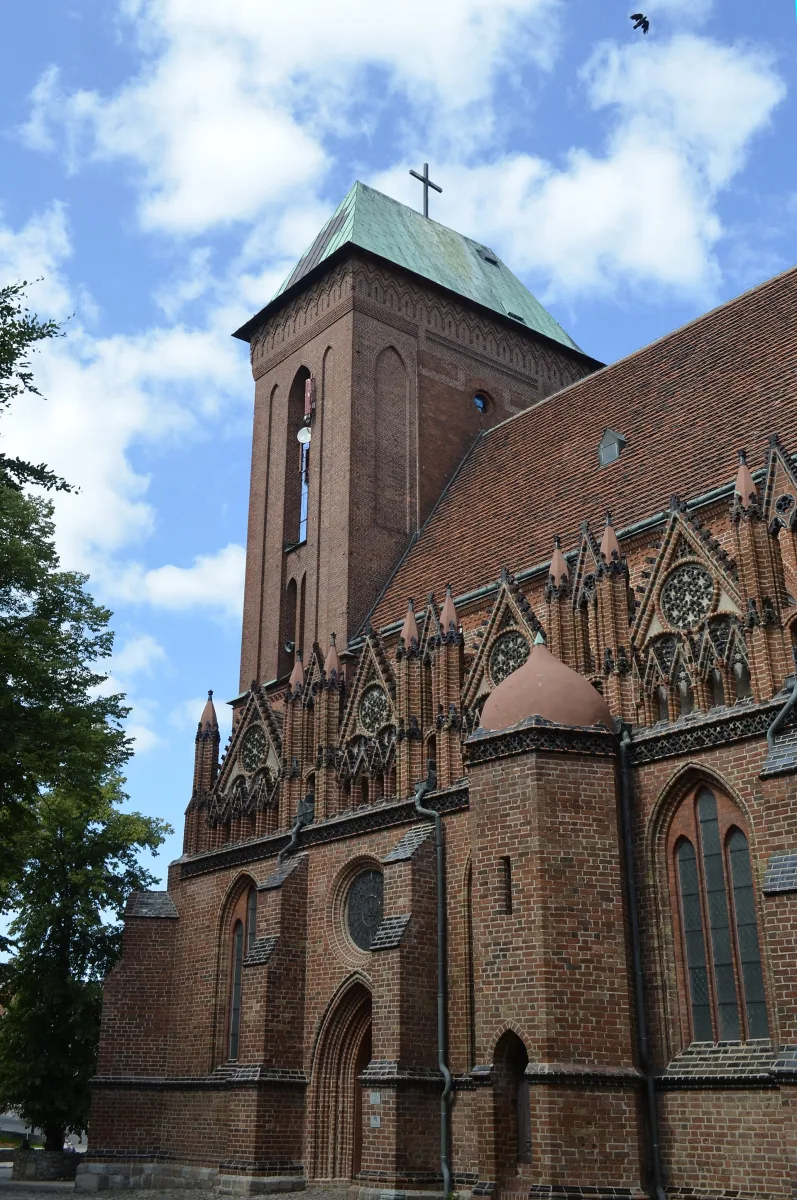
Part of the town's former wealth is also St Catherine's Church, the former parish church. Wikipedia lists it among the town's 15th-century buildings. The parish and the heritage register describe a Gothic brick hall church, rebuilt in the 19th century and reconstructed after the destruction of 1945, when, according to Wikipedia, the fighting covered 60-65 per cent of the town's area.
On the other side of the river, on the former settlement of Wyk, lie the ruins of St George's Chapel, discovered in 2004 during excavation work, and in 2005 the site was laid out as a square. The heritage register dates the chapel to the 15th century. The story of the whole town, from the time before its chartering to postwar settlement, is presented by the Centre for the Documentation of the History of the Goleniów Land in a townhouse called the Yellow House. Opening hours are given on the centre's website.
Be the first! Add a comment.
You need to log in to add a comment.
Log in