
First surveys in the 19th century
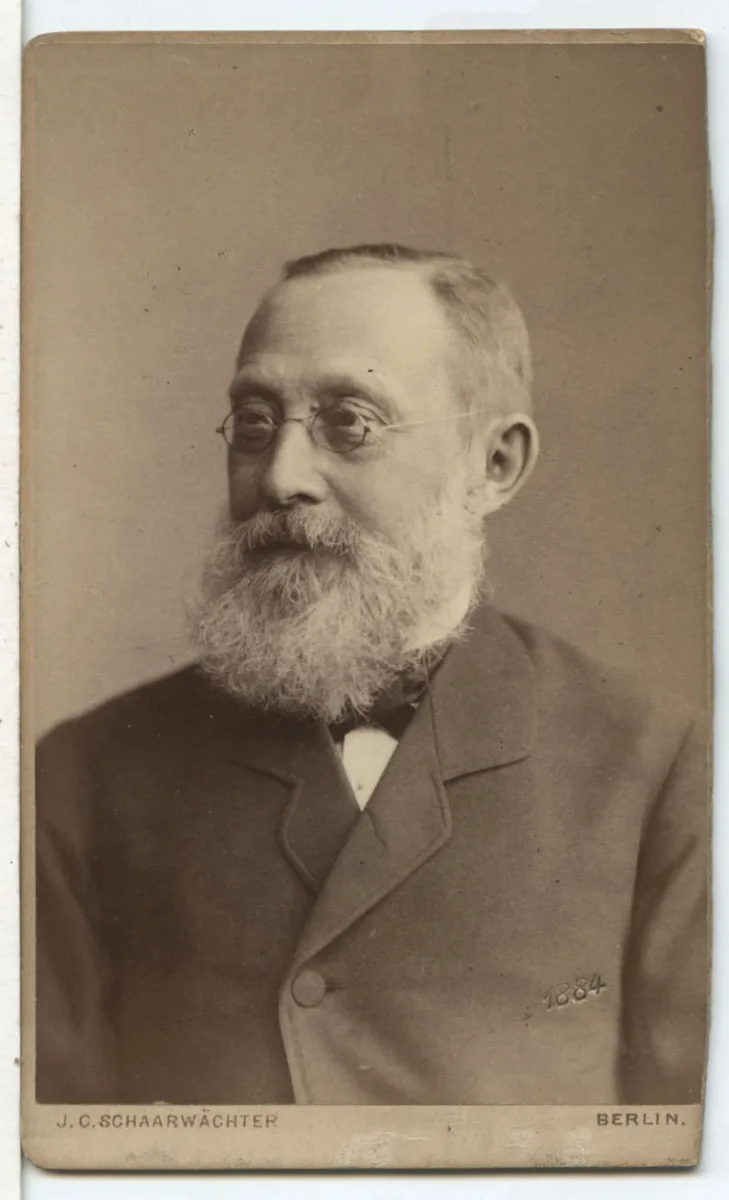
According to the Regional Museum in Wolin, chance discoveries in the town occurred as early as the 17th century. The first archaeological survey was carried out here in 1827 by B. Steffen, and its results were published. The German Wikipedia, in its entry on Vineta, mentions his mapping from 1828, so the year of Steffen's work is given differently. The next investigations took place, according to the museum, only in 1871, when Rudolf Virchow began the search.
According to the Encyclopedia of West Pomerania, Virchow carried out the largest excavations of the 19th century within the barrow cemetery on Wzgórze Wisielców (Gallows Hill). The museum notes that his discoveries triggered an avalanche of interest, and the history of the town was taken up by many German scholars, among them E. Kuster, H. Lemcke and O. Olshausen, A. Stubenrauch, C. Schuchardt, A. Kiekiebusch and E. Walter. The main inspiration was the discussion, continuing since the 17th century, about the location of Jomsborg, the mythical seat of a Viking warrior band, and about the legend of Vineta. In 1897 Adolf Stubenrauch of the museum in Szczecin carried out extensive excavations in Wolin, which according to the German Wikipedia included, among other places, the cemetery and Srebrne Wzgórze (Silver Hill).
The 1930s: the search for Vineta
Systematic investigations began in Wolin in the 1930s. They were led, according to the museum, by Otto Kunkel, director of the Pommersches Landesmuseum in Szczecin, and the work on site was carried out by Karl August Wilde, from 1937 a doctor of archaeology of the University of Greifswald. The museum states that the main aim was to find Vineta and Jomsborg, which had great propaganda potential for the Third Reich. In 1934-1939 large excavations were carried out in the market square and on Srebrne Wzgórze, then regarded as the site of Jomsborg, and in 1936-1938 the cemetery on Młynówka hill was investigated.
The German Wikipedia describes how in the market square a depth of about 6 metres was reached and successive layers of wooden buildings were found, and on the bank of the Dziwna wooden jetties with warehouse and craft buildings were uncovered. According to the museum, the results were published only in part, in Wilde's doctoral thesis and several reports by him and Kunkel.
Polish research from 1952
According to the museum, work began immediately after the war, in 1952. Władysław Filipowiak then carried out some of the first underwater archaeological investigations in Poland, preceding the construction of a road bridge in Wolin. The Encyclopedia of West Pomerania adds that in 1952 he investigated the remains of the port under a caisson, and in 1953 he used diving equipment. That year, according to the encyclopedia, his excavations became part of the programme of the Directorate of Research on the Origins of the Polish State. The thesis on the basis of which he completed his studies in Poznań in 1953 was titled “Wolin-Przedmieście. Wyniki badań ratunkowych w 1952 roku” (Wolin-Przedmieście: results of rescue investigations in 1952).
Filipowiak later headed the Wolin unit of the Institute of the History of Material Culture of the Polish Academy of Sciences, today the Institute of Archaeology and Ethnology of the Polish Academy of Sciences. According to the museum, the work was concentrated in the southern part of the town, in the Old Town, at the cemetery on Młynówka, on Srebrne Wzgórze, on Wzgórze Wisielców and in the Ogrody district. In 1999-2002 he supervised the investigations connected with the construction of the Wolin bypass and the crossing of the Dziwna, and as late as 2009 he exercised scholarly supervision over an underwater survey after the chance discovery of early medieval weapons in the Dziwna. The results of decades of research appeared, according to the encyclopedia, in two volumes of the series “Origines Polonorum” (VI and VII) in 2013 and 2014.
His publications on Wolin include “Wolin w świetle wykopalisk” (Wolin in the light of excavations, 1954), “Wolinianie. Studium osadnicze I” (The Wolinians: a settlement study I, 1962) and the book “Wolin - Vineta” with Heinz Gundlach (Rostock 1992). According to the encyclopedia, museums were created in Wolin, Kamień Pomorski and Cedynia on his initiative, in connection with the research; he was also the originator of the archaeological open-air museum in Wolin, and the travelling exhibition “Wolin-Jomsborg. Emporium handlowe epoki wikingów w Polsce” (Wolin-Jomsborg: a trading emporium of the Viking age in Poland) visited several European museums in the early 1990s.
What remains of it
According to the museum, the excavations in Wolin were a testing ground for research methodology and a place for training archaeologists from around the world. The town today has a collection which the museum describes as one of the best and largest in this part of Europe, numbering hundreds of thousands of early medieval artefacts. The collections and the story of the research are shown by the Regional Museum in Wolin, and the area of the barrow cemetery, a fenced reserve, can be seen on Wzgórze Wisielców.
Be the first! Add a comment.
You need to log in to add a comment.
Log in