
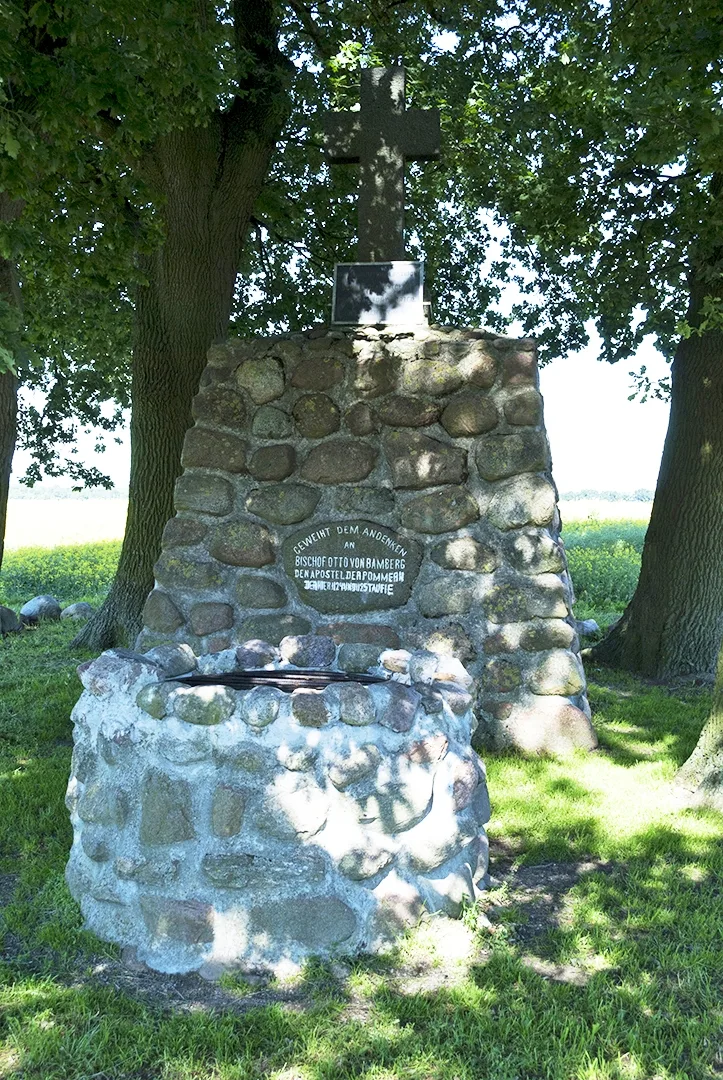
The expedition from Bamberg to Pomerania
According to Wikipedia, Otto of Bamberg set out for Pomerania from Bamberg on 24 April 1124, with the consent of Pope Callixtus II and at the invitation of the Polish duke Bolesław the Wrymouth. Through Prague, Niemcza, Wrocław and Kalisz he reached Gniezno, where Bolesław gave him companions, funds and supplies. The bishop was taken under the protection of the count of Santok, Duke Paweł. According to the same entry, Otto did not want to repeat the mistake of the missionary Bernard the Spaniard, who a year earlier had come barefoot, in poor clothing, and was ridiculed and soon beaten. The bishop therefore took liturgical vestments, chalices and gifts for the nobles.
The sources for this mission are three lives: the anonymous Life from Prüfening, Ebbo's Life of 1151 and Herbord's Dialogue from around 1158-1159. Wikipedia bases its account of the first expedition largely on a monograph of 1904, so the figures below are figures from that study and not from the medieval texts themselves.
Pyrzyce and Kamień
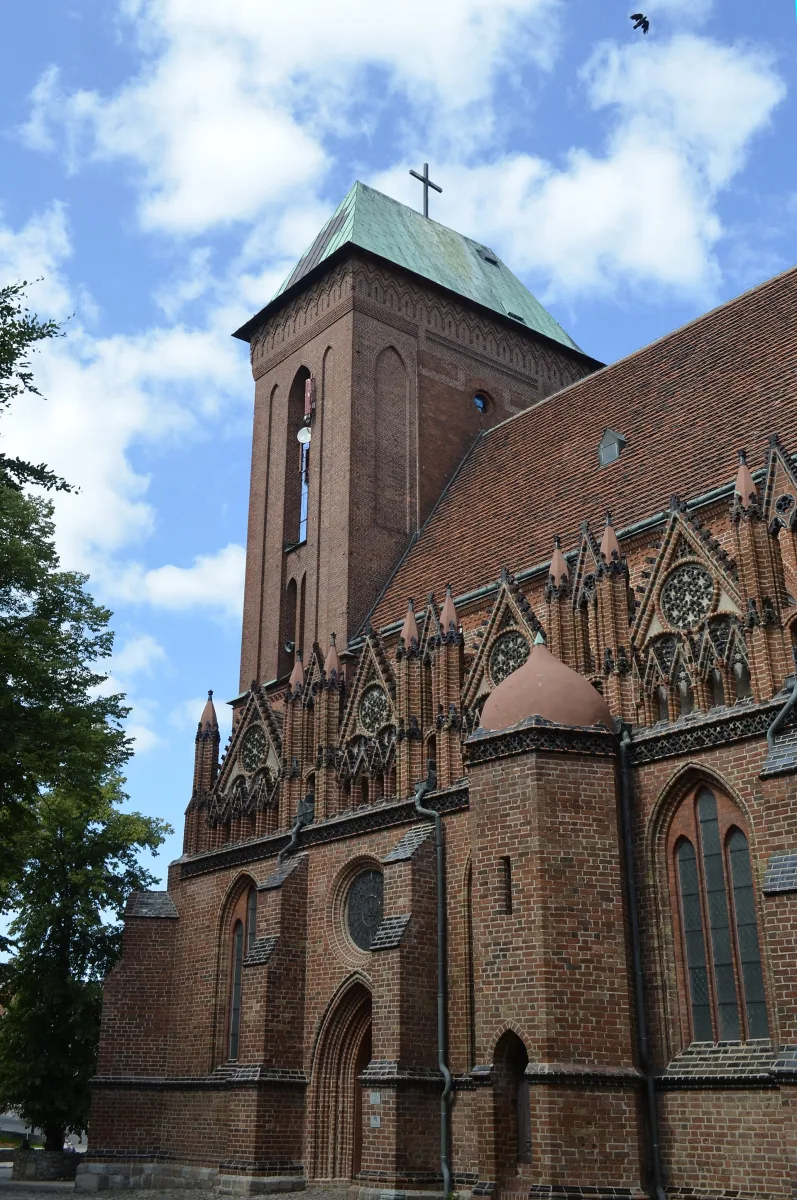
Duke Warcisław was said to have welcomed the bishop on the Noteć, according to another version near Stargard, and to have given him a guide. The first centre on the route was Pyrzyce. Wikipedia states that Otto taught there for twenty days, baptised about 7000 people, built a small church and left a priest. Pyrzyce remembers this mission to this day: the Gothic Church of the Assumption of the Blessed Virgin Mary belongs to the parish of St Otto. The Well of St Otto in Cerkwica is also linked with the baptisms at the turn of 1124 and 1125. The age of the well is disputed: tourist publications date it to the 12th century, while the heritage record card links it with the second half of the 19th century, the well having taken its present form in 1912.
From Pyrzyce the bishop went to Kamień, where according to Wikipedia Warcisław joined him, was baptised and renounced polygamy. Otto was said to have founded a church there and appointed a priest. As the description of the site states, after the mission a wooden church of St John the Baptist was built in the suburb, and in 1176 a cathedral was founded on its site, that is, today's Cathedral of St John the Baptist in Kamień Pomorski.
Wolin refuses, Szczecin accepts
Otto reached Wolin by ship. According to Wikipedia, citing the lives, he entered the town at night, into the ducal castle, which offended the inhabitants, and in the morning a crowd threatened him with death if he did not leave. The people of Wolin explained later that without their allies from Szczecin they would not make a decision about baptism. The lives give the dates of his stay in Wolin differently: according to the Anonymous author it was 4 August, according to Ebbo 13 August 1124. The history of the town and its beliefs is presented by the Andrzej Kaube Regional Museum in Wolin, in which one of the rooms is devoted to pre-Christian beliefs.
The bishop therefore sailed across the Szczecin Lagoon to Szczecin. Wikipedia writes of two months of activity, ending with the destruction of the temple of Triglav, and Herbord, according to the same entry, gives 1 November as the beginning of Christianisation, after a guarantee of safety from Bolesław. The hill on which the Szczecin temple stood is most probably the same as the hill on which the Ducal Castle (Castle of the Pomeranian Dukes) stands today. According to the description of the site, before 1124 there was a Slavic stronghold here with the wooden court of Duke Warcisław I, and under the north wing the remains of the Gothic church of St Otto have survived.
Churches, Lubin and the return to Wolin
Wikipedia in the entry on Otto writes that in Szczecin he built a church in honour of St Adalbert and a second to the apostles Peter and Paul. The entry on Triglav, by contrast, speaks of two churches in Wolin: one in the town, dedicated to St Adalbert and St Wenceslas, and a second outside the town, dedicated to St Peter. These are two different accounts of the foundations, and the entries do not settle which of them is complete, so it is hard to point to a present-day church as the successor of either.
After Szczecin Otto visited Gardziec, Lubin and Wolin again. According to Wikipedia some claim that the place meant is not Lubin but Lubczyna. Lubin has a trace in the landscape: according to the description of the site, Herbord states that the bishop consecrated an altar there, and excavations in 2008-2011 uncovered in the hillfort in Lubin the remains of a church of St Nicholas and a cemetery. In Wolin the bishop was this time received kindly. Wikipedia, following the same monograph, puts the number of those baptised in Wolin at 22,156. According to the entry on Triglav, Otto returned to his diocese on 28 March 1125.
The second expedition and the memory of Otto
Christianity in Pomerania proved short-lived, and after the bishop's departure some of the inhabitants returned to the old beliefs. The sources of the studies give the year of the second mission differently. The entry on Otto links it with the spring of 1128: a gathering on Uznam at Whitsun, then Wolgast, Choćków, Szczecin and Wolin. The entry on Triglav writes of April 1127 and a return to Szczecin on 31 July. Wikipedia does not explain the difference.
Otto died in Bamberg on 30 June 1139, and was canonised in 1189 by Pope Clement III. According to Wikipedia he is the patron of the Szczecin-Kamień archdiocese, and his feast day falls on 30 June, in Poland on 1 July. Traces of his cult can be seen in Szczecin, Cerkwica and Pyrzyce, and in the Kamień cathedral there is a stained-glass window with his figure.
Be the first! Add a comment.
You need to log in to add a comment.
Log in